Exchanges · fees
Crypto exchanges with low fees 2026: the cheapest trading fees, compared honestly
Updated 15 October 2026 · Originally published May 2024 · Reviewed for CryptosBeginner
Every fee figure below is taken from the exchange's published schedule as verified in our review library, not from marketing pages. You get the real spot and futures tables, what maker and taker mean, and the hidden costs that quietly matter more than the headline rate.
Alex Rivera · Crypto researcher, CryptosBeginner
Every review is research-led: specs, fees, and availability are checked against official sources before publication and re-checked on every update. Affiliate links never influence verdicts. Last reviewed 15 October 2026.
Spot trading fees compared
These are entry-tier spot rates from each exchange's published fee schedule, as verified in our reviews. VIP tiers, native-token discounts, and promotions can push them lower.
| Exchange | Maker | Taker | Notes |
|---|---|---|---|
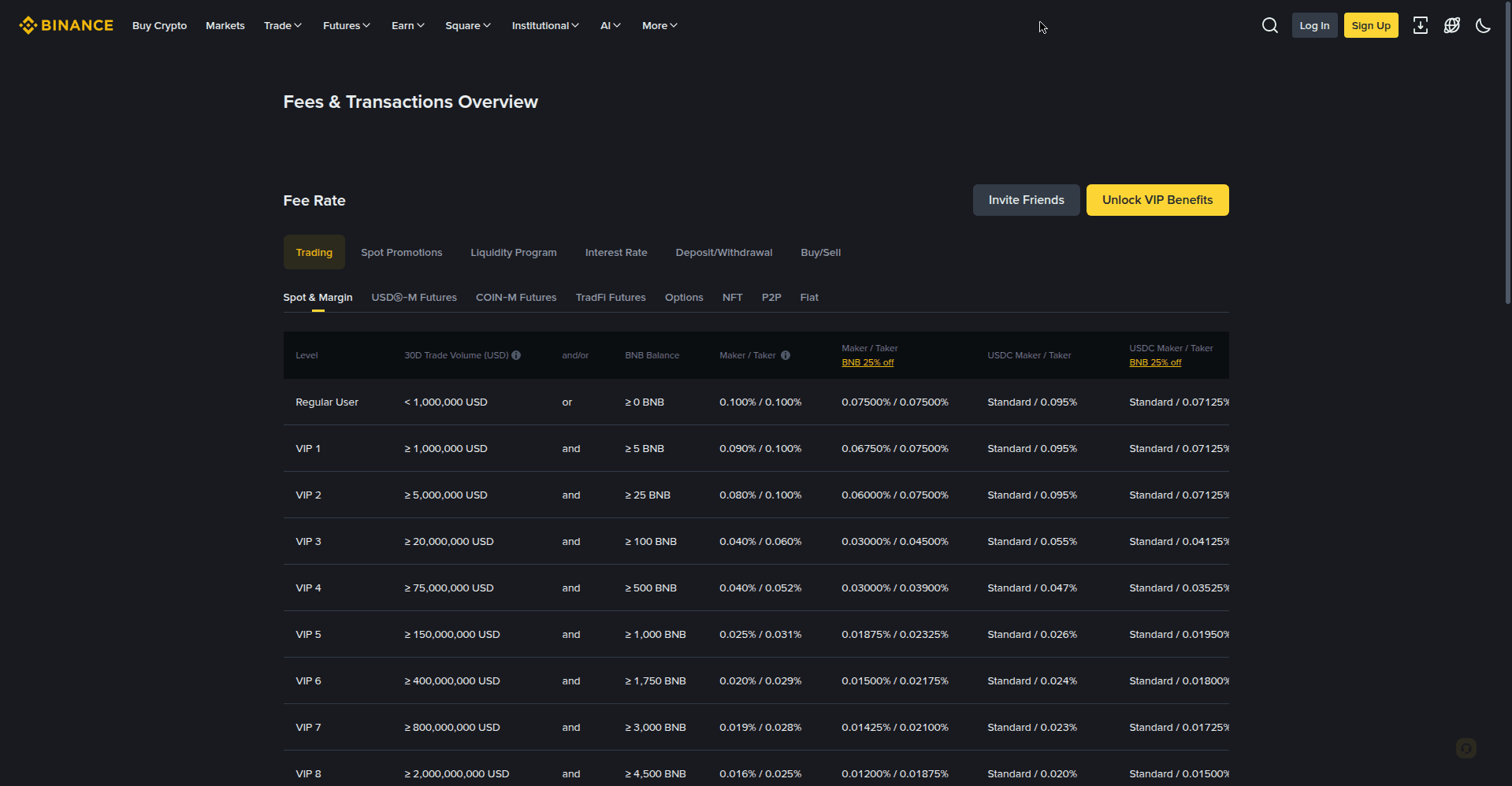
| MEXC | 0% | 0.05% | 20% off with MX token; zero-fee promos run regularly |
| OKX | 0.08% | 0.05% | Regular tier; lower at VIP levels |
| Bitunix | 0.08% | 0.10% | Base tier |
| Binance | 0.10% | 0.10% | 0.075% when you pay fees with BNB |
| Bybit | 0.10% | 0.10% | Entry tier; VIP tiers reduce both |
| Bitget | 0.10% | 0.10% | 0.08% when you pay fees with BGB |
| WEEX | 0.10% | 0.10% | Base tier, flat |
| BYDFi | 0.10% | 0.10% | Flat, no discounts |
| Kraken Pro | 0.40% | 0.80% | Entry tier since the July 2026 change; falls with volume |
Verified against our MEXC review, OKX review, Bitunix review, Binance review, Bybit review, Bitget review, WEEX review, BYDFi review, and Kraken review. Fee schedules change, so confirm the live page before a large trade.
Futures and derivatives fees compared
Derivatives fees run lower than spot because exchanges compete fiercely for leveraged volume. Remember that leverage multiplies losses exactly as fast as gains, so a cheap fee schedule is no reason to use high leverage.
| Exchange | Maker | Taker | Notes |
|---|---|---|---|
| MEXC | 0% | 0.02% | As stated on the MEXC homepage |
| PrimeXBT | 0.01% | from 0.045% | Crypto futures entry tier; falls at VIP levels |
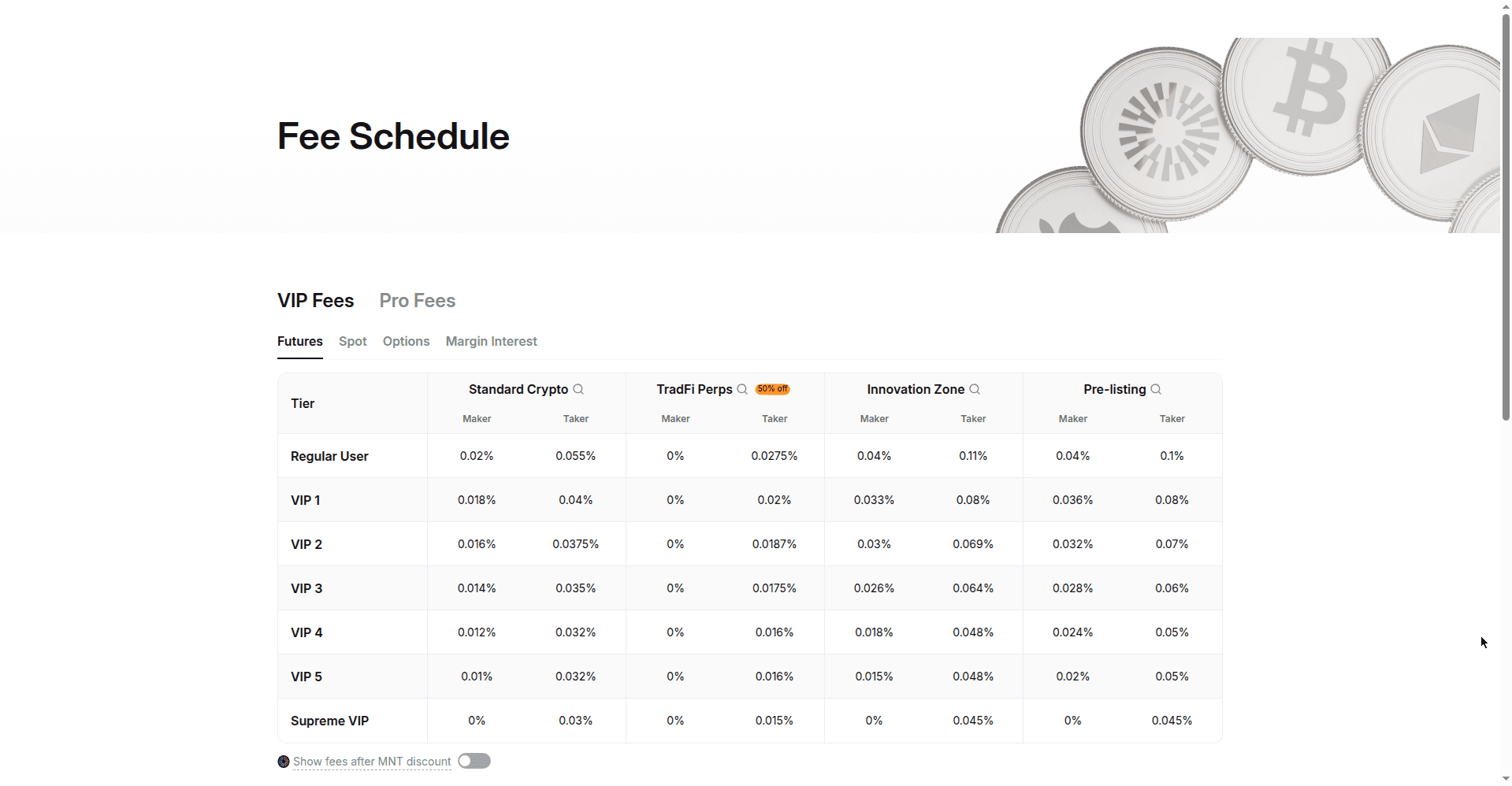
| Bybit | 0.02% | 0.055% | Perpetuals entry tier; options 0.02% / 0.03% |
| Kraken | 0.02% | 0.05% | Futures entry tier |
Verified against our MEXC review, PrimeXBT review, Bybit review, and Kraken review. Funding rates are a separate, ongoing cost on perpetuals and are not included above.
Maker vs taker: the fee lever most beginners miss
Every trade has two sides. The maker places a limit order that waits on the order book, adding liquidity. The taker hits an existing order with a market order, removing liquidity. Exchanges reward makers with lower fees, sometimes even a small rebate, because makers are what make the market function.
On MEXC, that distinction is the difference between 0% and 0.05%. On Kraken Pro, it is the difference between 0.40% and 0.80%. If your trade is not urgent, placing a limit order at the price you actually want almost always costs less than smashing the market-buy button. It is the single easiest fee saving in crypto.
Our picks by trading style
Cheapest spot trading overall: MEXC. Zero maker fees and 0.05% taker on the standard tier is simply the lowest verified spot schedule we cover, with regular zero-fee promotions on top. Best for active spot traders who are comfortable with a less regulated platform. Read the MEXC review first.
Cheapest with EU licensing: OKX and Bybit. OKX at 0.08% maker and 0.05% taker and Bybit at 0.10% each side both hold MiCA licenses and serve Europeans cleanly. If you trade from the EU, the small fee premium over MEXC buys meaningful regulatory protection. See our Europe guide.
Cheapest futures: PrimeXBT. Crypto futures from 0.01% maker and 0.045% taker at the entry tier is the lowest verified derivatives schedule in our library. Only relevant if you genuinely need leverage and understand liquidation risk. Our PrimeXBT review covers the full picture.
Best-known brands at fair prices: Binance and Bitget. Binance at 0.10% (0.075% with BNB) and Bitget at 0.10% (0.08% with BGB) are not the absolute cheapest, but they pair competitive fees with deep liquidity, which keeps spreads tight. For most people, tight spreads on a liquid exchange beat a lower fee on a thin one.
Verdict
If you want the lowest verified fees, MEXC wins on spot and PrimeXBT wins on futures. If you want low fees with EU licensing, OKX and Bybit are the sweet spot. But the biggest fee saving available to a beginner is not switching exchanges: it is abandoning the one-tap buy button for limit orders on the advanced interface, which cuts costs roughly tenfold on any platform. Do that first, then optimize the last few basis points.
Frequently asked questions
Which crypto exchange has the lowest trading fees?+
On verified published schedules, MEXC is the cheapest for spot at 0% maker and 0.05% taker on the standard tier. For crypto futures, PrimeXBT's entry tier starts at 0.01% maker with taker from 0.045%. But the headline rate is only part of the story: spreads, funding rates, and withdrawal fees can outweigh a small difference in trading fees.
What is the difference between maker and taker fees?+
A maker places a limit order that sits on the order book, adding liquidity. A taker places a market order that fills immediately against existing orders, removing liquidity. Exchanges usually charge makers less, and sometimes pay them a small rebate, because makers make the market work. If you trade with limit orders instead of market orders, you almost always pay the lower maker rate.
Do 0% fee promotions really mean free trading?+
They mean no trading commission on eligible pairs, but trading is never truly free. You still pay the spread between the buy and sell price, network or withdrawal fees when you move coins out, and possibly deposit fees depending on your payment method. Read the promotion terms: zero-fee campaigns usually cover specific pairs and exclude volume from VIP tier calculations.
How much do fees matter for a beginner buying occasionally?+
Less than you think, and more than you expect. On a single $100 buy, the difference between 0.10% and 1% is 90 cents. But beginners usually pay the expensive simple-buy price, around 1% plus spread, instead of the 0.10% advanced rate. Learning the advanced interface once saves you far more than switching between cheap exchanges.
Are low-fee exchanges safe?+
Low fees and safety are unrelated. Some of the cheapest exchanges are well-established and regulated, others are not. Check licensing, proof of reserves, security history, and how long the exchange has operated before funding any account. Never choose an exchange on fees alone, and never keep more on any exchange than you are actively trading.
Do fees go down if I trade more?+
Yes, on almost every major exchange. VIP tiers reduce maker and taker rates based on your 30-day trading volume or token holdings. Holding the exchange's native token, like BNB on Binance or BGB on Bitget, usually unlocks an extra discount on top. Check the fee schedule page for the exact thresholds.