Updated 11 October 2026 · Originally published 12 May 2025 · By Alex Rivera · Reviewed for CryptosBeginner
BYDFi Review 2026: Fees, No-KYC Trading & 500x Leverage, Honestly Assessed
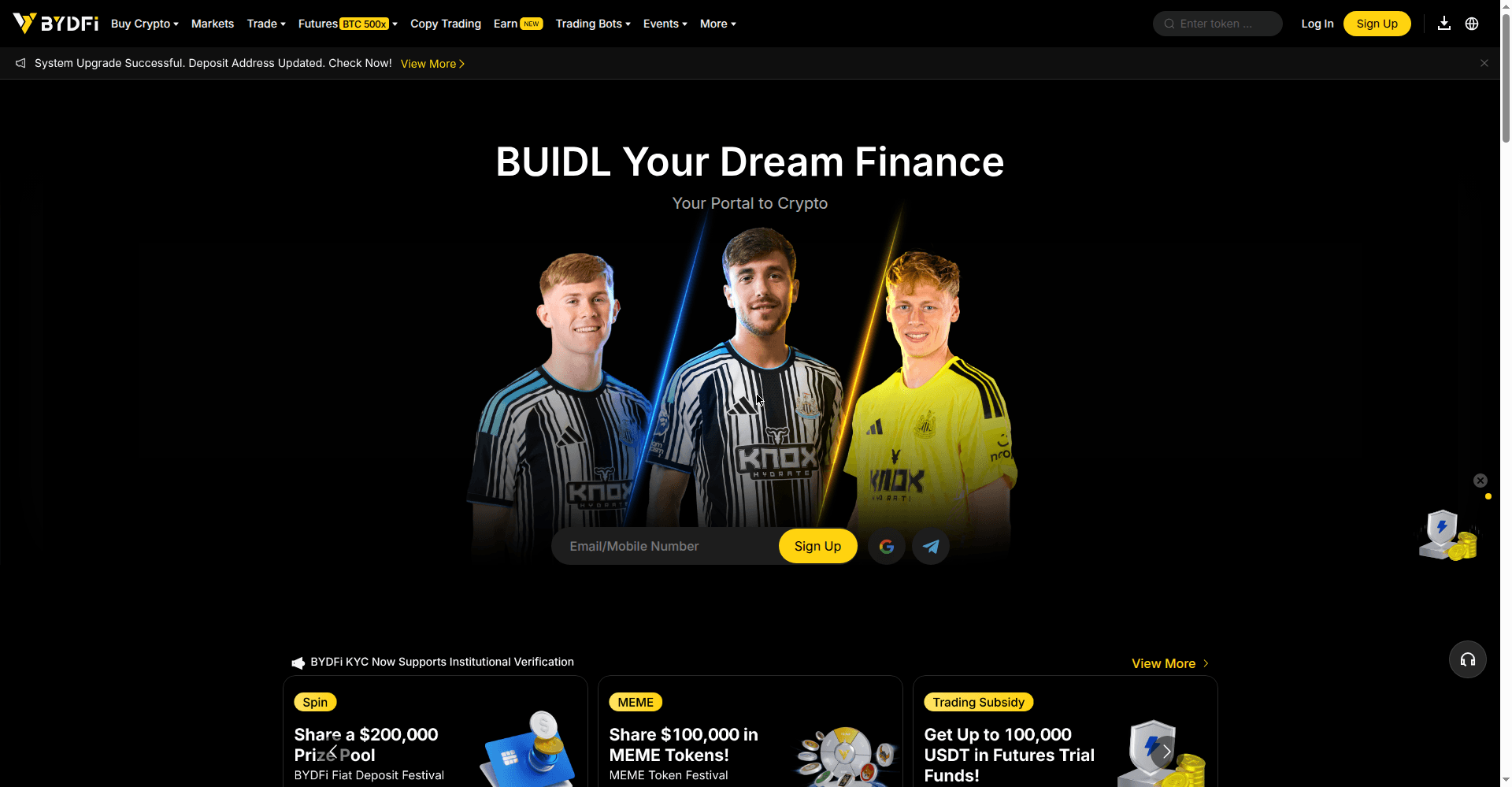
If you want to trade crypto without verifying your identity, BYDFi is one of the first names you will hear: 1,000-plus spot pairs, copy trading, and futures leverage that hit 500x in September 2026. It is usable for active traders, but go in with your eyes open. The missing licence, the removed proof-of-reserves page, and that leverage all need to be said plainly.
Alex Rivera · Crypto researcher, CryptosBeginner
Every review is research-led: specs, fees, and availability are checked against official sources before publication and re-checked on every update. Affiliate links never influence verdicts. Last reviewed 11 October 2026.
The short version
- No-KYC trading. Trade without identity verification, up to about 50,000 USDT in daily withdrawals.
- 500x leverage. BTC and ETH futures went to 500x in September 2026. A 0.2% move against you means liquidation. Read that twice.
- Simple fees. Spot 0.10% maker and taker, futures 0.02% maker and 0.06% taker, no tiers or discounts.
- Wide product set. 1,000-plus spot pairs, 500-plus perps, copy trading, bots, MoonX on-chain trading, TradFi assets, and a Visa card.
- Transparency went backwards. The September 2026 upgrade removed the proof-of-reserves page and the trading API. No regulator supervises the exchange.
- Trade here, do not store here. Keep balances minimal and withdraw to your own wallet.
What BYDFi is
BYDFi's whole identity is access. It launched in 2020 out of Singapore and made its name by letting people trade without KYC and listing the long tail of altcoins the big exchanges ignore. Today it lists over 1,000 spot pairs and 500-plus perpetual contracts, earned a Forbes top-ten nod in 2023, and the name stands for "BUIDL Your Dream Finance."
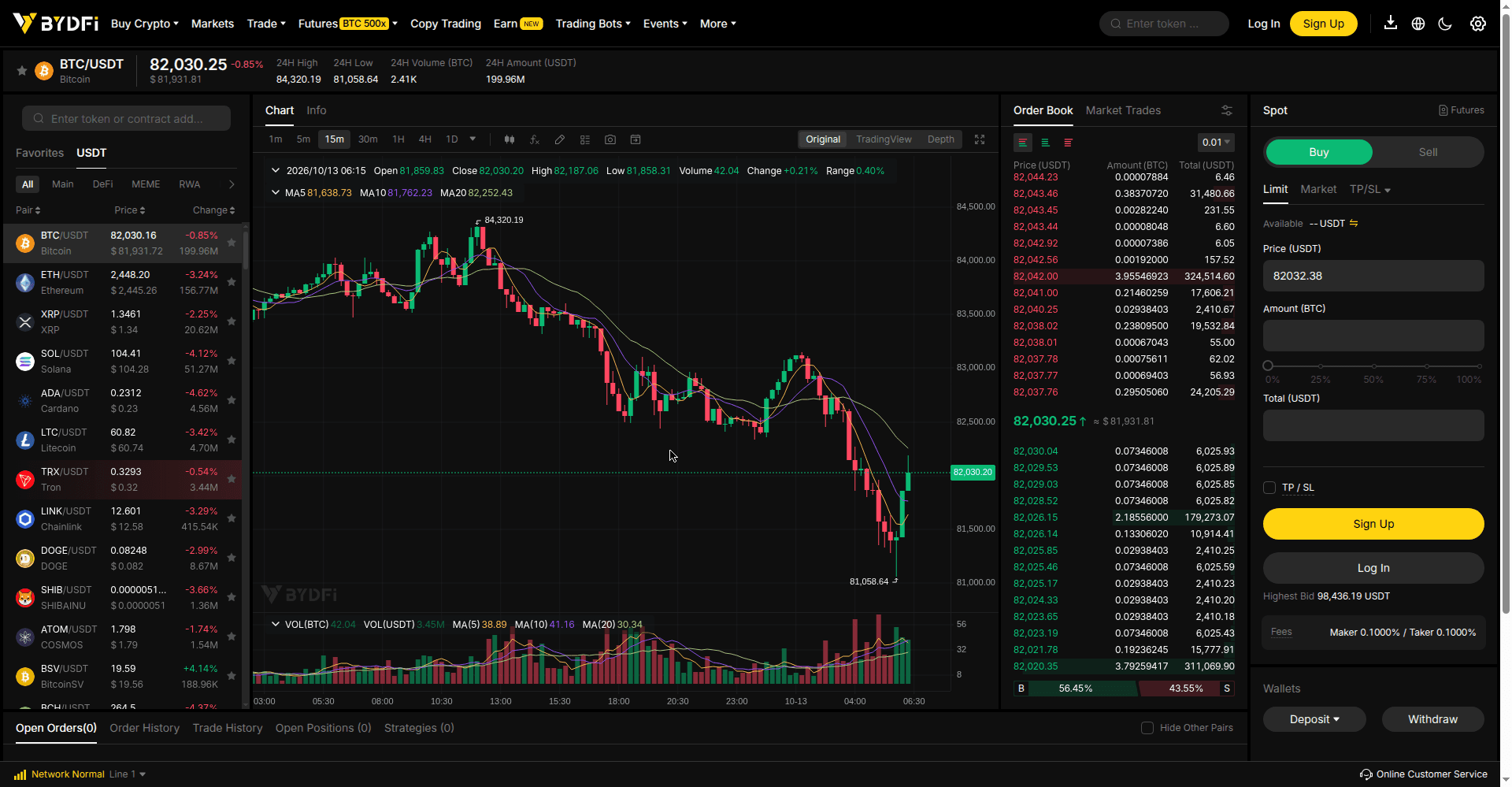
It is a derivatives-first venue in beginner-friendly clothing: one-click buy, demo trading, and copy trading sit right next to 500x leverage. That combination is exactly why the honest framing in this review matters, so read the leverage section before you trade a single dollar.
Fees and costs
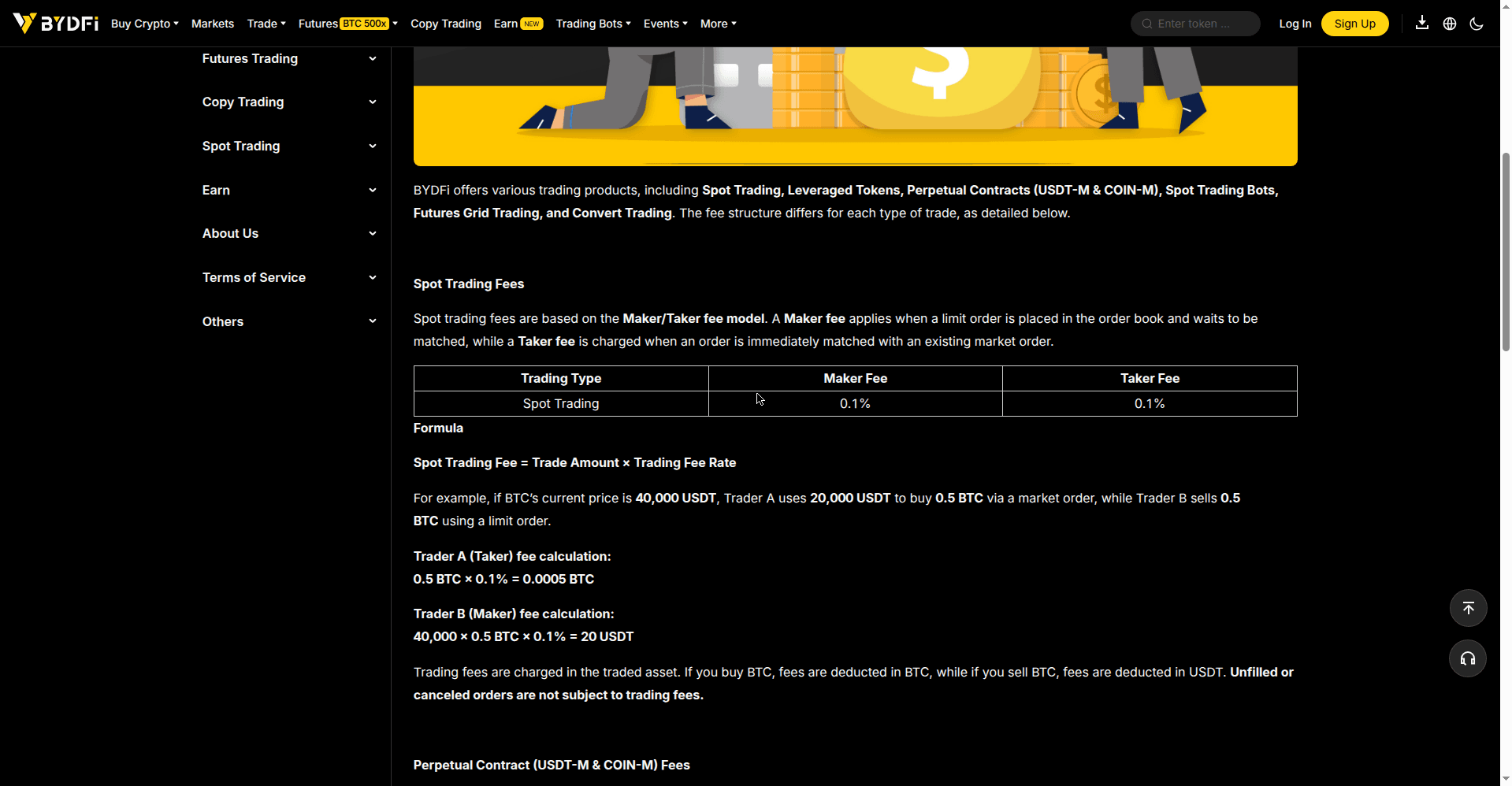
Spot trading costs 0.10% maker and taker, flat, with no volume tiers or token discounts. Futures cost 0.02% maker and 0.06% taker. Crypto deposits are free, withdrawals carry network-based fees, and fiat on-ramps run through third-party processors with fees typically between 1% and 5%. Check the official fee article before you trade, since fee pages change.
How to sign up and start trading
Signing up on BYDFi is fast, and unlike most exchanges, you can start trading without verifying your identity. That convenience comes with a trade-off, so read the limits before you deposit.
- Go to the BYDFi website or app and register with your email or phone number.
- You can start trading right away: unverified accounts can deposit, trade, and withdraw up to around 50,000 USDT per day.
- Optional: complete KYC in your account settings to raise your limits and unlock more fiat deposit methods.
- Turn on two-factor authentication before you deposit anything.
Check that BYDFi serves your country first. It restricts users in China, Pakistan, Bangladesh, Kazakhstan, the UK, and Iran, and you should never use a VPN to get around that.
How to deposit
Crypto is the natural way to fund a no-KYC account. Fiat is possible through third-party processors, but it costs more.
- Log in and open your Assets or Wallet, then choose Deposit.
- For crypto: pick the coin, copy your BYDFi deposit address, and send from your wallet or another exchange. Crypto deposits are free, but always match the network.
- For fiat: choose a third-party on-ramp in your region. Fees typically run between 1% and 5%, so check the quote before you confirm.
- For a first deposit, send a small test amount and confirm it arrives before moving the rest.
How to buy crypto step by step
BYDFi's spot market is simple enough for a first trade. If the futures tab is calling your name, resist it until you have read the leverage warning below, and start on the free demo account.
- Go to Spot trading.
- Pick your pair, for example BTC/USDT.
- For an instant fill, place a market order at 0.10%. To set your own price, use a limit order instead.
- Enter the amount, review, and confirm. Your crypto lands in your BYDFi wallet.
Use the demo account to learn the interface before risking real money. It is free and it exists for exactly this.
How to withdraw
Withdraw regularly and keep only what you are actively trading on the exchange. That is the golden rule for any no-KYC venue.
- Open Assets or Wallet and choose Withdraw.
- Pick the coin, paste your external wallet address, and confirm the network matches. Withdrawal fees are network-based.
- Enter the amount, keeping in mind the roughly 50,000 USDT daily limit for unverified accounts.
- Confirm the withdrawal with your two-factor and email codes.
Test new addresses with a small amount first. Crypto withdrawals cannot be undone.
No-KYC trading
BYDFi does not require KYC to trade. Unverified accounts can deposit, trade, and withdraw up to roughly 50,000 USDT per day. Completing verification raises limits and unlocks more fiat deposit options. This is the exchange's main draw for privacy-minded traders, and it is a genuine differentiator from the majors.
The trade-off is real: no-KYC venues operate with thinner regulatory protection, and BYDFi restricts users in China, Pakistan, Bangladesh, Kazakhstan, the UK, and Iran. Do not use a VPN to bypass restrictions; getting funds frozen in a restricted account is a well-worn way to lose money.
The 500x leverage warning
On 30 September 2026, BYDFi raised maximum leverage on BTC and ETH futures from 200x to 500x. At 500x, a 0.2% price move against your position liquidates it. On a volatile asset like Bitcoin, that is a move that happens in seconds, routinely, on ordinary days.
High leverage is marketed as opportunity; mathematically it is a near-certain path to losing the position. If you are new to trading, start with the free demo account, never trade leverage with money you cannot afford to lose, and understand that most leveraged retail traders lose money. This applies on every exchange, and especially on one advertising 500x.
Regulation and the removed PoR page
BYDFi names no financial regulator that supervises it. Some sources cite US money-services registration and a Canadian FINTRAC registration, but neither amounts to prudential supervision of the exchange. This is the normal state of affairs for no-KYC offshore venues, and it is the price of the privacy: if something goes wrong, you have fewer places to complain.
The September 2026 system upgrade made transparency worse, not better: it removed the trading API and the Proof of Reserves page. The 800 BTC protection fund is still advertised, but without a public PoR page, users cannot verify reserves themselves. That is a step backwards, and it is the single biggest reason to keep balances on BYDFi minimal.
Copy trading, MoonX, TradFi, and the card
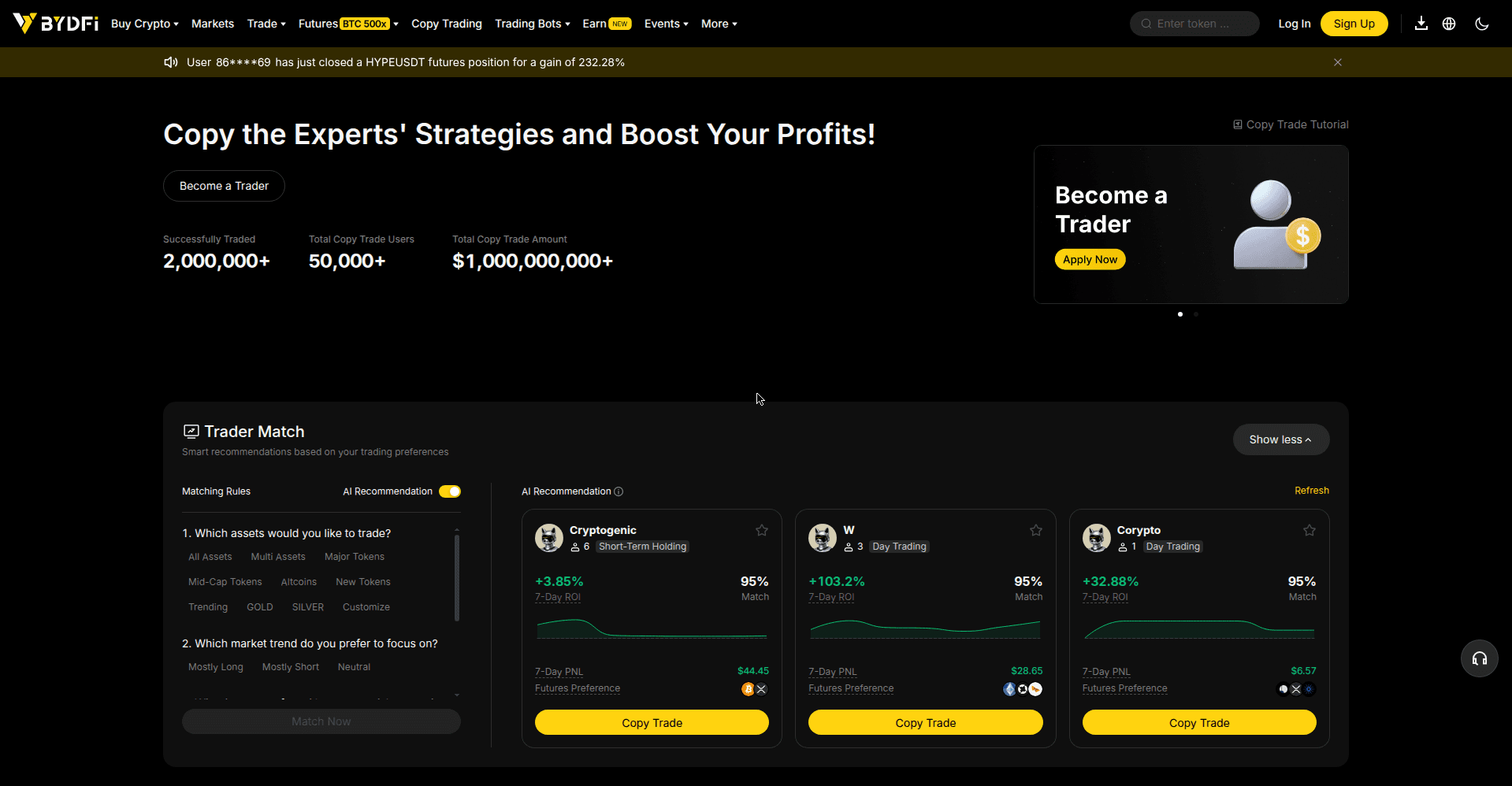
Copy trading is one of BYDFi's better products, with multiple modes including on-chain copy and whale wallet tracking, plus trading bots and a bot marketplace. A warning that belongs here: past performance of copied traders predicts nothing, and most copy traders lose money. MoonX routes orders to over 500,000 on-chain pairs across Solana, BNB Chain, and Base, so you can reach memecoins and DeFi tokens without leaving the exchange.
Two unusual extras: USDT-settled TradFi products (stocks, ETFs, commodities, forex with zero posted commissions, though spreads apply), and the BYDFi Visa card with a free virtual card. The mobile app rates 4.6 out of 5 on both major app stores.
What users say: ratings
Our verdict is our own, but it is worth seeing how other users rate BYDFi on public platforms. These are third-party ratings, checked in October 2026, and they move over time.
| Platform | Rating |
|---|---|
| Trustpilot | 4.0 out of 5 (~215 reviews) |
| Google Play | 4.6 out of 5 (~4.8K) |
| Apple App Store | 4.6 out of 5 (~1.2K) |
The review base is small, so treat these figures as directional; what is there skews positive.
Pros and cons
Pros
- KYC-optional trading up to ~50,000 USDT/day withdrawals
- 1,000+ spot pairs, 500+ perps
- Simple flat fees: 0.10% spot, 0.02%/0.06% futures
- Copy trading, bots, demo account, MoonX
- TradFi assets and a Visa card
- 800 BTC protection fund
Cons
- No supervising regulator
- Proof-of-reserves page removed in September 2026
- 500x leverage is a liquidation machine
- Thin liquidity on smaller altcoin pairs
- Crypto-only withdrawals, limited fiat rails
- Restricted in several countries
Who it suits, and who should skip it
BYDFi suits experienced derivatives traders who want no-KYC access, a huge altcoin list, and copy trading tools, and who understand exactly what unregulated leverage means. Use the demo account first, keep balances small, and withdraw regularly.
Beginners should skip the leverage entirely and think carefully about whether a no-KYC offshore venue is the right first exchange. If you want licensed, supervised trading, look at Kraken or WhiteBIT instead.
Alternatives
For no-KYC derivatives with deeper liquidity, Bybit is the larger venue. For regulated futures with a real licence story, Deribit is the professional choice. For lower spot fees on a licensed exchange, OKX. Our best crypto exchanges guide compares the leading venues side by side.
Verdict
So, is BYDFi worth it? It is a genuinely useful no-KYC venue with a strong product set, but the missing regulator, the removed proof-of-reserves page, and 500x leverage define its risk profile. If you know exactly what you are doing, trade here small and withdraw often. For most beginners, a licensed exchange is still the better first account.
BYDFi questions
Is BYDFi safe and legit?
BYDFi is a real, operating exchange founded in 2020 with an 800 BTC protection fund and cold-warm-hot custody. But it names no financial regulator that supervises it, and a September 2026 system upgrade removed both its trading API and its Proof of Reserves page, which are steps in the wrong direction for transparency. Treat it as a place to trade, not a place to store funds.
Does BYDFi require KYC?
No. BYDFi is KYC-optional: unverified users can trade with a daily withdrawal limit of around 50,000 USDT. Completing KYC raises limits and unlocks some fiat deposit methods. The exchange is restricted in some countries, including China, Pakistan, Bangladesh, Kazakhstan, the UK, and Iran.
What are BYDFi's trading fees?
Spot trading costs 0.10% maker and taker, flat, with no discounts. Futures cost 0.02% maker and 0.06% taker. Crypto deposits are free; withdrawals carry network-based fees.
What is the maximum leverage on BYDFi?
Since 30 September 2026, BYDFi offers up to 500x leverage on BTC and ETH futures, up from 200x. At 500x, a 0.2% price move against you liquidates the position. This is an extremely dangerous product for beginners and should be treated as a warning label, not a selling point.
What is MoonX on BYDFi?
MoonX is BYDFi's on-chain trading tool that routes orders to over 500,000 pairs on Solana, BNB Chain, and Base, letting you trade memecoins and DeFi tokens from inside the exchange interface.
Does BYDFi have copy trading and a demo account?
Yes to both. BYDFi offers copy trading with several modes, trading bots, and a free demo trading account, which is the only safe way to learn its futures interface before risking real money.