Bybit is one of the world's largest crypto exchanges by trading volume, built first for derivatives and now offering spot, earn products, copy trading, and a Web3 wallet. It is also the exchange that survived the largest theft in crypto history. This review treats that hack as core trust data, alongside fees, licensing, products, and who should avoid the platform.
Affiliate disclosure: Some links on this page are affiliate links, including Bybit links. CryptosBeginner may earn a commission if you register through one. This does not change our assessment criteria, risk discussion, or conclusions. This page is educational content, not financial advice.
How we reviewed Bybit
This review combines Bybit's published fee schedules, licensing announcements, and proof-of-reserves reports with third-party reporting on the February 2025 hack, forensic summaries, and regulatory records. We separate provider claims from editorial interpretation, and we treat the hack response as evidence rather than marketing. Features, fees, eligibility, and legal entities can change, so verify the live provider terms before depositing funds.
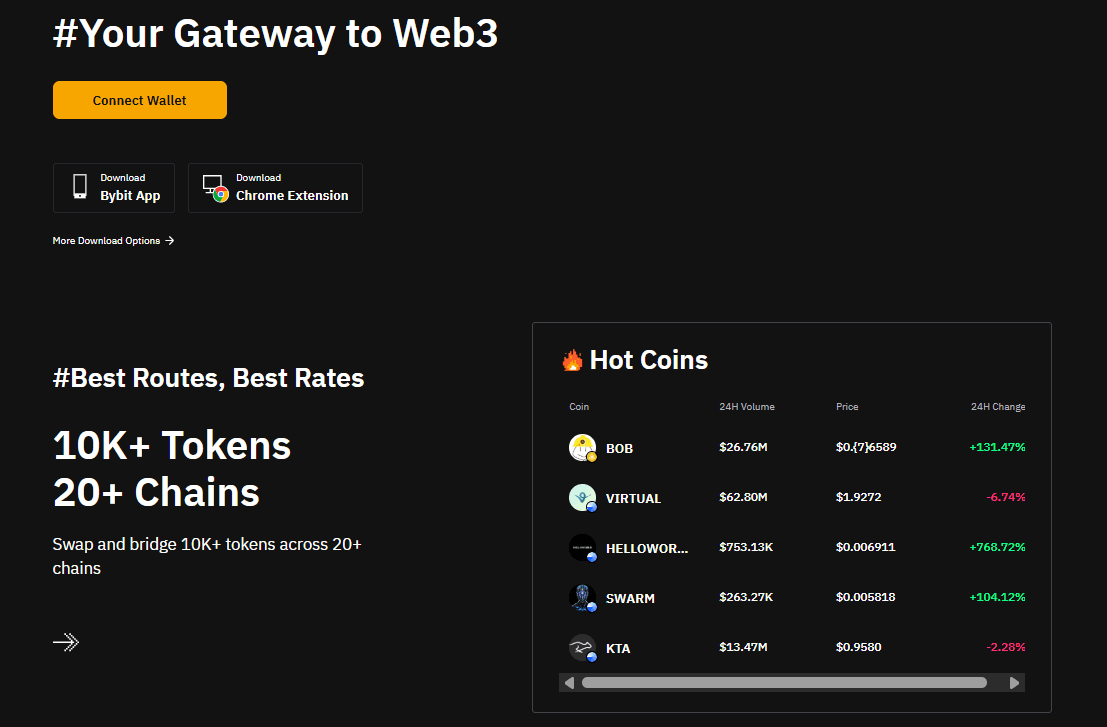
Bybit's Web3 portal. Product availability, features, and terms vary by legal entity and jurisdiction.
TL;DR: our take
Best for: active traders who want deep derivatives liquidity, competitive futures fees, and a broad product suite in one account.
Not ideal for: US, Canadian, and several other restricted residents, absolute beginners, and anyone who wants maximum regulatory protection for long-term holdings.
The hack, in one line: about $1.5B stolen in February 2025 through a spoofed signing interface, and no user lost funds because Bybit kept withdrawals open and covered the shortfall.
Regulation: MiCA-licensed in the EU via Austria and licensed in the UAE, with several other regional registrations. Protections still depend on your entity and jurisdiction.
Fee reality: entry-tier spot at 0.10% and perps at 0.02% maker / 0.055% taker are competitive, but funding rates, spreads, and withdrawal fees are separate layers. Check the live schedule.
Main risk: custody risk on any exchange, plus leverage and liquidation risk on derivatives. Keep only trading funds on the platform.
Bybit launched in 2018 as a derivatives-first exchange and has grown into one of the largest crypto trading venues in the world by volume. It now serves tens of millions of registered users, per company claims, across spot trading, perpetual futures, options, earn products, copy trading, trading bots, a Web3 wallet, a crypto card, and P2P markets. Its headquarters are in Dubai, and it operates through several separately licensed regional entities.
The platform's identity is still derivatives: deep order books, a wide range of perpetual contracts, and tooling aimed at frequent traders. Spot trading and passive products were added later and are solid, but Bybit is not designed as a simple buy-and-hold app for first-time buyers. Beginners can use it, but the product menu rewards users who already understand order types, margin, and funding rates.
The February 2025 hack, honestly assessed
On 21 February 2025, Bybit suffered the largest crypto theft on record. During a routine transfer of ETH from a cold wallet to a warm wallet, attackers drained about 401,347 ETH plus staked ETH derivatives, roughly $1.46 billion at the time. The theft was not a breach of Bybit's trading engine. Attackers had compromised credentials belonging to a developer at Safe, the multisig wallet tool Bybit used, and used them to spoof the signing interface shown to Bybit's wallet signers. The signers approved what looked like a routine transfer, but the underlying transaction had been swapped to replace the wallet's implementation contract with a malicious one and redirect the funds.
Five days later, the FBI publicly attributed the attack to North Korean actors it tracks as TraderTraitor, linked to the Lazarus Group. Independent reviews commissioned afterward found no evidence that Bybit's core infrastructure had been compromised, according to the exchange, a claim worth noting as company-reported rather than independently verified. On-chain investigator ZachXBT traced the stolen funds across thousands of addresses and received a bounty for the work. Most of the ETH was converted into Bitcoin and dispersed, and only a small fraction has been frozen or recovered since.
How Bybit responded
The response is the part of this story that matters most for trust, and it is unusually well documented. CEO Ben Zhou disclosed the breach publicly about 90 minutes after it happened, confirmed that one cold wallet was affected, and said withdrawals would continue normally. He then stated that Bybit remained solvent even if the stolen funds were never recovered and that client assets were backed 1:1, and he took live questions from users the same evening.
Over the next 12 hours, Bybit processed a record wave of more than 350,000 withdrawal requests as users rushed for the exit, and the exchange let every one of them through. Behind the scenes it secured bridge loans and bought ETH over the counter, with on-chain data showing roughly 100,000 ETH of inflows from the wider exchange ecosystem. By 24 February, three days after the attack, Bybit said it had fully closed the ETH gap and published a new audited proof-of-reserves report. For context, our exchange security incidents timeline covers how other platforms handled smaller breaches far worse.
What changed afterward, and what did not
Bybit says it ordered third-party penetration testing and hardened its wallet-signing processes ahead of its EU licensing application, and it went on to secure a MiCA license in Austria and a full UAE license within months of the attack. Regulators do not hand those out to insolvent or opaque firms, so the licensing run is meaningful external evidence that the company's finances and controls withstood scrutiny. A public bounty program for freezing and recovering the stolen funds remains active.
What did not change: the stolen funds are overwhelmingly still gone, which is the normal outcome for state-linked crypto thefts. And the attack vector, a compromised third-party signing interface deceiving human approvers, is a reminder that multisig and cold storage are only as strong as the screens people sign on. No user lost funds, but the incident should permanently retire the idea that any exchange balance is risk-free.
Pros and cons
Strengths
Deep derivatives liquidity and a wide contract range
Competitive futures fees with VIP tiers
Exemplary hack crisis management: open withdrawals, fast disclosure, users made whole
Growing regulated footprint: EU MiCA license, UAE license
Monthly proof-of-reserves reports verified by Hacken
Suffered the largest exchange hack in history; custody risk is proven, not theoretical
Unavailable in the US, Canada, Singapore, Hong Kong, and other jurisdictions
Mandatory KYC, no anonymous tier
Complex interface for absolute beginners
Spot fees slightly above the cheapest competitors at the entry tier
Protections vary by entity; offshore users get less regulatory cover
Regulation and availability
Bybit's regulatory footprint expanded significantly after the hack. In May 2025, Austria's Financial Market Authority granted Bybit EU GmbH a MiCA license, passporting services across 29 EEA states, and EEA users were migrated to the dedicated bybit.eu platform in July 2026. Note that derivatives on bybit.eu remain limited pending further permissions: Bybit applied for a MiFID II license in September 2025, and per public statements from the CEO, approval was expected in late 2026. In October 2025, the UAE's Securities and Commodities Authority granted Bybit a full Virtual Asset Platform Operator license covering the UAE mainland. The company also holds registrations or licenses in Kazakhstan, Georgia, and India, and serves UK users with spot trading only through the FCA-authorized firm Archax.
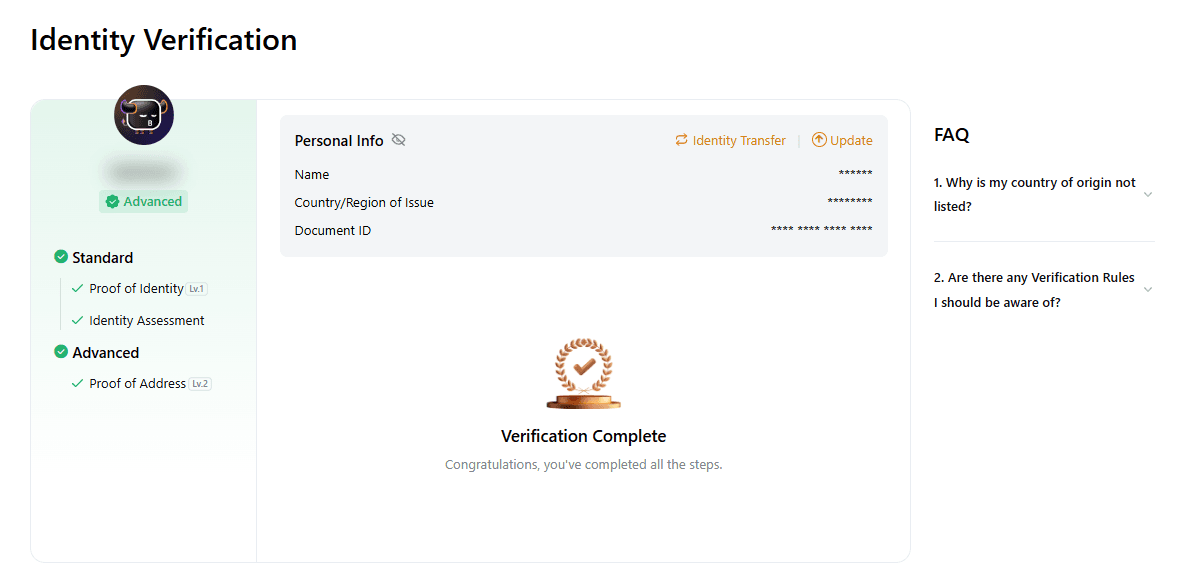
The other side of that map is a long restricted list. Bybit does not serve residents of the United States, mainland China, Hong Kong, Singapore, or Canada, among other jurisdictions. Identity verification is mandatory for meaningful use, with higher verification levels unlocking higher limits and selected services. Availability also varies by product: an account can exist while a specific derivative, earn product, or fiat route stays unavailable. Do not attempt to bypass restrictions with a VPN. It conflicts with platform terms and can leave funds stranded during a compliance review.
Fees and costs
Bybit's published entry-tier schedule is straightforward: 0.10% maker and taker on spot, 0.02% maker and 0.055% taker on perpetual futures, and 0.02% maker and 0.03% taker on options. VIP tiers reduce these rates based on 30-day trading volume or asset balance. On headline futures pricing, Bybit sits near the competitive end of the market, roughly in line with Binance and OKX at the entry tier.
As with every exchange, the commission is only one cost layer. Perpetual positions pay funding rates that change with market conditions, spreads and slippage apply in fast markets, conversion and withdrawal fees vary by asset and network, and card-funded deposits carry processor charges. Treat the figures above as a starting point and check the live fee schedule for your exact product, tier, and legal entity before trading.
Platform and products
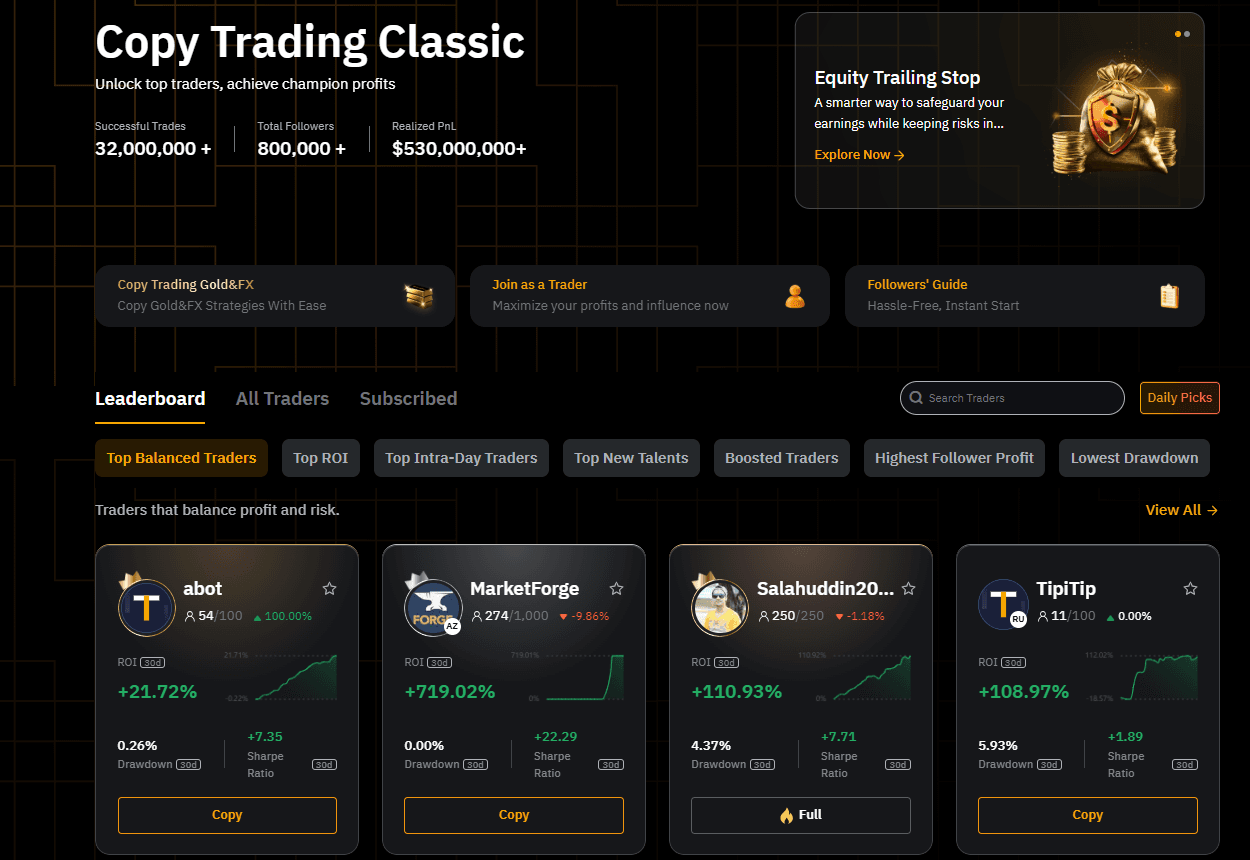
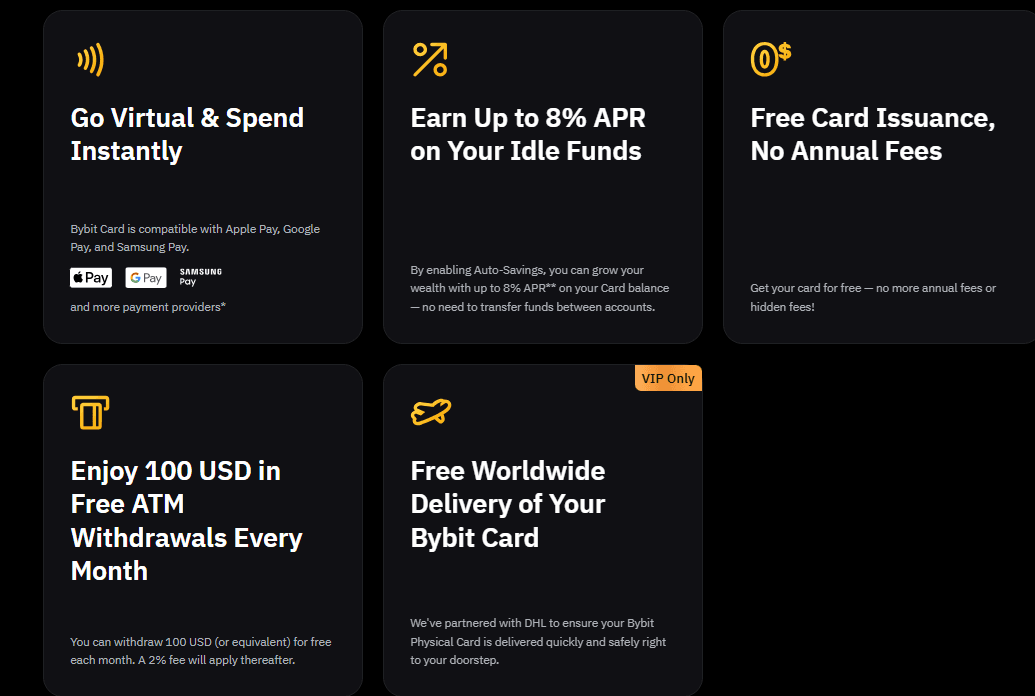
The core trading experience covers spot, margin, perpetual futures, and options, with leverage advertised up to 100x on the most liquid contracts. Around that core sits a full product menu: Bybit Earn (flexible savings, fixed staking, dual investment, crypto loans), copy trading, trading bots including grid and martingale strategies, a Launchpad and Launchpool for new token listings, P2P markets, an OTC desk, a Web3 wallet, and a crypto card for spending balances. Bybit has also added traditional-market instruments such as TradFi perpetuals and MT5-based CFDs.
The interface is polished by exchange standards, with capable charting and a functional mobile app for iOS and Android, but the sheer number of products, order types, and settings can overwhelm newcomers. Beginners should treat the derivatives terminal, bots, and especially martingale strategies as advanced tools, not starting points. Spot buying, small sizes, and limit orders are the sane way to learn the platform.
Security
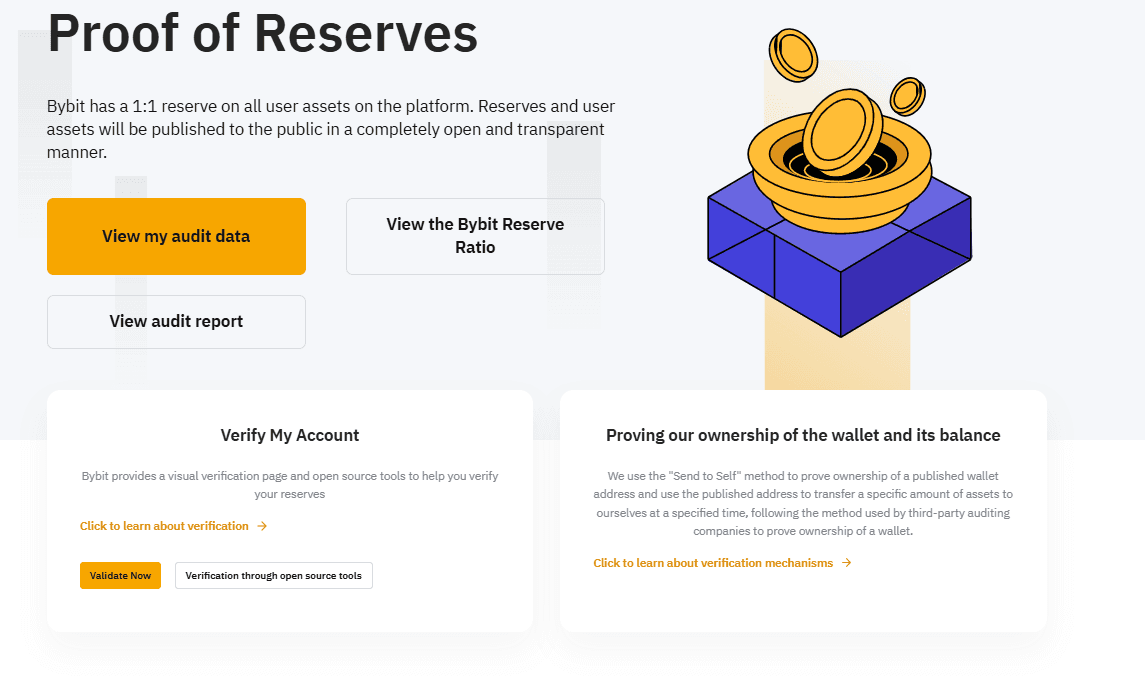
Beyond the hack itself, Bybit's published security stack includes two-factor authentication, withdrawal address whitelisting, anti-phishing codes, cold storage for the bulk of user assets, and encrypted connections. It publishes monthly proof-of-reserves reports with Merkle-tree verification, assessed by the security firm Hacken, and discloses wallet ownership so users can check reserves themselves. A bug bounty program covers the platform and the stolen-funds recovery effort.
The honest framing: these are standard controls for a large exchange, and they did not prevent the 2025 theft, because the attack targeted the human signing step through a trusted third-party tool. Proof of reserves shows assets at a point in time; it does not prove liabilities are fully covered or that operational security is flawless. Use the security features, verify the PoR reports if you like, and still keep only trading funds on the exchange.
Who Bybit may suit, and who should skip it
Bybit may suit active traders who want deep futures liquidity, competitive derivatives fees, and many products under one roof, and who are comfortable with KYC and with keeping disciplined, limited balances on an exchange. It can also work for spot traders in supported regions who want an alternative to the biggest venues.
Skip Bybit if you live in a restricted jurisdiction, if you want to trade anonymously, if you are an absolute beginner looking for the simplest possible first purchase, or if you want your long-term holdings under the strongest available regulatory protections. In that last case, a regulated spot-first exchange plus self-custody is the more conservative combination.
Alternatives to consider
No single exchange fits everyone, and Bybit's restricted list alone rules it out for many readers. US and EU-focused users often compare Kraken and Coinbase for their regulatory footprint, while OKX competes directly on derivatives with its own MiCA licensing. Our best crypto exchanges of 2026 guide compares the leading options by fees, availability, and trust factors so you can match a venue to your jurisdiction and trading style.
Verdict
Bybit is a capable, competitive exchange for active traders, and its handling of the February 2025 hack is genuinely the best crisis response the industry has seen: fast disclosure, open withdrawals, and users made whole within days. That record deserves weight in any trust assessment, alongside the MiCA and UAE licenses earned afterward.
But the hack also proved that custody risk at Bybit is real, not theoretical, and no licensing or proof-of-reserves report eliminates it. Use Bybit for what it is good at, active trading with competitive fees, keep balances limited to what you trade, and hold the rest in self-custody. For beginners, start with spot, skip leverage until you understand liquidations, and verify every fee and restriction on the live site before depositing.
No exchange is risk-free, and Bybit suffered the largest crypto exchange theft on record in February 2025. What distinguishes the incident is the response: withdrawals stayed open, no user funds were lost, and the ETH shortfall was closed within days through reserves and bridge loans. Bybit has since added MiCA licensing in the EU and UAE licensing, and publishes monthly proof-of-reserves reports verified by Hacken. Treat the hack as a reminder to keep only trading funds on any exchange.
What happened in the February 2025 Bybit hack?
On 21 February 2025, attackers drained about 401,347 ETH plus staked ETH derivatives, roughly $1.46 billion, during a routine cold-to-warm wallet transfer. They had compromised credentials belonging to a Safe developer, spoofed the Safe{Wallet} signing interface shown to Bybit's signers, and replaced the multisig wallet's implementation contract with a malicious one. The FBI attributed the attack to North Korea's TraderTraitor group, linked to Lazarus.
Did Bybit users lose money in the hack?
No. Bybit kept withdrawals open through the crisis, processed a record wave of withdrawal requests within hours, and stated that client assets remained backed 1:1. The company covered the stolen ETH through its own reserves and bridge loans, and said it was solvent even if the stolen funds were never recovered. Only a small fraction of the stolen funds has been frozen or recovered since.
What are Bybit's trading fees?
Bybit's published entry-tier schedule shows 0.10% maker and taker for spot, 0.02% maker and 0.055% taker for perpetual futures, and 0.02% maker and 0.03% taker for options. VIP tiers reduce these rates based on 30-day volume or asset balance. Funding rates, spreads, and withdrawal fees are separate cost layers. Always check the live fee schedule for your product and entity before trading.
Is Bybit available in my country?
It depends on your residence and which Bybit entity serves you. The United States, mainland China, Hong Kong, Singapore, and Canada are among the prohibited jurisdictions. The UK gets spot trading only through an FCA-authorized partner, and EEA users were moved to the MiCA-licensed bybit.eu. KYC is mandatory. Do not use a VPN to bypass restrictions.
Is Bybit good for beginners?
Bybit is primarily built for active and derivatives-focused traders, and its interface can overwhelm newcomers. Beginners who want simple spot buying may find regulated spot-first platforms easier, while anyone using Bybit should start with spot, avoid leverage until they understand liquidations, and keep most holdings in self-custody.
Sources and verification
This page was reviewed on 8 October 2026. Platform features, fees, leverage, available markets, legal entities, and restrictions can change. Check the current provider terms before registering, depositing, or opening a leveraged trade.
Disclaimer: Educational content only. This page is not financial, investment, legal, or tax advice. Cryptocurrency, futures, options, and leveraged products can result in rapid or total loss of capital. Availability depends on your jurisdiction. Some links are affiliate links. Verify live terms, fees, legal disclosures, restrictions, and product conditions on Bybit's official website before depositing funds.