Bitcoin protocol guide
One chain. Two rulebooks. A lot of context.
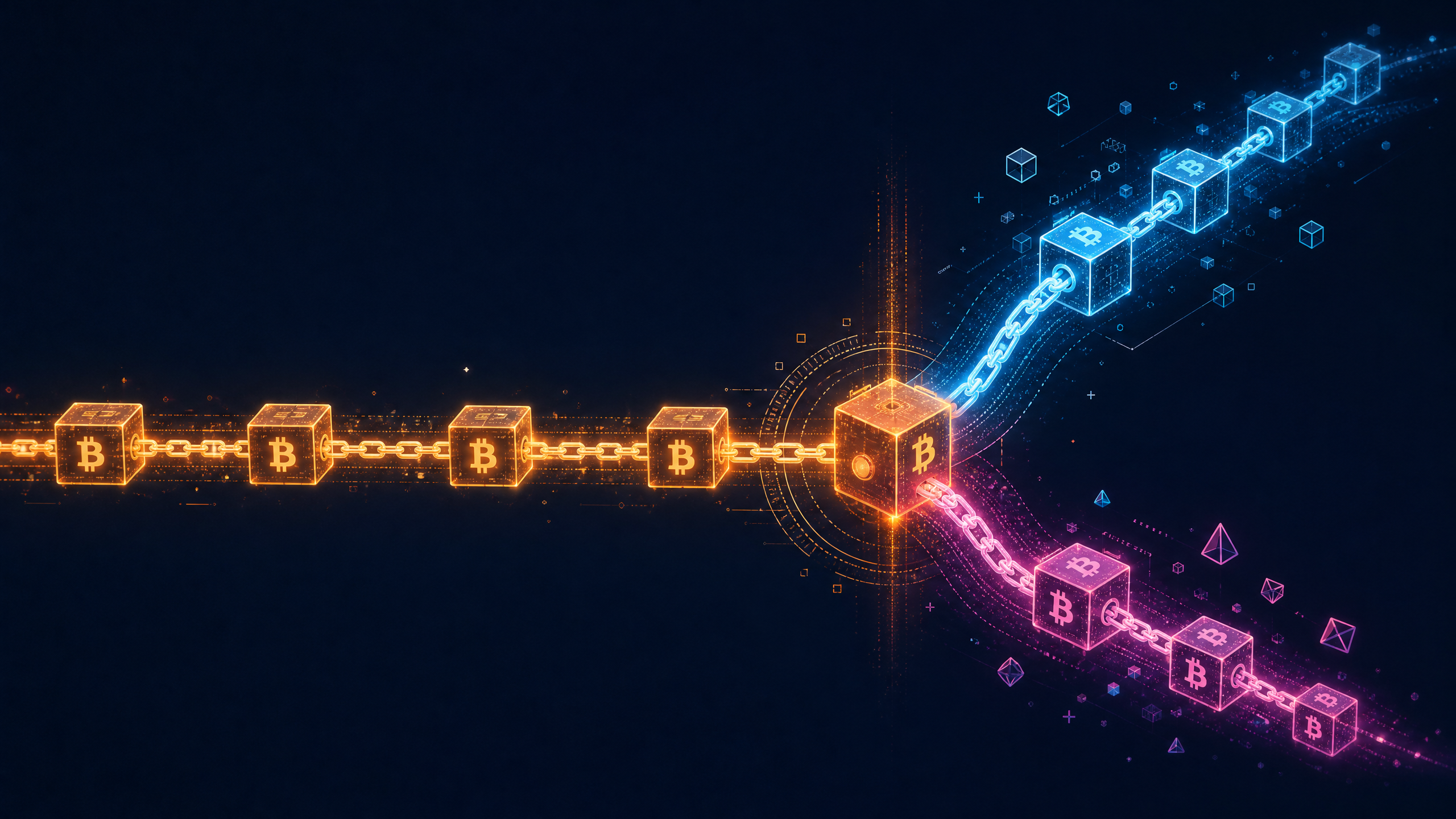
Bitcoin forks are not just ticker changes. They are decisions about which blocks and transactions a node will accept. This guide gives the vocabulary, history, and verification checks to follow a fork without mistaking branding for consensus.
Soft fork
Tighter rules that old nodes may still accept
A soft fork narrows what counts as valid. Coordination is still important, but older nodes can often continue following the chain because the new blocks fit inside older validity assumptions.
Hard fork
A rule change that can create a separate chain
A hard fork changes validity in a way that older nodes may reject. If the community does not converge on one rule set, two networks can continue from a shared history.
Temporary split
Competing blocks before the network settles
Two valid-looking blocks can appear close together. Nodes and miners eventually converge on a preferred chain under the network’s rules; that is different from a deliberate permanent fork.
Why forks happen
A fork is a coordination problem in technical clothing.
Bitcoin has no central operator who can flip a master switch. Developers can propose code, miners can choose what to run, businesses can decide what to support, and node operators can reject rules they do not accept. A fork becomes meaningful when enough independent participants enforce the new rule set for long enough to give it a distinct history.
The disagreement may involve block size, transaction format, activation method, economic policy, or governance expectations. The technical change is only one layer; the social and operational response determines whether a branch remains active.
Research translation
Ask “which nodes accept which blocks?” before asking “what is the new ticker?”
Bitcoin-family timeline
A few names worth separating
Shared ancestry does not make networks interchangeable.
| Network or event | What changed | Reader check |
|---|---|---|
| Bitcoin · 2009 | Original proof-of-work network and monetary schedule. | Confirm the network and address format. |
| SegWit · 2017 | A Bitcoin soft-fork upgrade that changed witness accounting and transaction design. | Do not call a protocol upgrade a separate coin. |
| Bitcoin Cash · 2017 | A Bitcoin hard fork that continued with a different block-size and roadmap direction. | BCH has separate nodes, markets, and support. |
| Bitcoin SV · 2018 | A later branch from the Bitcoin Cash family with its own rules and community. | Trace the ancestry rather than relying on a similar logo. |
| Taproot · 2021 | A Bitcoin soft-fork upgrade adding new spending and scripting options. | Wallet support and spend type affect the user experience. |
Beyond Bitcoin
Other fork stories worth knowing
Not every fork is the same kind of event. The lineage matters.
Bitcoin is the best-known example, but other major networks have also split, changed consensus, or grown from a shared code lineage. The table below separates a true chain split from a continuation chain and from a project that inherited code without sharing the same ledger history.
| Project or family | Fork story | What it is not | Primary reading |
|---|---|---|---|
| Ethereum → Ethereum Classic | In 2016, the Ethereum community adopted a hard fork after the DAO incident. Ethereum Classic continued the non-fork chain, creating two separate networks with shared pre-fork history.[1] | ETC is not a second Ethereum wallet mode or a claim that can be moved using ETH network assumptions. | ETC history ↗ |
| Ethereum → EthereumPoW | When Ethereum switched from proof of work to proof of stake in 2022, a separate proof-of-work continuation emerged around the old mining model.[2] | A continued PoW chain is not automatically the same network, liquidity, security model, or application ecosystem as Ethereum. | Ethereum PoW history ↗ |
| Bitcoin code lineage → Litecoin | Litecoin is a separate digital-money network built from the wider Bitcoin code and design family. It is useful as an example of a code lineage rather than a later Bitcoin ledger split.[3] | LTC is not a balance copied from a Bitcoin block at a particular fork height. | Litecoin site ↗ |
| Litecoin lineage → Dogecoin | Dogecoin is another separate project that grew from the Litecoin-family code lineage and developed its own community, issuance model, and network identity. | A shared code ancestor does not make two networks interchangeable or mutually redeemable. | Dogecoin site ↗ |
The useful distinction
A chain split shares a ledger history up to a defined point. A continuation chain keeps an older rule set after a major upgrade. A code-lineage project borrows design or software but begins its own network history. Treating all three as “free coins” is how research turns into confusion.
References
[1] Ethereum Classic: The DAO Hard Fork Completed. [2] Ethereum.org: Proof of Work. [3] Litecoin official site.
Video lesson
Bitcoin forks, visually explained
Use this external explainer as a second perspective. Compare its terminology with the definitions above, and check technical claims against primary documentation before acting on them.
Interesting fact
A shared history can make a fork look familiar while its later rules, addresses, replay behavior, and wallet support are completely different.
Interesting fact
A soft fork does not mean “no change.” It can alter which transactions are valid while preserving compatibility for older nodes.
Research shortcut
Start with the node software, consensus proposal, block explorer, and official wallet guidance, not a screenshot of a token balance.