Updated 11 October 2026 · Originally published 3 May 2025 · By Alex Rivera · Reviewed for CryptosBeginner
Kraken Review 2026: Fees, Security & the Exchange That Was Never Hacked
Kraken has operated since 2011 without a single successful hack, a claim no other major exchange can make. This review covers the July 2026 fee changes that made Kraken Pro pricier at the entry tier, the proof-of-reserves record, the growing license stack including fresh Dubai approval, xStocks tokenized equities, and the honest trade-offs against Binance and Coinbase.
Alex Rivera · Crypto researcher, CryptosBeginner
Every review is research-led: specs, fees, and availability are checked against official sources before publication and re-checked on every update. Affiliate links never influence verdicts. Last reviewed 11 October 2026.
The short version
- Security is the story. Operating since 2011 with no successful hack, cold storage for the bulk of assets, and regular proof-of-reserves audits.
- Fees got worse in July 2026. Kraken Pro entry tier is now 0.40% maker and 0.80% taker, up from 0.25% and 0.40%. The simple app still charges 1% plus a spread. Always trade on Pro with limit orders.
- Regulation is a strength. More than 100 licenses and registrations worldwide, MiCA coverage in the EU, and full Dubai approval secured in October 2026.
- Tokenized equities are live. xStocks give non-US users stock price exposure with 0% fees on USD funding, and US clients get zero-commission stocks and ETFs.
- Not for everyone. No futures or margin for US clients, state-by-state staking limits in the US, and unavailable in New York and Washington.
What Kraken is
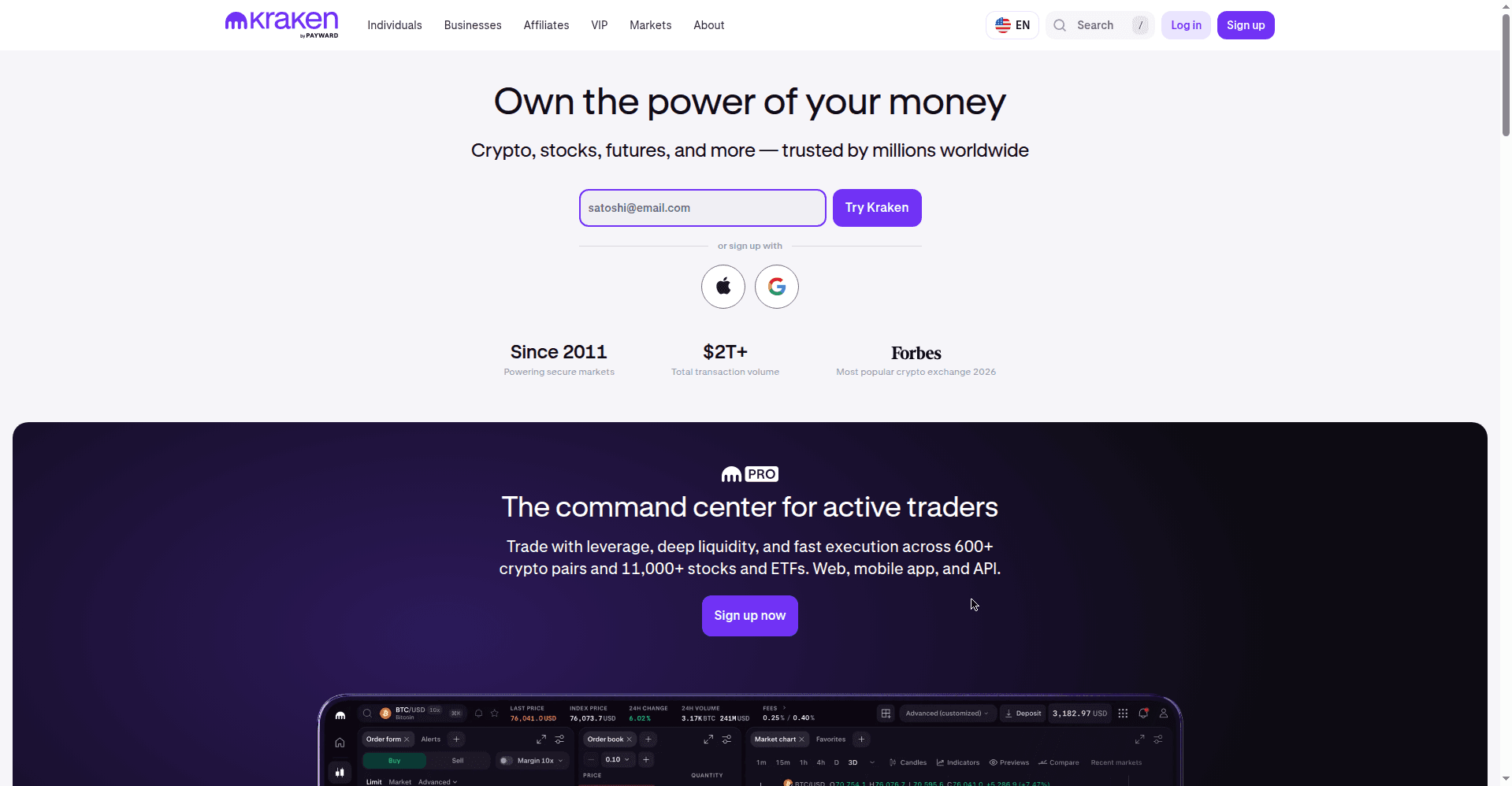
Kraken is a US-based centralized crypto exchange founded in 2011, making it one of the oldest continuously operating venues in the industry. It lists hundreds of cryptocurrencies across spot markets and serves clients in more than 190 countries. The business runs two interfaces on one account: the simple Kraken app and website for buying in a few taps, and Kraken Pro, a full trading terminal with order books, charting, and advanced order types.
Positioning matters here. Kraken never tried to be the everything app. It built its reputation on security engineering and regulatory compliance first, then layered on products: margin, futures, staking, an OTC desk, the Krak payments app, and now tokenized equities. If Binance is the supermarket and Coinbase is the beginner on-ramp, Kraken is the exchange for people who rank trust above novelty.
Security: the never-hacked record
This is the section every Kraken review leads with, because no competitor can match it: in more than 14 years of operation, Kraken has never suffered a successful hack of client funds. Through the Mt. Gox era, the 2022 collapses, and the 2025 wave of exchange breaches, Kraken's cold storage stayed cold. That is not luck. It is the product of a security-first culture that predates most of the industry's current best practices.
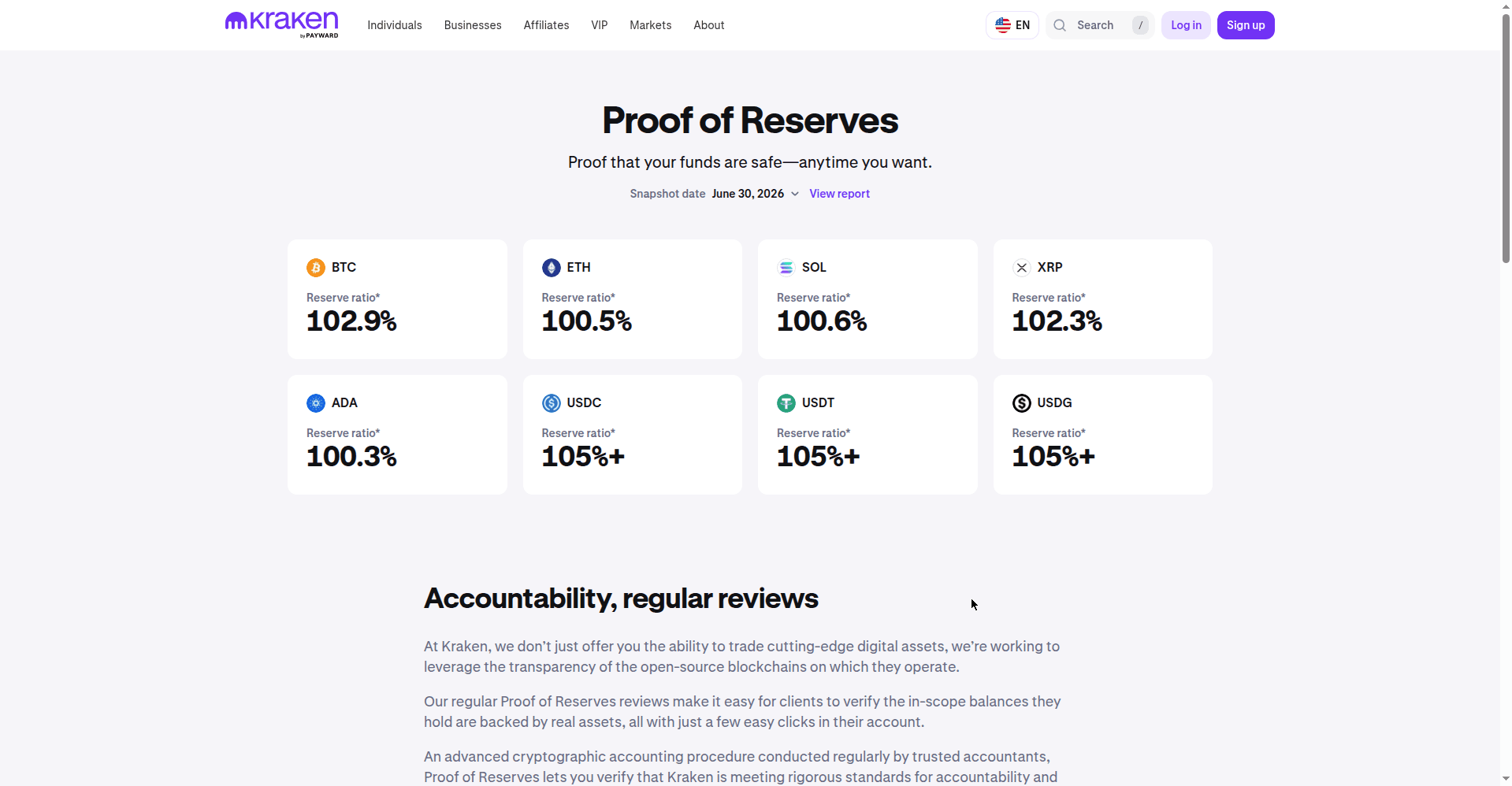
The published stack is what you would expect from a venue with that record: the bulk of client assets held in offline cold storage, two-factor authentication, withdrawal allowlisting, encrypted connections, and regular proof-of-reserves audits that let users cryptographically verify their balances are backed. Kraken was running PoR audits before they became a marketing checkbox after FTX. The latest published snapshot, dated 30 June 2026, shows reserve ratios above 100% across the board: BTC at 102.9%, ETH at 100.5%, SOL at 100.6%, XRP at 102.3%, and the major stablecoins at 105% or more.
The honest caveat, and it applies to Kraken as much as anyone: proof of reserves is a point-in-time snapshot of assets, not a full audit of liabilities or operational security. A clean 14-year record is the strongest trust signal in crypto, but it is a record, not a guarantee. Keep trading balances on the exchange and long-term holdings in self-custody.
Fees and costs
Kraken has two fee realities, and the gap between them is the most expensive lesson a beginner can learn on the platform. The simple app charges a flat 1% on every buy, sell, and convert, plus a spread baked into the quoted price that Kraken does not disclose as a number. Custom orders in the app cost 1.5%. That is convenient and costly.
Kraken Pro, free on the same account, is where the real pricing lives. But pay attention, because it changed recently: on 9 July 2026 Kraken raised the entry tier to 0.40% maker and 0.80% taker, up from 0.25% and 0.40%. Your tier is set by 30-day Pro spot volume or by assets held on the platform, whichever gives you the better rate. From there it steps down: 0.30%/0.60% at $2,500 volume, 0.22%/0.38% at $10,000 volume or $20,000 in assets, and down to 0.00%/0.10% at the top public tiers.
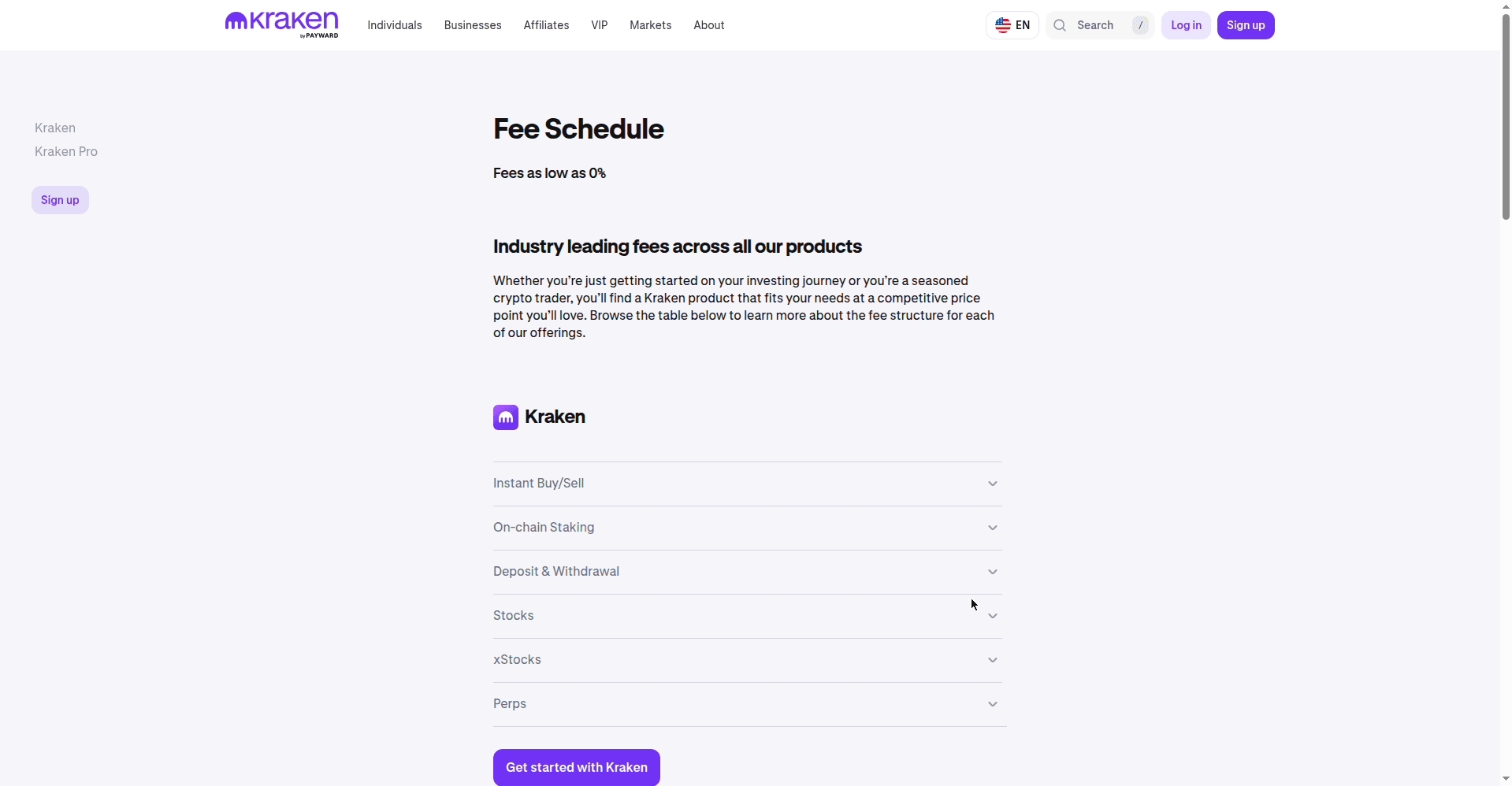
A few more cost layers to know. Futures trade at 0.02% maker and 0.05% taker. Stablecoin and FX pairs have their own lower schedule starting at 0.20% each side. There is also Kraken+, a subscription that waives trading fees on up to $10,000 a month of app buys, sells, and converts, but it does not cover Pro spot, futures, or API trading, and the spread still applies underneath.
Bottom line: at the entry tier Kraken Pro is now meaningfully pricier than Binance or OKX for small spot traders. The fee hike is real and worth stating plainly. Kraken's pitch was never the cheapest trade; it is the trade you can trust. If rock-bottom fees are your priority, the comparison guide below has cheaper options.
Regulation and licensing
Kraken's parent company says it now holds more than 100 licenses and registrations worldwide, one of the deepest regulatory footprints of any crypto exchange. In the EU it operates under MiCA through its Cyprus-regulated entity. In the US it is registered as a money services business and holds state-level licenses where it operates.
The freshest data point: on 12 October 2026, Kraken's parent received full market approval from Dubai's Virtual Assets Regulatory Authority, clearing a UAE launch with dirham-denominated spot and margin trading, direct AED deposits and withdrawals, staking, xStocks, and the Krak payments app. Derivatives and more yield products are slated for later, pending further approvals.
Regulation is not a force field. Licenses set conduct standards and give you somewhere to complain; they do not make an exchange hack-proof or guarantee fund recovery. But in an industry where several large venues operate with thin or offshore licensing, Kraken's stack is a genuine differentiator, and regulators keep approving it after full scrutiny.
Products and trading tools
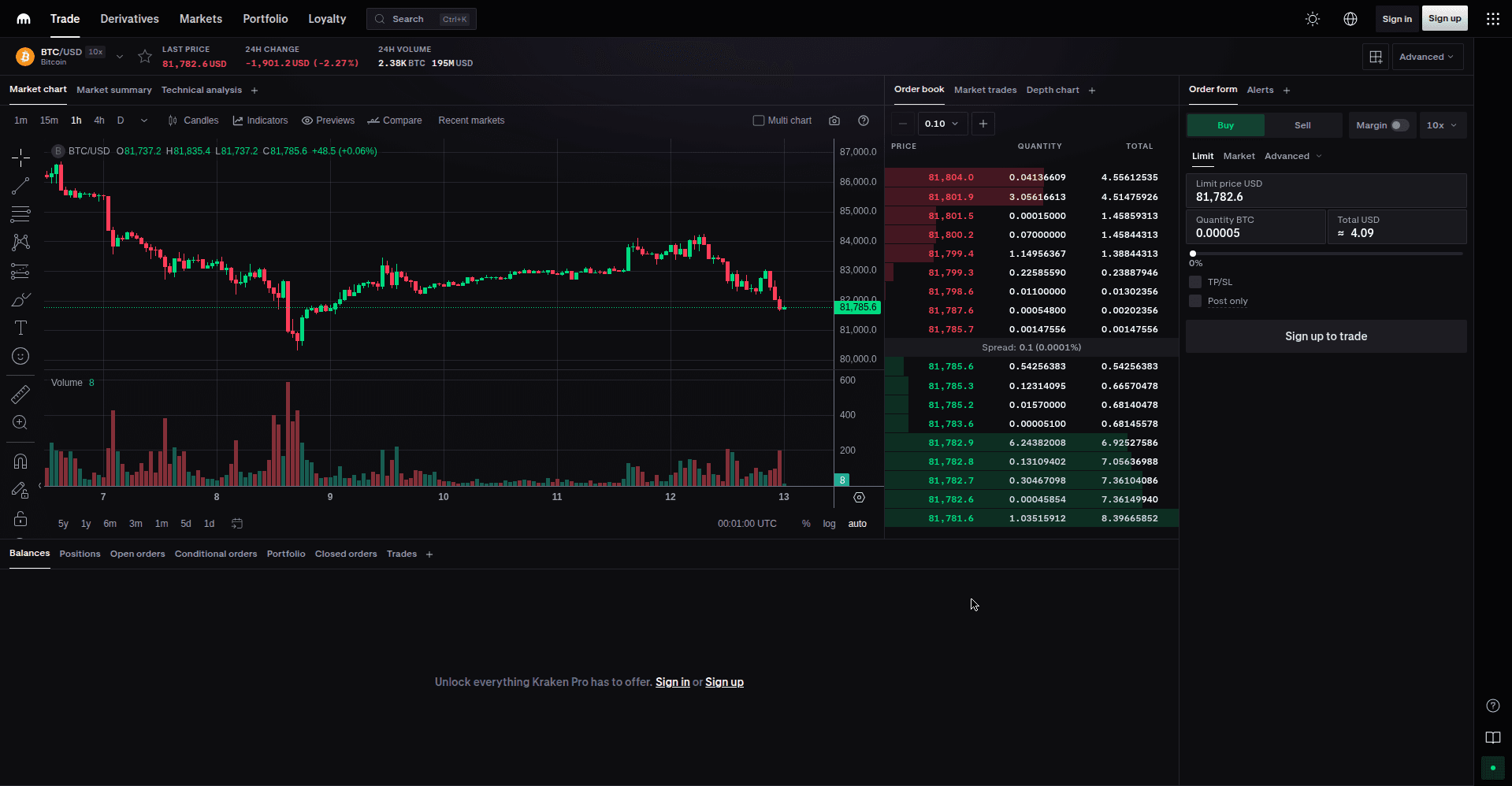
The core is spot trading on Kraken Pro: hundreds of pairs, real order books, limit, stop, and take-profit orders, and full charting. Around that sit margin trading up to 5x and futures up to 50x, both unavailable to US clients, plus an OTC desk for large orders and API access for algorithmic traders.
Staking
Kraken offers staking on 17+ assets with flexible and bonded options. US users should read this carefully: after regulatory action curtailed staking, Kraken resumed it for clients in 39 states in 2025, but availability is still state-dependent. Check the current list for your state rather than assuming it works.
xStocks and US equities
Kraken was early to tokenized equities through xStocks, issued by Backed and tracking real share prices. Trading costs 0% when funded with USD or USDG and 1% with other assets, and Kraken has even offered IPO access through xStocks. The catch is jurisdiction: xStocks are not available in the US, UK, Canada, or Australia, and they give price exposure only, with no voting or dividend rights.
US clients get a different product: zero-commission trading in US stocks and ETFs directly. Between the two offerings, Kraken now covers equity exposure on both sides of the Atlantic, just not with the same instrument.
Krak and the rest
Krak is Kraken's payments app for moving crypto and fiat between users. Add recurring buys for automated investing, a solid mobile app for both the simple and Pro interfaces, and 24/7 support, and the package is complete without being bloated. What you will not find: copy trading, trading bots, or the casino-style product sprawl of some competitors. Kraken's restraint here is a feature, not a gap.
Where it is available
Kraken serves clients in more than 190 countries, with seven fiat currencies supported for deposits and withdrawals: USD, EUR, GBP, CAD, AUD, CHF, and JPY. Verification is tiered, with higher limits for fully verified accounts.
The exclusions: Kraken is not available in New York and Washington state in the US, and futures, margin, and some staking products are restricted or unavailable for US clients generally. Sanctioned jurisdictions including Russia, Cuba, Iran, North Korea, and Syria are excluded. Always check the current supported-countries list for your residence before planning around Kraken.
Pros and cons
Pros
- Never hacked in 14+ years, the industry's best record
- 100+ licenses and registrations, MiCA and fresh VARA approval
- Regular proof-of-reserves audits since before they were fashionable
- xStocks tokenized equities plus zero-commission US stocks
- Seven fiat currencies, 190+ countries served
- Clean product set without casino-style sprawl
Cons
- July 2026 fee hike: Pro entry tier now 0.40%/0.80%
- Simple app costs 1% plus an undisclosed spread
- No futures or margin for US clients
- US staking still state-dependent
- Unavailable in NY and Washington state
- No copy trading or built-in bots
Who it suits, and who should skip it
Kraken suits security-first traders who want a regulated venue with a spotless breach record, competitive-enough Pro pricing, and access to staking, margin, and tokenized equities in supported regions. It is also the natural pick for US clients who want a domestic exchange with real compliance depth.
Skip Kraken if you live in New York, Washington state, or another unsupported jurisdiction, if you need futures as a US client, if you want the absolute lowest spot fees at small size, or if you want copy trading and automation built in. Beginners who will only ever tap buy should know the 1% app fee in advance.
Alternatives to consider
Coinbase is the simpler first purchase for absolute beginners and the most regulated US on-ramp, at higher fees. Binance offers the widest product range and cheaper entry-tier spot fees, with a thinner regulatory footprint in the West. Our best crypto exchanges of 2026 guide compares the leading venues by fees, availability, and trust factors.
Verdict
Kraken is the trust pick among major exchanges. Fourteen years without a hack, cold storage discipline, early proof of reserves, and a license stack that keeps growing, most recently into Dubai, add up to the strongest safety story in the business. The July 2026 fee increase is a genuine mark against it: entry-tier Pro pricing is no longer cheap, and the 1% app fee remains a trap for beginners who never discover Pro.
If you rank security and regulation first and are willing to learn limit orders on Kraken Pro, it is hard to beat. If you want the lowest possible fees or the widest product menu, look at the alternatives. Either way, keep most holdings in self-custody. No record, however clean, makes an exchange a vault.
Kraken questions
Is Kraken safe?
Kraken has never been hacked in over 14 years of operation, a record no other exchange of its size can claim. It keeps the bulk of client assets in offline cold storage, runs regular proof-of-reserves audits, and holds more than 100 licenses and registrations worldwide. No exchange is risk-free, so keep only trading funds on the platform and most holdings in self-custody.
What are Kraken's fees in 2026?
The simple Kraken app charges 1% per buy, sell, or convert plus a spread. Kraken Pro, the advanced interface on the same account, starts at 0.40% maker and 0.80% taker after the 9 July 2026 schedule change, dropping with 30-day volume or assets held on the platform. Futures start at 0.02% maker and 0.05% taker. Always use Kraken Pro with limit orders for regular trading.
Is Kraken available in the US?
Yes, Kraken serves US clients except in states where it is not licensed, including New York and Washington. Futures and margin are not available to US clients, and staking availability is state-dependent. KYC verification is required.
What are xStocks on Kraken?
xStocks are tokenized equities offered on Kraken, issued by Backed and tracking real share prices. They trade with 0% fees when funded with USD or USDG and 1% with other assets. They are not available in the US, UK, Canada, or Australia, and they carry price exposure without voting or dividend rights.
Kraken vs Coinbase: which is better for beginners?
Coinbase is simpler for a first purchase, but Kraken Pro is cheaper once you learn limit orders, and Kraken has the stronger security record. Beginners who plan to trade more than occasionally should learn Kraken Pro rather than paying the 1% app fee plus spread.
Does Kraken offer staking?
Yes, Kraken offers staking on 17+ assets with flexible and bonded options. In the US, staking availability depends on your state after regulatory action limited it; Kraken resumed staking for clients in 39 states in 2025. Check the current list for your state before counting on it.
How this review was written: This review was originally published on 3 May 2025 and last reviewed on 11 October 2026. Fees, availability, and product details were checked against Kraken's published schedules and announcements at review time. Exchanges change terms often; verify the live fee schedule for your region before trading. Educational content, not financial advice.