Updated 9 October 2026 · Originally published 3 June 2024 · By Alex Rivera · Reviewed for CryptosBeginner
Deribit Review 2026: Options Fees, Coinbase Ownership & Is It Safe?
Deribit is where the crypto options market actually lives. When analysts quote a Bitcoin max pain level for options expiry, the number comes from Deribit's open interest. It is the deepest BTC and ETH options book in the industry, now owned by Coinbase after a $2.9 billion acquisition in 2025. It is also a derivatives-only venue where liquidation is a routine event, and most retail traders should never touch it. This review covers the fees, the insurance fund, and the new ownership, then shows you how the platform works, honestly.
Alex Rivera · Crypto researcher, CryptosBeginner
Every review is research-led: specs, fees, and availability are checked against official sources before publication and re-checked on every update. Affiliate links never influence verdicts. Last reviewed 9 October 2026.
The short version
- The options venue. The deepest BTC and ETH options books in crypto, with over $30 billion in BTC options open interest.
- Now a Coinbase company. Acquired for about $2.9 billion in August 2025 and folded into Coinbase Global Exchange in October 2026.
- Cheap for what it is. Futures at 0.015% maker and 0.035% taker, options at 0.03% of the underlying capped at 12.5% of the premium.
- Real risk controls. A public insurance fund with a long record of absorbing liquidations without socialized losses.
- Not for beginners, and not for US retail. Derivatives-only, leverage up to 100x, and liquidation is routine. Most people should not trade here.
What Deribit is
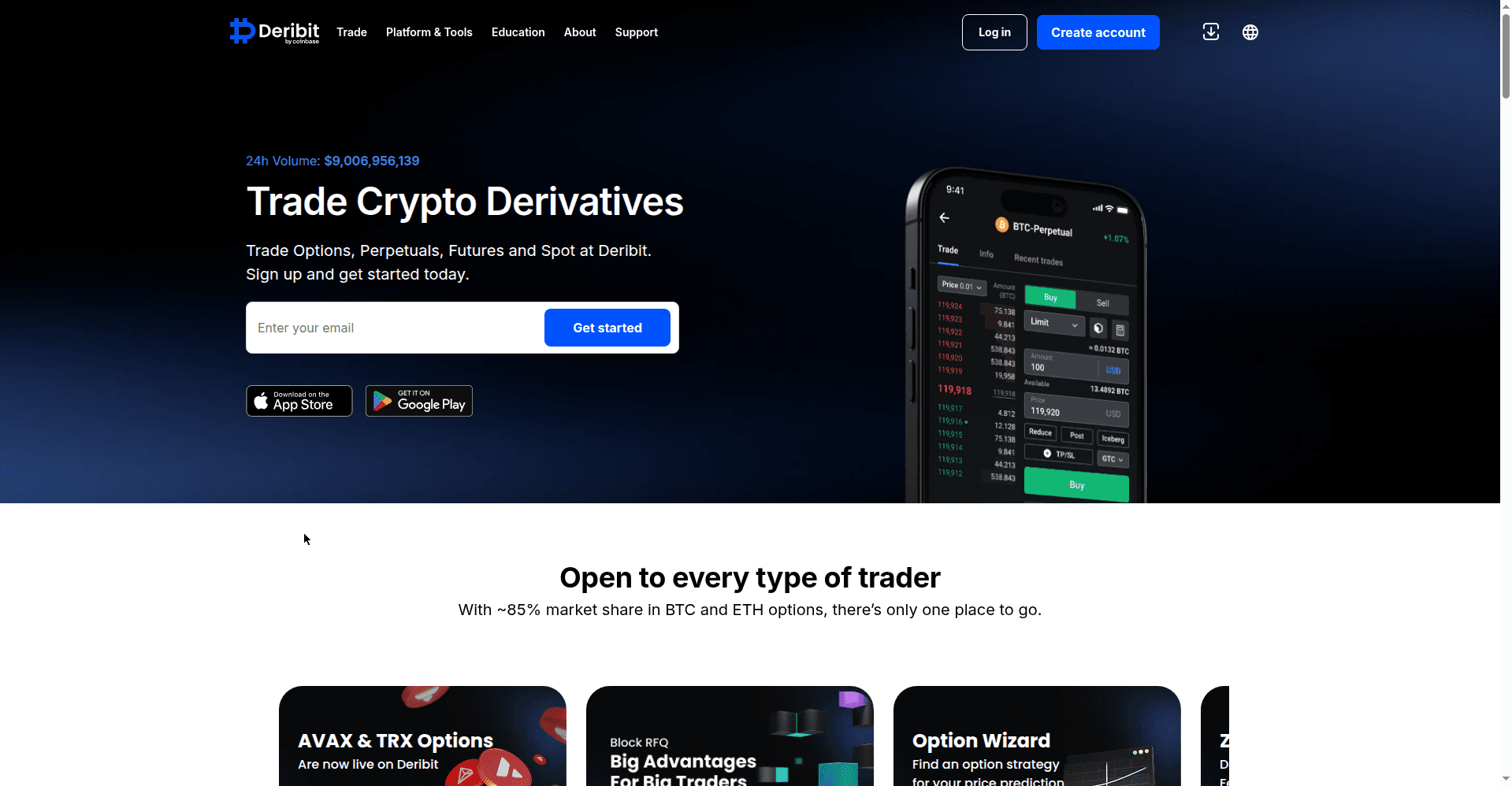
Deribit launched in 2016 as a derivatives-only exchange and became the place where crypto options actually trade. Other exchanges bolt options onto a spot business; Deribit built its entire order book around them: BTC, ETH, and SOL options with weekly, monthly, and quarterly expirations, plus perpetual swaps and quarterly futures that traders use to hedge those options.
That specialization shows in the numbers. Coinbase reported over $30 billion in BTC options open interest on Deribit as of September 2026, and the platform processed more than $1 trillion in volume in the year before the acquisition. When you see a max pain level quoted for Bitcoin options expiry, it was calculated from this book.
The Coinbase acquisition
In August 2025, Coinbase completed its acquisition of Deribit for about $2.9 billion in cash and stock. In October 2026, Coinbase announced the integration is complete: Deribit now sits inside a new Coinbase Global Exchange, with Deribit-powered options, spot margin, and unified portfolios rolling out to eligible traders.
For users, the practical effects are still unfolding. US institutional clients can already access Deribit options and perpetuals through Coinbase Prime under CFTC guidance from May 2026, a regulated route that did not exist before. US retail access to Deribit-powered options is planned for later in 2026, and Coinbase is relaunching Coinbase Pro as a professional platform covering spot, futures, perpetuals, options, and equities. None of this makes options safer. It makes them more accessible, which is a different thing.
Fees and costs
The headline structure is simple. At the standard tier, perpetuals and futures cost 0.015% maker and 0.035% taker, with maker rebates kicking in at higher VIP tiers. Options cost 0.03% of the underlying value for both makers and takers, capped at 12.5% of the option's price, which protects traders on cheap deep-out-of-the-money contracts. Spot on Deribit's own order book is free at 0% maker and taker; only pairs routed to Coinbase Exchange carry spot fees.
These are Deribit's own published rates, verified on its official fee schedule. Expiry adds settlement fees: 0.025% of contract value for futures and 0.015% for options, with daily options exempt. Volume-based VIP tiers cut these further for heavy traders. Deposits are free in crypto, and withdrawals cost only the network fee. Check the live fee schedule before trading, since tiers were updated in late 2025.
Options trading
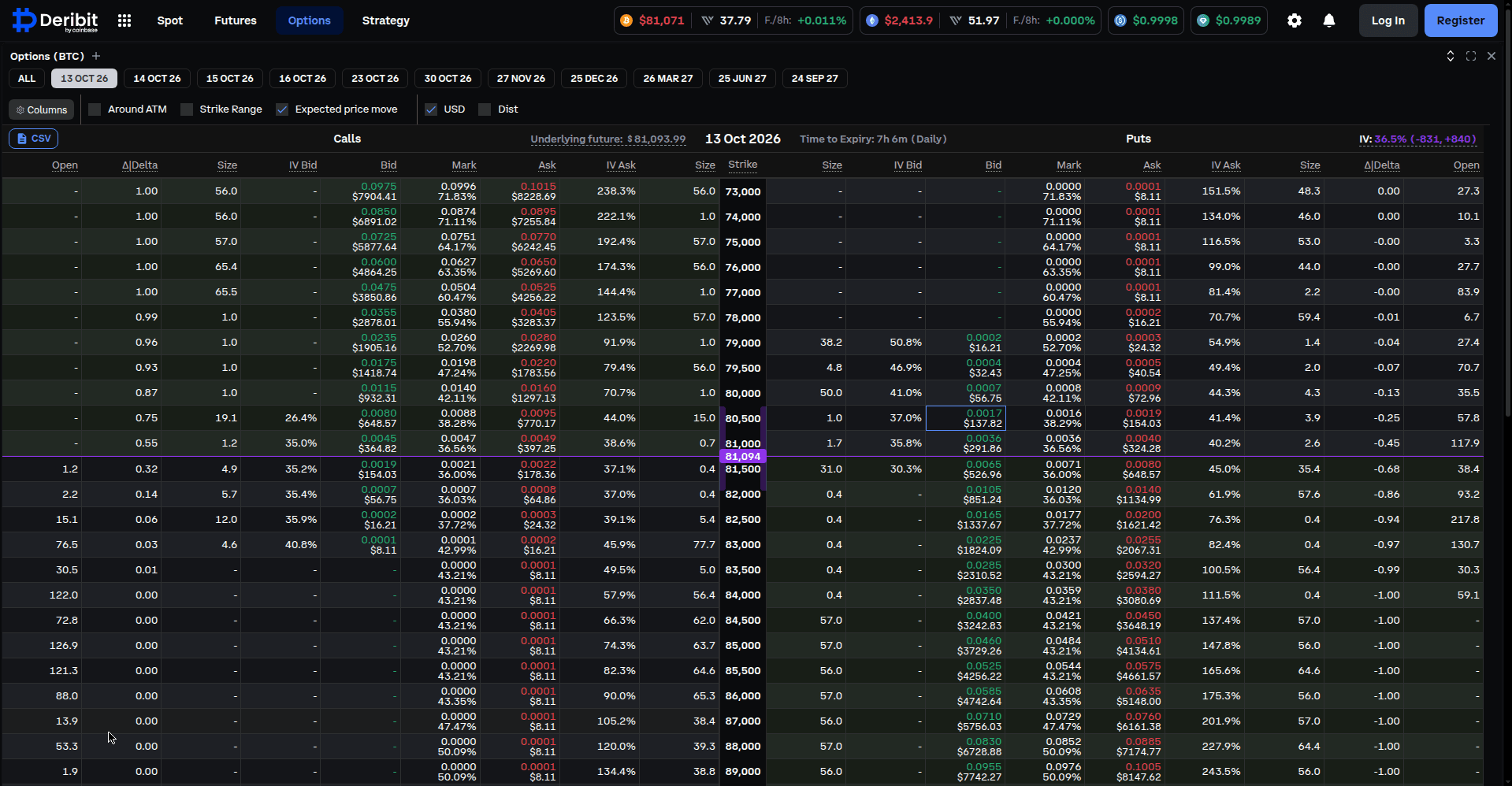
All Deribit options are European-style, which means they can only be exercised at expiry. That removes the early-assignment risk that complicates American-style contracts, one small mercy in a product that has few. Calls and puts trade on every market, expirations run from daily out to quarterly, and the options chain shows live Greeks (delta, gamma, theta, vega) natively.
The position builder lets you model multi-leg strategies before committing capital: straddles, strangles, iron condors, covered calls. Block trading is available for large orders that would move the public book. Minimum sizes were lowered in 2025 with USDC-settled linear options (0.01 BTC, 0.1 ETH), which made the venue slightly less institutional-only than it used to be. Slightly.
Security and the insurance fund
Deribit's defining safety feature is its insurance fund. When a leveraged position is liquidated below its bankruptcy price, the fund absorbs the shortfall instead of passing it to other traders. Deribit publishes the fund's balance in its officialdocumentation, and it has a long record of covering liquidations without socialized losses, which is exactly the failure mode that has hurt traders on other derivatives venues.
Standard protections are all present: mandatory KYC, 2FA, IP allowlisting, and cold storage for the bulk of client funds. Deribit has no reported history of losing customer funds to a platform hack. That is a strong record, but it does not make trading safe: liquidation is a product feature here, and most options buyers lose money over time.
Regulation and availability
Deribit operates through Deribit FZE, which holds a licence from Dubai's VARA. It is not a US-regulated exchange and does not serve US retail traders directly. Since the Coinbase acquisition, US institutions have a regulated route in through Coinbase Financial Markets, but that is an institutional product, not a retail one.
KYC is mandatory for every account, and a long list of restricted jurisdictions applies. Do not use a VPN to bypass regional blocks; getting flagged during a compliance review can freeze withdrawals. Check the current restricted-countries list for your location before signing up.
How to sign up and verify
Before anything else, confirm you are eligible. Deribit does not serve US retail traders directly, and a long list of restricted jurisdictions applies. KYC is mandatory for every account, and there is no way around it. Do not use a VPN to bypass regional blocks: getting flagged during a compliance review can freeze your withdrawals.
- Create your account with an email address and a strong password.
- Turn on two-factor authentication immediately, before you deposit anything.
- Complete KYC: provide your personal details and upload a government-issued ID plus a selfie. Wait for approval before funding the account.
- Set IP allowlisting in the security settings so the account can only be accessed from your addresses.
How to deposit crypto
Deribit is funded with crypto, not fiat. Deposits are free from Deribit's side; you pay only the network fee to send from your wallet or another exchange.
- Go to your account wallet and choose Deposit, then pick the currency: BTC, ETH, SOL, USDC, or USDT, depending on what you want to trade with.
- Copy the deposit address for that currency. Match the network on the sending side if there is a choice.
- Send a small test amount first, then the rest once it confirms.
- Wait for the required network confirmations. The balance shows in your account when they clear.
Decide upfront which currency you will margin with. Mixing coin margins and stablecoin margins in your first month is a good way to confuse yourself about your real exposure.
How to open your first futures position
Read this first, because it matters more than the steps: on a derivatives exchange, liquidation is not a bug, it is the product working as designed. Most options buyers lose money over time, and leverage multiplies both directions. Only trade with money you can afford to lose completely, and treat your first position as tuition, not income.
- Open the Futures section and pick a perpetual contract, for example BTC-PERPETUAL. Perpetuals have no expiry, so you do not have to manage a settlement date.
- Set your leverage low. The platform offers up to 100x; a first position should use a small fraction of that. High leverage means the liquidation price sits uncomfortably close to your entry.
- Use a limit order to enter at your chosen price, and note the maker fee of 0.015% at the standard tier.
- Before confirming, check the liquidation price shown for the position. If the market touches it, the position closes automatically and the margin is gone.
- Monitor the position from the Positions tab. Do not add to a losing position hoping it recovers; that is how small losses become account-ending ones.
When you are done experimenting, close the position and withdraw the remainder. Leaving margin sitting on a derivatives exchange invites impulsive trades, and impulsive trades are where accounts go to die.
How to withdraw
Withdrawing is crypto-only, and Deribit charges no platform fee: you pay only the network fee. The process is the mirror of depositing, with the same address discipline.
- Go to your account wallet and choose Withdraw, then pick the currency.
- Paste your external wallet address and select the correct network.
- Enter the amount, confirm the network fee shown, and complete the 2FA check.
- For a large first withdrawal, send a small test amount first. It costs a few cents and removes the anxiety.
What users say: ratings
Our verdict is our own, but it is worth seeing how other users rate Deribit on public platforms. These are third-party ratings, checked in October 2026, and they move over time.
| Platform | Rating |
|---|---|
| Trustpilot | 3.5 out of 5 (very few reviews) |
| Google Play | 4.2 out of 5 (~550) |
Deribit is a derivatives niche with a small review base, so treat these figures as low-confidence.
Pros and cons
Pros
- Deepest BTC/ETH options books in crypto ($30B+ BTC OI)
- Low derivatives fees with maker rebates
- Public insurance fund, no socialized losses on record
- No reported loss of customer funds to a hack
- Now backed by Coinbase ($2.9B acquisition)
- Professional tooling: Greeks, position builder, block trades
Cons
- Derivatives-only; not a place to buy and hold spot
- No US retail access
- Lighter regulation than major spot exchanges
- Leverage up to 100x; liquidation is routine
- Interface assumes you already understand options
- Options buyers lose money more often than not
Who it suits, and who should skip it
Deribit suits experienced derivatives traders who need real options liquidity: hedgers, volatility traders, and market makers running multi-leg strategies. If you already trade options elsewhere, the depth, the Greeks in the chain, and the fee structure are the reasons to be here.
Everyone else should skip it. If you are buying crypto for the first time, want to hold long term, or do not know what theta decay is, Deribit is not your exchange. Start with a spot venue like Kraken or Binance, and treat derivatives as an advanced topic for much later, if ever.
Alternatives
For crypto derivatives with a broader product set and spot markets attached, Bybit and OKX both offer options alongside perps and spot, with larger retail user bases. Neither matches Deribit's options depth. Our best crypto exchanges guide compares the leading venues side by side.
Verdict
Deribit is the best crypto options exchange by the measure that matters: liquidity. The fees are fair, the insurance fund has a genuine track record, and Coinbase ownership adds institutional weight. But it is a professional derivatives venue, not a general crypto exchange, and options are a negative-sum game for most retail traders after fees.
Use it if you already know exactly what you are doing with options. Otherwise, admire it from a distance and build your foundation on a spot venue first. There is no shame in that; it is what the professionals did too, before they earned the right to be here.
Deribit questions
Is Deribit safe and legit?
Deribit is a long-running derivatives exchange (since 2016) with no reported loss of customer funds to a platform hack and an insurance fund designed so losing positions never socialize losses onto other traders. The caveats: it is a derivatives-only venue with lighter regulation than spot exchanges, it holds a VARA licence in Dubai but is not available to US retail directly, and derivatives themselves carry liquidation risk no platform can remove.
Who owns Deribit now?
Coinbase completed its acquisition of Deribit in August 2025 for about $2.9 billion. In October 2026, Coinbase folded Deribit into its new Coinbase Global Exchange and announced Deribit-powered options rolling out to eligible traders, with US institutional access routed through Coinbase Financial Markets under CFTC guidance.
What are Deribit's trading fees?
At the standard tier, perpetuals and futures cost 0.015% maker and 0.035% taker, with maker rebates at higher VIP tiers. Options cost 0.03% of the underlying value for both makers and takers, capped at 12.5% of the option's price. Settlement fees apply at expiry: 0.025% for futures and 0.015% for options, with daily options and weekly futures exempt. Spot on Deribit's own book is free. Volume-based VIP tiers reduce these further.
Is Deribit available in the US?
Deribit does not serve US retail traders directly. Following the Coinbase acquisition, US institutional clients can access Deribit options and perpetuals through Coinbase Prime and Coinbase Financial Markets under CFTC guidance issued in May 2026. US retail access to Deribit-powered options is planned for later in 2026.
Does Deribit require KYC?
Yes. KYC verification is mandatory for all accounts. Older descriptions of Deribit as a no-KYC venue are outdated.
What can you trade on Deribit?
European-style options on BTC, ETH, and SOL with weekly, monthly, and quarterly expirations, plus perpetual swaps, quarterly futures, spot, DVOL volatility futures, and block trading for large orders. Leverage runs up to 100x on select perpetual contracts, which is extremely risky and unsuitable for most people.
What is the Deribit insurance fund?
The insurance fund absorbs losses when a liquidated position closes below bankruptcy price, so the shortfall is not passed on to other traders. Deribit reports the fund's balance publicly, and it has a long record of covering liquidations without socialized losses.