Exchanges · centralized exchanges
Binance Review 2026: the giant, honestly assessed
Updated 13 October 2026 · Originally published May 2024 · Reviewed for CryptosBeginner
Binance remains the world's largest crypto exchange: 323 million registered users, over a third of global spot volume, and the deepest liquidity in the industry. This review covers the 0.10% fees, the SAFU safety net, the regulatory record since the 2023 DOJ settlement, and the geo restrictions that decide everything before you sign up.
Affiliate disclosure: Some links on this page are affiliate links. CryptosBeginner may earn a commission if you sign up through one. This does not change our assessment criteria or conclusions. This page is educational content, not financial advice.
Alex Rivera · Crypto researcher, CryptosBeginner
Every review is research-led: specs, fees, and availability are checked against official sources before publication and re-checked on every update. Affiliate links never influence verdicts. Last reviewed 13 October 2026.
TL;DR: our take
- Best for: traders who want the deepest liquidity, lowest standard fees, and the widest product range in one account.
- Not available for: US residents (Binance.US is separate), new UK sign-ups, and new EU sign-ups. Geography is the first filter, before fees or features.
- Fee reality: 0.10% spot maker/taker, 0.075% when paying with BNB. Among the cheapest standard rates anywhere.
- Safety net: SAFU fund now at 15,000 BTC, monthly proof-of-reserves reports, and the 2019 hack was covered in full.
- Main caveat: the regulatory record is real and ongoing. The $4.3B DOJ settlement and CZ's exit are history, but access restrictions in major markets are the present.
On this page
What Binance is
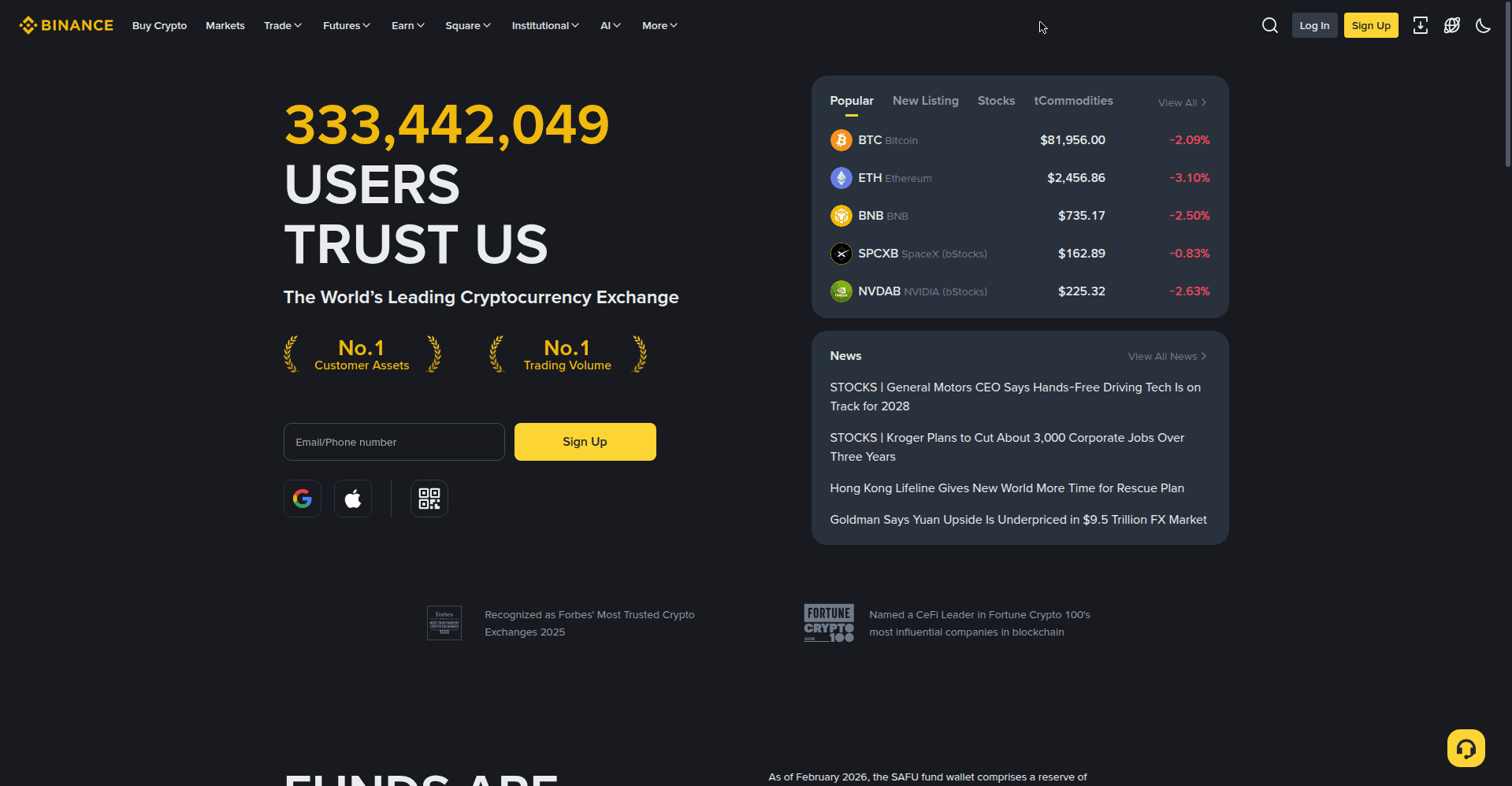
Founded in 2017, Binance is the largest cryptocurrency exchange in the world by a distance: over 330 million registered users as of late 2026, more than 500 listed coins across 1,300+ spot pairs, and roughly a third of global spot trading volume. For most of the market, Binance is the reference point that other exchanges are measured against.
Scale is the product here. The deepest order books mean the tightest spreads and the cleanest fills, which is why professional traders keep coming back even as competitors nibble at the edges. But scale also makes Binance the biggest regulatory target in crypto, and that tension defines the entire review.
Where it is available
Check this before reading another word, because it decides everything. Binance.com is not available to US residents (Binance.US is a separate, smaller company), paused new UK sign-ups in October 2023, and has no MiCA license, with new EU sign-ups stopped. Availability also varies across the Middle East, Asia, and Latin America, where Binance holds licenses in places like Dubai, France, Bahrain, and Australia.
If your country is on the restricted list, the fee comparison below is irrelevant to you. See our best crypto exchanges guide for alternatives available in your region.
Fees
Binance's standard spot fee is 0.10% maker and taker, among the lowest base rates of any major exchange. Pay with BNB and it drops to 0.075%. USDⓈ-M futures start at 0.02% maker and 0.05% taker, with a 10% BNB discount available. Higher 30-day volume unlocks VIP tiers that push rates down further.
| Product | Maker | Taker | With BNB |
|---|---|---|---|
| Spot | 0.10% | 0.10% | 0.075% |
| USDⓈ-M futures | 0.02% | 0.05% | 10% off taker |
| Crypto deposit | Free | ||
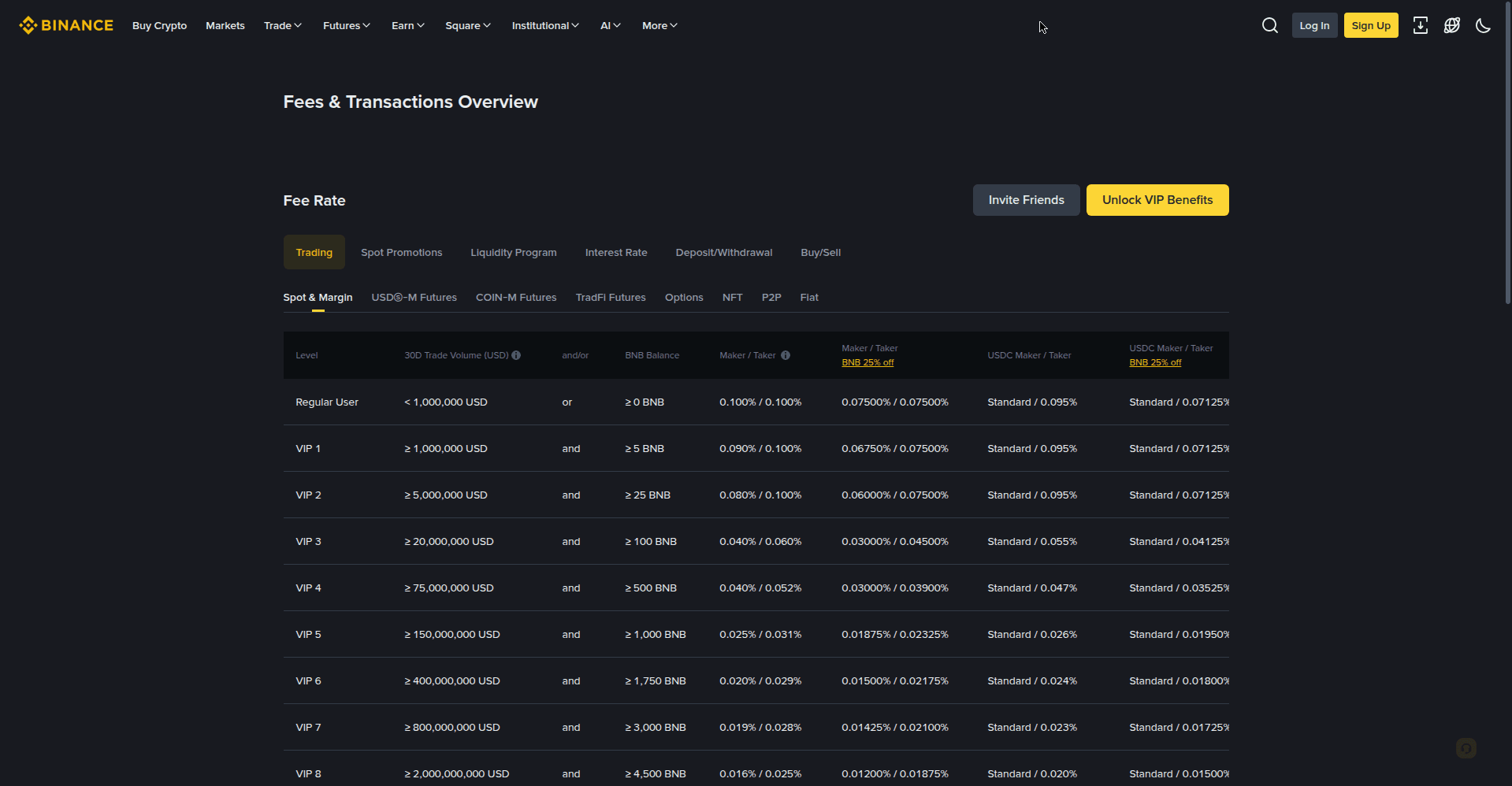
Crypto deposits are free. Fiat deposits and card purchases carry fees that vary by method and region (card buys are the expensive route, often a few percent), and withdrawal fees depend on the asset and network. Binance also runs periodic zero-fee promotions on popular pairs. The honest summary: for spot and futures trading itself, almost nobody beats Binance on price.
Security and proof of reserves
Binance publishes monthly proof-of-reserves reports using Merkle-tree and zk-SNARK cryptography, letting users verify their balances are backed. It also maintains the SAFU (Secure Asset Fund for Users) emergency insurance fund, currently holding 15,000 BTC. Standard protections include cold storage for most funds, two-factor authentication, withdrawal address whitelisting, and anti-phishing codes.
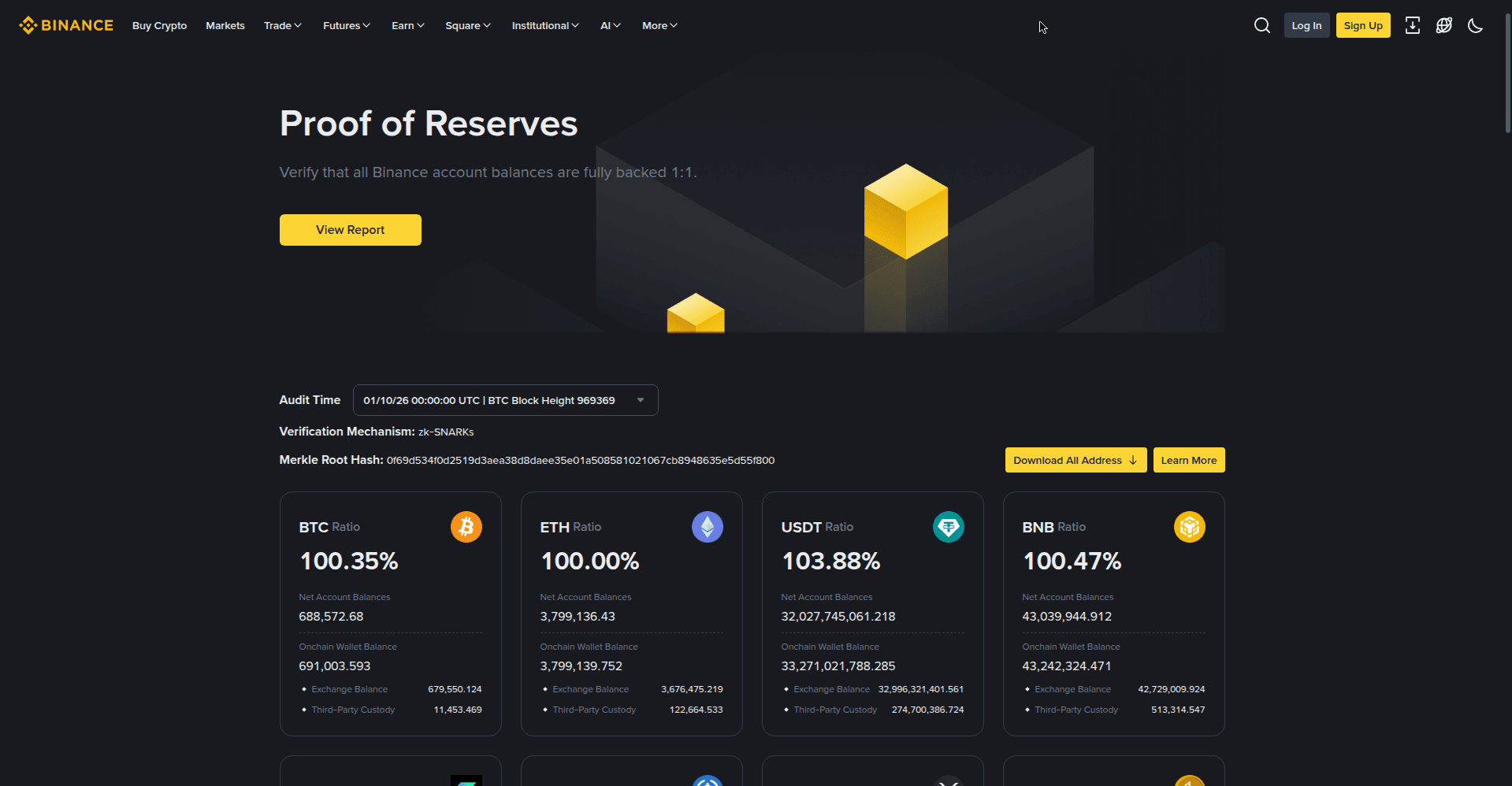
The track record has one major incident: the May 2019 theft of 7,000 BTC, which Binance covered entirely through SAFU with no user losses. Handling a hack that well is a genuine positive. The caveat that applies to every centralized exchange also applies here: your funds are ultimately custodied by the company, and no insurance fund changes that structural fact.
Regulation and company history
This is the section most reviews soft-pedal, so here it is straight. In November 2023 Binance settled with the US Department of Justice for $4.3 billion over anti-money-laundering and sanctions compliance failures. Founder Changpeng "CZ" Zhao stepped down as CEO and later served a prison sentence in 2024. Richard Teng now leads the company.
Since then, Binance has pursued a licensing strategy: full VASP licensing in Dubai, registration in France, Bahrain, Australia, and Abu Dhabi Global Market entities. Progress is real but uneven, which is exactly why the availability section above matters so much. A compliance turnaround in progress is not the same as a clean record, and you should weigh that according to your own risk tolerance.
Products and trading tools
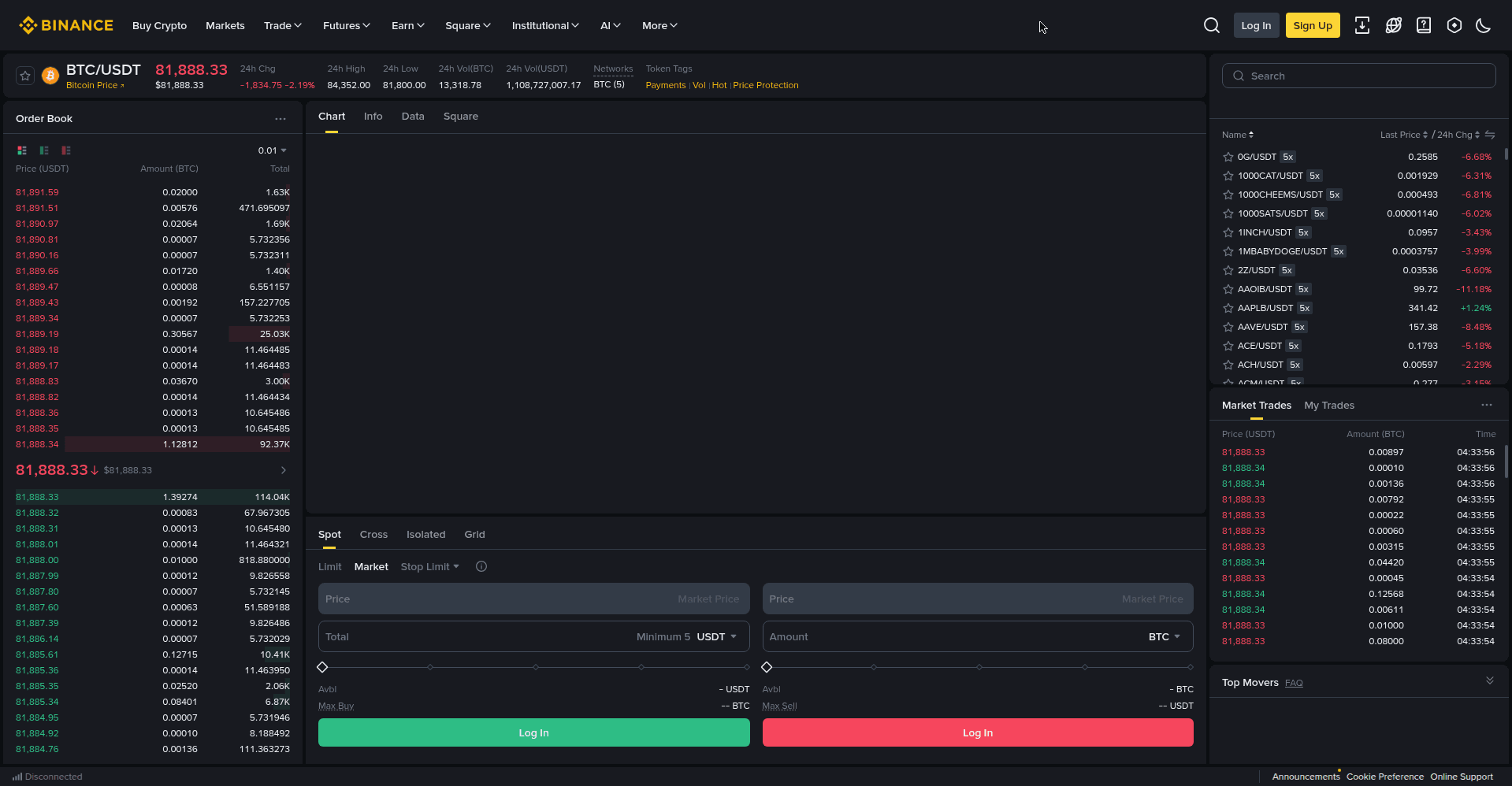
The product list is the longest in the industry: spot, margin, USDⓈ-M and coin-M futures, options, a Lite mode for beginners and a Pro interface for advanced traders, staking and Earn products, P2P trading, an NFT marketplace, Launchpool token launches, trading bots, and even 7,000+ US stocks and ETFs alongside crypto. Few traders will ever touch half of it, but the breadth means most people never need a second exchange.
Breadth is also the main usability complaint: the platform can overwhelm newcomers, and customer support response times stretch during market peaks. Start in Lite mode, ignore everything you do not understand, and expand only as needed.
Tokenized stocks and TradFi
In June 2026 Binance launched bStocks, tokenized securities backed 1:1 by real shares held with the issuer. The first five listings covered Nvidia, Tesla, Circle, Micron, and Sandisk, trading 24/7 as ordinary USDT spot pairs (NVDAB/USDT, TSLAB/USDT, and so on). By August the list had grown past 46 names with over $500 million in assets within seven weeks of launch, according to industry reporting.
Alongside spot bStocks, Binance lists TradFi perpetuals: USDT-settled futures on equities with up to 20x leverage, funding every eight hours, also trading around the clock. Together they let eligible users hold equity exposure and hedge it without leaving the exchange. In September 2026, Ethena chose Binance as the first venue to extend its USDe basis trade into equities, using bStocks as spot collateral against short equity perpetuals, which is a meaningful institutional vote of confidence in the plumbing.
Know what you are buying: bStocks give economic exposure to the share price but no voting rights, and availability is jurisdiction-dependent. Tokenized equities are still a young product class, so position sizing and the usual custody discipline apply.
Aster DEX inside Binance Wallet
One clarification worth making: Binance did not build Aster. Aster DEX is an independent perpetuals protocol, formed from the 2024 merger of Astherus and APX, that integrated with Binance Wallet in January 2026, following earlier integrations with SafePal and Trust Wallet. From inside the self-custody Binance Wallet, users can trade on-chain perpetuals on BNB Smart Chain, including stock-linked markets such as Apple and Nvidia alongside crypto pairs, without handing custody to an exchange.
Why it matters for this review: it shows where Binance is heading. The company is pushing derivatives deeper into self-custody rails instead of keeping everything on the centralized order book. For traders, that means a choice between Binance's centralized futures (deepest liquidity, up to 125x on crypto) and on-chain perps via Aster (you keep your keys, thinner liquidity). Beginners should treat high leverage on either venue as a fast way to lose money, not a feature to maximize.
Platform and usability
The web platform and mobile app are fast, stable, and available in Lite and Pro modes. Order types cover the full range from market and limit to stop-limit, trailing stop, and TWAP for larger traders. The app handles spot, futures, Earn, and P2P without forcing you to the desktop site.
Verification (KYC) is mandatory for meaningful use, as on all compliant exchanges. Have your ID documents ready; approval is usually quick but can slow during surges.
Getting started
If Binance is available in your country, the path from zero to first trade is short. Four steps, in order:
- Confirm availability. Check that Binance.com accepts new sign-ups in your country before anything else. If not, pick a licensed alternative from our best crypto exchanges guide.
- Create your account. Sign up with an email address, set a strong unique password, and enable two-factor authentication immediately. Turn on the anti-phishing code too, so you can spot fake Binance emails at a glance.
- Verify your identity. Complete KYC with a government ID and a quick liveness check. Approval is usually fast outside peak periods.
- Deposit and start small. Fund with a crypto transfer (free) or a local fiat method, then place a small spot buy in Lite mode. Learn the interface with amounts you would not miss before touching futures or margin.
Pros and cons
Strengths
- Deepest liquidity in crypto: tightest spreads, cleanest fills
- 0.10% spot fees, 0.075% with BNB: among the cheapest anywhere
- 500+ coins, 1,300+ spot pairs, plus futures, options, staking, P2P
- SAFU fund at 15,000 BTC and monthly proof of reserves
- 2019 hack covered in full, no user losses
- Lite mode keeps it approachable for beginners
Weaknesses
- No US access; UK and EU sign-ups restricted
- $4.3B DOJ settlement and founder conviction in its history
- Overwhelming product sprawl for newcomers
- Support slows badly during market peaks
- Custodial by design: not your keys, not your coins
- Regulatory picture still uneven by jurisdiction
Who it suits, and who should skip it
Binance suits active traders and anyone who wants maximum liquidity, minimum fees, and every product under one roof, in a country where it is fully available. Beginners in supported regions get a gentle on-ramp through Lite mode plus room to grow.
Skip it if you are in the US, UK, or EU (use a locally available alternative), if you want non-custodial control (use a hardware wallet for savings), or if a spotless regulatory record matters more to you than price and liquidity. Nobody is wrong for making that trade.
Alternatives
Bybit is the closest derivatives-first rival with strong liquidity and its own loyal following. OKX matches Binance on product breadth with a cleaner regulatory posture in some regions. Kraken is the conservative pick: fewer products, longer clean security record, strong in the US and EU.
For savings rather than trading, consider cold storage instead of any exchange: see our SafePal S1 review, our Prokey Optimum review, and our best crypto exchanges guide.
Verdict
Binance is the best-priced, deepest, most complete exchange in crypto, and also the one with the most complicated past. Both things are true at once. If it is available in your country and you want low fees with maximum liquidity, it remains the default choice for good reason.
Go in with open eyes: confirm availability first, keep only trading funds on the exchange, move savings to self-custody, and never treat any centralized platform as a vault. That discipline matters more than which logo is on the app.
FAQ
Binance questions
Is Binance safe and legit in 2026?
Binance is the world's largest exchange by volume, with monthly proof-of-reserves reports and a SAFU emergency fund now holding 15,000 BTC. It is a real, operating business, not a scam. But 'legit' depends on your country: it has no MiCA license in the EU, paused new UK sign-ups in October 2023, and US residents must use the separate Binance.US. Check availability in your jurisdiction first.
What are Binance's trading fees?
Spot trading starts at 0.10% maker and taker for entry-tier users, dropping to 0.075% when you pay with BNB. USDⓈ-M futures start at 0.02% maker and 0.05% taker. Higher 30-day volume unlocks VIP tiers with lower rates. Crypto deposits are free; fiat deposit and card purchase fees vary by method and region.
Can US residents use Binance?
No. Binance.com is not available to US residents. Binance.US is a separate company with fewer products and listings. If you are in the US, evaluate Binance.US on its own merits rather than assuming it matches the global platform.
What happened with Binance and regulators?
In November 2023 Binance settled with the US Department of Justice for $4.3 billion over compliance failures, and founder Changpeng Zhao stepped down as CEO, later serving a prison sentence in 2024. Richard Teng now leads the company. Since then Binance has pursued licenses in jurisdictions including Dubai, France, Bahrain, and Australia, but access remains restricted in several major markets.
Has Binance ever been hacked?
The largest incident was the May 2019 theft of 7,000 BTC, which Binance covered in full through its SAFU insurance fund, with no user losses. That response is a genuine positive in its track record, though no exchange is immune to future incidents.
What are Binance bStocks?
bStocks are tokenized securities launched by Binance in June 2026, backed 1:1 by real shares. They trade 24/7 as USDT spot pairs (for example NVDAB/USDT for Nvidia) and give holders economic exposure to the share price without voting rights. Availability depends on your jurisdiction.
What is Aster DEX on Binance Wallet?
Aster DEX is an independent perpetuals protocol that integrated with the self-custody Binance Wallet in January 2026. It lets wallet users trade on-chain perpetuals on BNB Smart Chain, including stock-linked markets, without depositing funds on the centralized exchange. Binance did not build Aster; it provides the wallet rails Aster plugs into.
Is Binance good for beginners?
Mostly yes. Binance Lite mode simplifies the interface, liquidity is the deepest in the industry so orders fill cleanly, and fees are low. The downsides for beginners are the overwhelming number of products, uneven customer support at peak times, and the need to confirm the platform is actually available in your country before signing up.
Disclaimer: Educational content only. This page is not financial, investment, legal, or tax advice. Fees, availability, and regulations change; verify the live provider terms for your country before signing up. Availability of linked third-party sites depends on their own terms.