Updated 4 October 2026 · Originally published 13 May 2025 · By Alex Rivera · Reviewed for CryptosBeginner
Bitunix Review 2026: Fees, KYC Change & 200x Leverage, Honestly Assessed
Bitunix first caught my eye for a simple reason: futures fees that are genuinely among the lowest in the market, on an interface that does not make you work for it. Then 2026 changed the story. Since 1 July, withdrawals require identity verification, and the old no-KYC pitch is dead. Here is the full picture: the low fees, the published reserves, the 200x leverage warning, all of it said plainly.
Alex Rivera · Crypto researcher, CryptosBeginner
Every review is research-led: specs, fees, and availability are checked against official sources before publication and re-checked on every update. Affiliate links never influence verdicts. Last reviewed 4 October 2026.
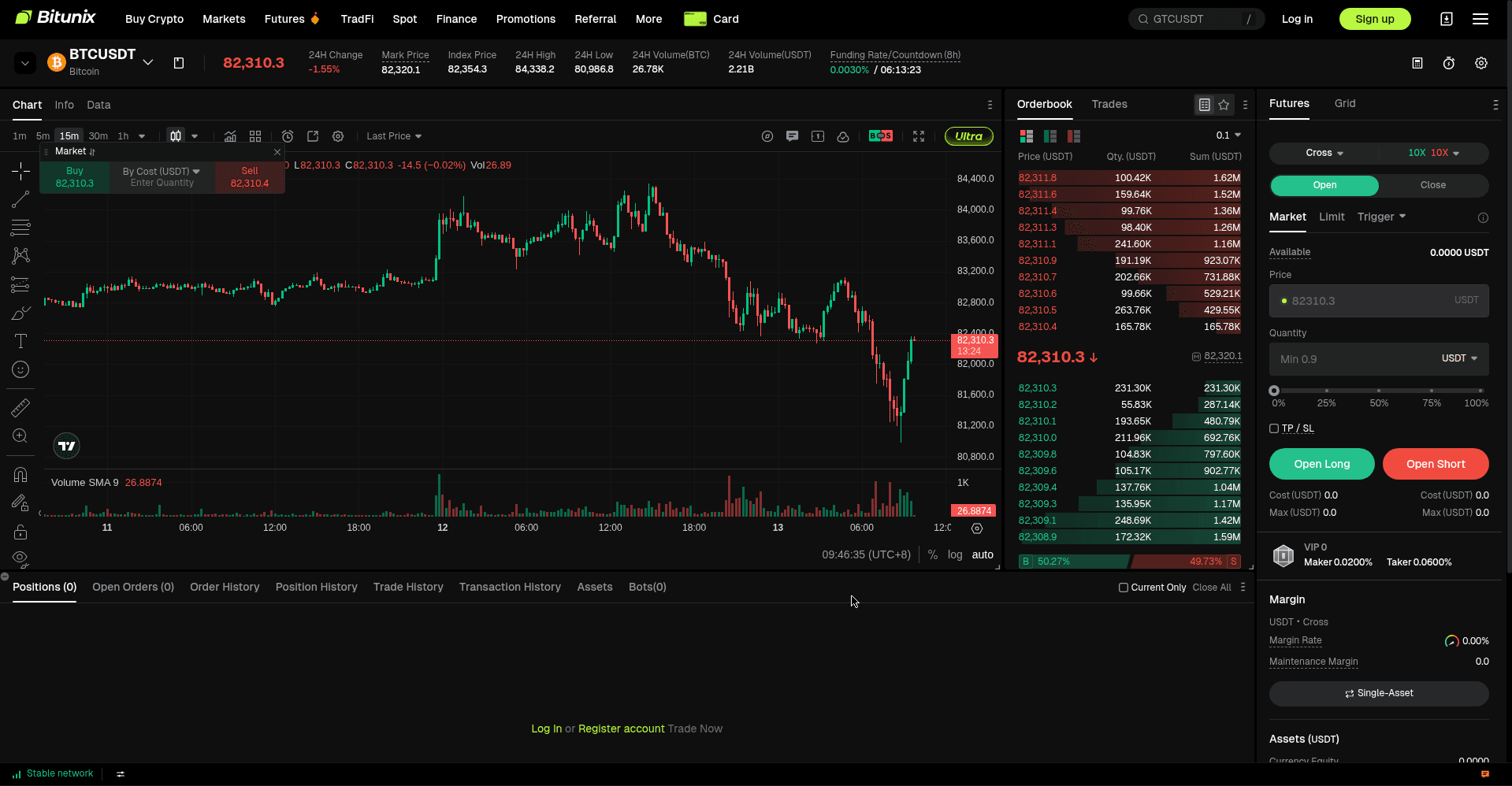
The short version
- Futures-first, low fees. Spot 0.08% maker and 0.10% taker, futures 0.02% maker and 0.06% taker, with VIP tiers going lower still.
- KYC now required for withdrawals. Since 1 July 2026 you can trade without KYC, but you cannot get your money out without verifying first.
- 200x leverage. Up to 200x on BTC and ETH perpetuals. A 0.5% move against your position liquidates it. Read that twice.
- Published reserves. October 2026 audit: BTC 156%, ETH 108%, USDT 105%. MPC custody via Cobo plus a reported $30M Care Fund.
- TradFi on the side. Stock, ETF, forex, index, and commodity perpetuals sitting next to crypto.
- Young and offshore. Founded 2021 in Seychelles, thin team documentation, no major licence. A trading venue, not a vault.
What Bitunix is
Bitunix launched in 2021, founded by Arron Lee, and registered in Seychelles. It grew fast into a top-15 derivatives exchange, reporting 5 to 10 million users and more than 1,200 trading pairs: 540-plus spot assets, 520-plus futures contracts, and a TradFi lineup of stocks, ETFs, forex, indices, and commodities.
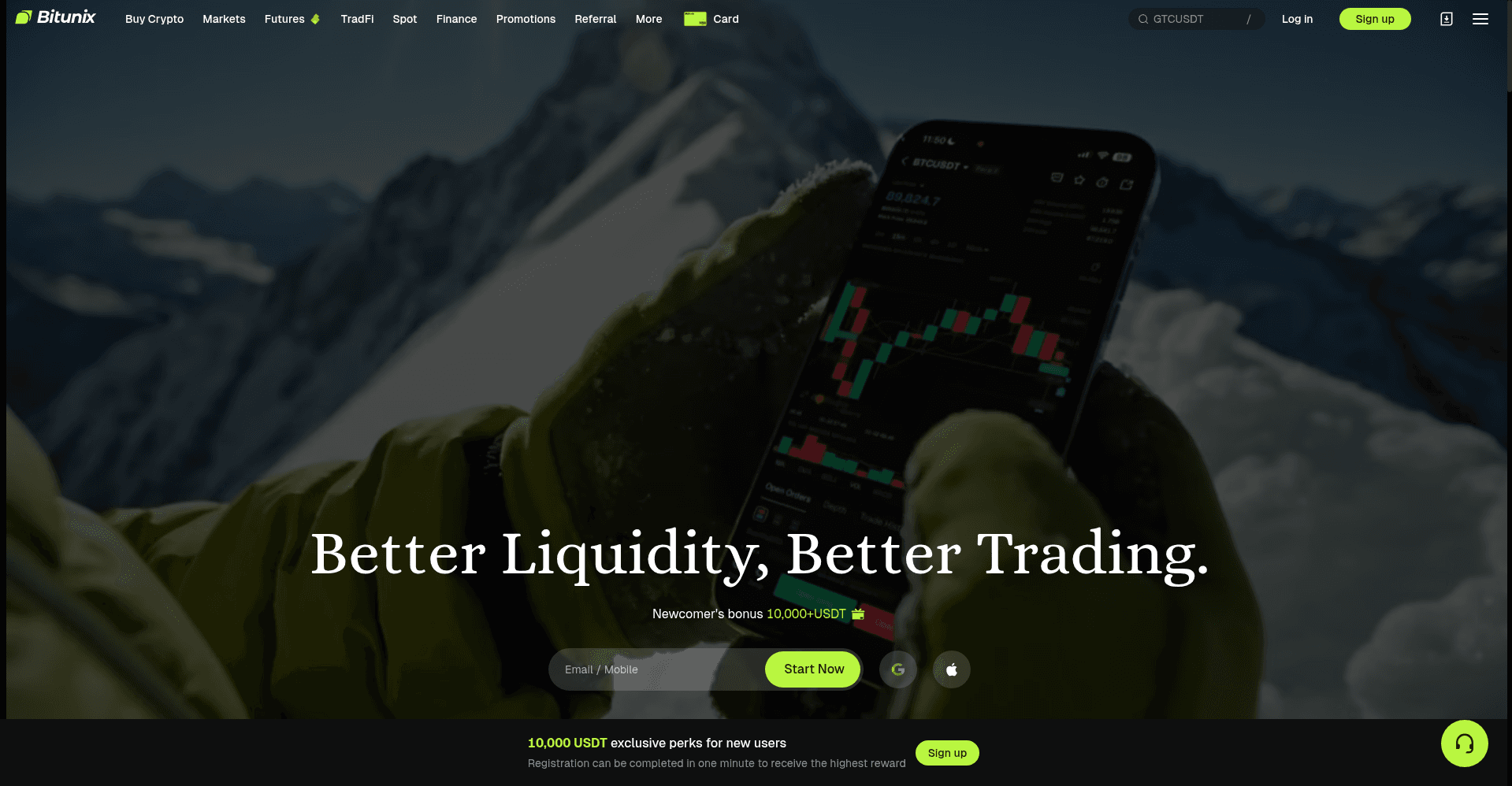
What Bitunix is known for is simple: futures-first and fee-competitive. At 0.02% it offers one of the lowest futures maker fees anywhere, the interface is clean, and the mobile app genuinely feels like a first-class product rather than an afterthought.
Fees, verified from the official schedule
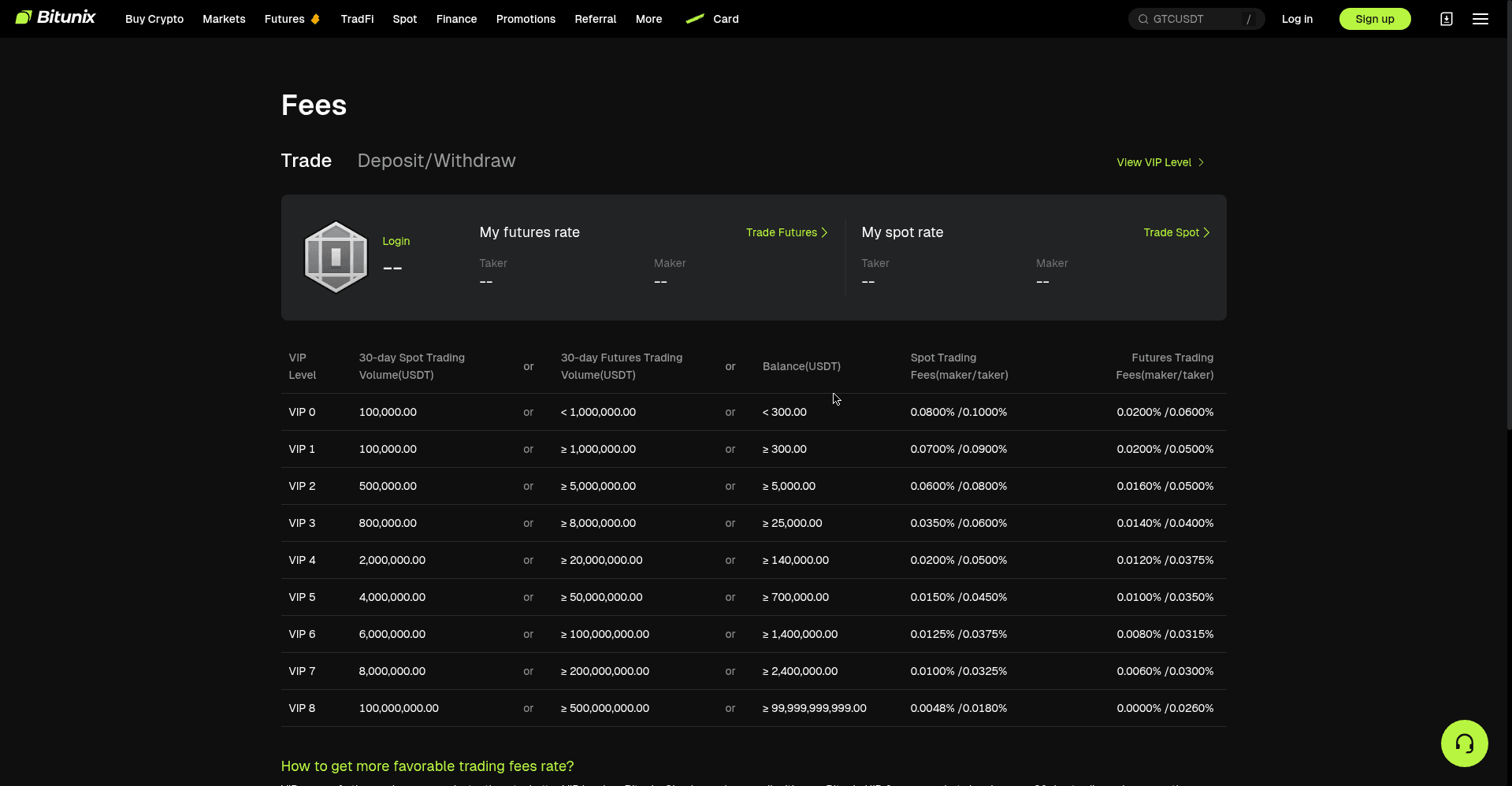
Bitunix's official fee page states base rates of 0.08% maker and 0.10% taker on spot and 0.02% maker and 0.06% taker on futures. VIP tiers, qualified by 30-day volume or balance, bring futures down to 0% maker and 0.026% taker at the top tier. These are genuinely among the lowest headline fees in the derivatives segment.
The July 2026 KYC change
Let me spell this out, because old reviews are still misleading on it. Since 1 July 2026, withdrawals require completing identity verification. You can still register and trade without upfront KYC, and KYC is also mandatory for card purchases and higher limits, but the era of withdrawing freely without verification is over.
Practically, this makes Bitunix a low-friction trading venue rather than a privacy venue. If anonymous withdrawals are your priority, venues like BloFin still allow higher no-KYC withdrawal limits.
The 200x leverage warning
Bitunix offers up to 200x leverage on BTC and ETH perpetual futures. At 200x, a 0.5% price move against your position liquidates it. On Bitcoin, that is a move that happens in minutes on ordinary days.
High leverage is marketed as opportunity; mathematically it is a near-certain path to losing the position. Never trade leverage with money you cannot afford to lose, and understand that most leveraged retail traders lose money. Bitunix has no officially documented demo mode, so practice elsewhere before risking real capital.
How to sign up and verify
Signup itself is quick: you can register and start trading without upfront KYC. The important thing to know is that you will need to verify your identity before you can withdraw, so plan to do that step before you deposit anything serious.
- Register with your email address, set a strong password, and turn on two-factor authentication right away.
- Complete identity verification with a government ID. Since 1 July 2026, withdrawals are blocked until verification is done.
- KYC is also mandatory for card purchases and higher limits, so treat verification as part of signup, not an optional extra.
How to deposit
Bitunix funds like most derivatives exchanges: mainly with crypto from your own wallet or another exchange. Card purchases are available but require KYC first.
- Log in and open the deposit page, then pick the coin you want to send, such as USDT.
- Choose the network carefully. It must match the network you are sending from, or your funds can be lost.
- Copy your Bitunix deposit address and paste it into your wallet or the withdrawal screen of your other exchange.
- Send the funds and wait for network confirmations. Start with a small test amount on your first deposit.
How to buy and trade
Bitunix offers both spot and futures, and it pays to be clear which one you are using. Spot is straightforward buying. Futures is where leverage, and liquidation, live.
- For spot: open the markets page, pick your pair, choose a market or limit order, enter your amount, and confirm.
- For futures: pick your contract and set your leverage to a low, deliberate level before opening the position.
- Choose an order type you understand, enter your position size, and place a stop-loss.
- Bitunix has no officially documented demo mode, so practice on a platform that does before risking real capital here.
How to withdraw
This is the section the 2026 KYC change is about. Verify your identity first, then withdrawing is a normal exchange process. Keep balances small and send funds back to a wallet you control.
- Make sure your identity verification is complete, or the withdrawal will be blocked.
- Go to Withdraw, select the coin, and pick the network you are sending on.
- Paste your external wallet address. Double-check the address and confirm the network matches.
- Enter the amount, review the fee, and confirm with your 2FA code. For large amounts, send a small test withdrawal first.
Proof of reserves and the Care Fund
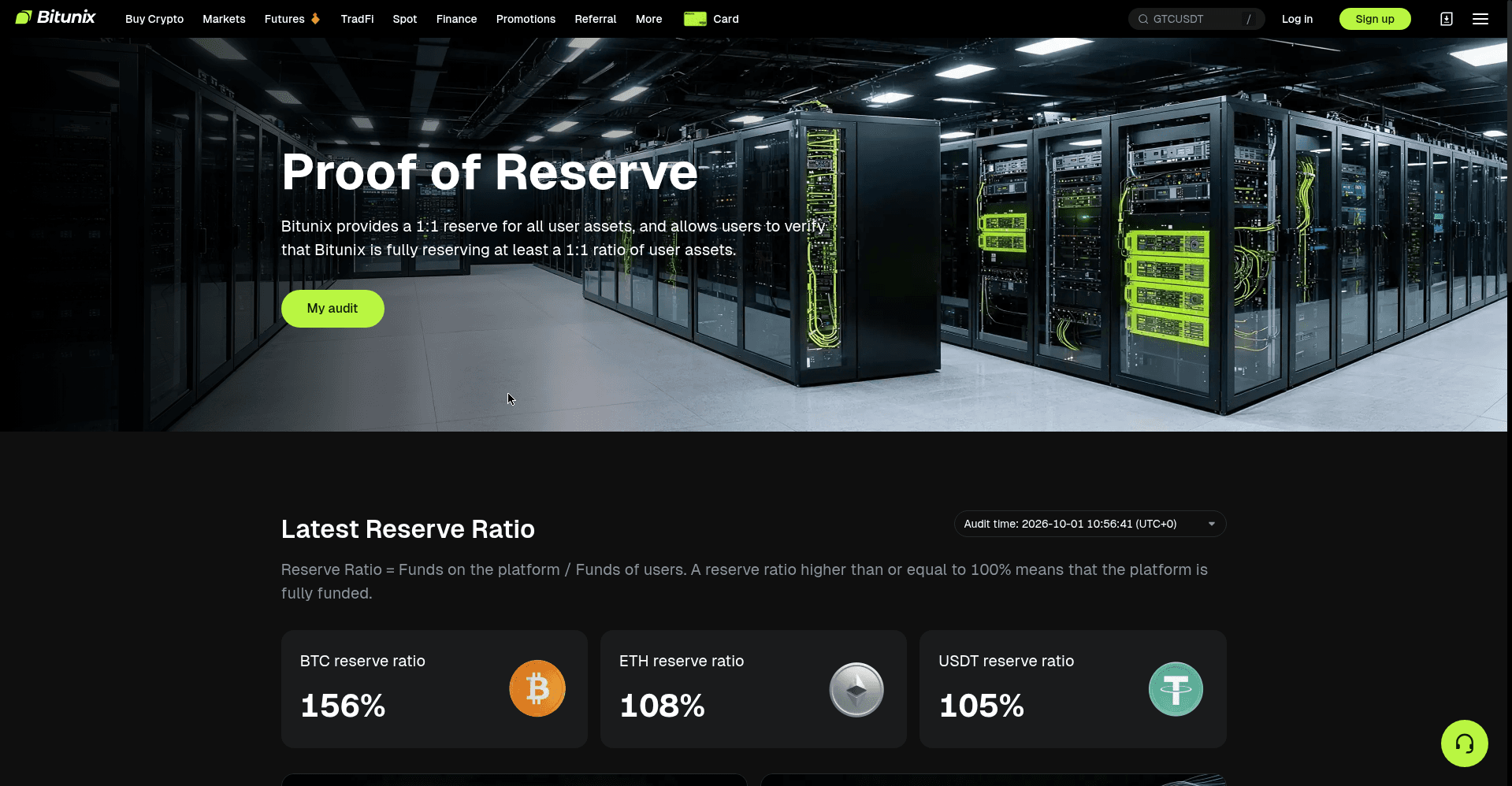
Bitunix publishes proof-of-reserve snapshots with a user audit tool you can check yourself. The 1 October 2026 audit showed reserve ratios of 156% for BTC, 108% for ETH, and 105% for USDT. Custody runs through Cobo's MPC infrastructure, and the exchange reports a $30 million Care Fund. See the live proof-of-reserve page for current figures.
The qualifier, as always with self-published reserves: this is better than nothing, but it is not an independent audit at the standard of the most regulated exchanges.
Copy trading, TradFi, and multi-window charts
Bitunix offers copy trading with trader stats and auto-copy, plus a distinctive multi-window mode that fits up to 16 charts on one screen for active futures traders. The TradFi lineup, 177 stocks, 35 ETFs, 49 forex pairs, 12 indices, and 12 commodities, sits alongside the crypto perpetuals. On copy trading, stay honest with yourself: past performance of copied traders predicts nothing, and most copy traders lose money.
What users say: ratings
Our verdict is our own, but it is worth seeing how other users rate Bitunix on public platforms. These are third-party ratings, checked in October 2026, and they move over time.
| Platform | Rating |
|---|---|
| Trustpilot | 3.0 out of 5 (~650 reviews) |
| Google Play | 4.5 out of 5 (~5.7K) |
| Apple App Store | 4.6 out of 5 |
A modest review base overall, with mobile users rating Bitunix higher than the Trustpilot average.
Pros and cons
Pros
- Among the lowest futures fees: 0.02%/0.06%
- Published PoR, MPC custody, $30M Care Fund
- 1,200+ pairs including TradFi perpetuals
- Copy trading and 16-chart multi-window
- Clean interface and mobile app
- No reported major hack
Cons
- Withdrawals require KYC since July 2026
- No major-jurisdiction licence
- 200x leverage is a liquidation machine
- Thin team and audit documentation
- No officially documented demo mode
- Thinner spot liquidity than top-tier venues
Who it suits, and who should skip it
Bitunix suits experienced futures traders who want low fees, a clean terminal, and multi-chart workflows, and who are comfortable completing KYC for withdrawals. Keep balances small and withdraw regularly.
Skip it if you need anonymous withdrawals, want a licensed exchange, or are new to derivatives. Beginners belong on spot first, on a regulated venue like Kraken.
Alternatives
For no-KYC derivatives with deeper liquidity, Bybit is the larger venue. For a similar no-KYC profile with higher withdrawal allowances, BloFin. For regulated futures with a real licence story, Deribit is the professional choice. Our best crypto exchanges guide compares the leading venues side by side.
Verdict
My honest read: Bitunix is a solid low-fee futures exchange with real proof of reserves and a clean trading experience. The July 2026 KYC-for-withdrawals change ended its no-KYC era for good, and the young, offshore profile keeps it a trading venue rather than a place to store funds. Use it for what it is good at, keep balances small, and never touch 200x unless you fully understand what liquidation feels like.
Bitunix questions
Is Bitunix safe and legit?
Bitunix is a real operating exchange founded in 2021 with MPC custody via Cobo, Merkle Tree proof of reserves, and a reported $30 million Care Fund. It holds a US money-services registration and a Philippines SEC compliance licence, but no major exchange licence. It has no reported major hack. The honest caveat: it is a young offshore exchange with thin public documentation about its team and audits.
Does Bitunix require KYC?
Partially, and this changed in 2026. You can register and trade without upfront KYC, but since 1 July 2026 withdrawals require completing identity verification. KYC is also mandatory for card purchases and higher limits. The no-KYC era of withdrawing freely is over on Bitunix.
What are Bitunix's trading fees?
Verified from Bitunix's official fee page: spot costs 0.08% maker and 0.10% taker, futures cost 0.02% maker and 0.06% taker at the base tier. VIP tiers bring futures down to 0% maker and 0.026% taker at the top.
What is the maximum leverage on Bitunix?
Up to 200x on BTC and ETH perpetual futures. At 200x, a 0.5% move against your position liquidates it. This is an extremely dangerous product for beginners.
What is Bitunix's proof of reserves?
Bitunix publishes proof-of-reserve snapshots on its website. The 1 October 2026 audit showed reserve ratios of 156% for BTC, 108% for ETH, and 105% for USDT, meaning reserves exceeded user holdings for all three.
Does Bitunix have copy trading and a demo account?
Bitunix offers copy trading with trader stats and auto-copy, but there is no officially documented demo mode, despite third-party sites claiming one. Do not trust demo claims you cannot verify on Bitunix's own site.