Exchanges · derivatives
Crypto options trading platforms compared 2026
Updated 15 October 2026 · Originally published May 2025 · Reviewed for CryptosBeginner
Deribit, Bybit, OKX and Binance all offer crypto options, but they serve very different traders. This guide explains what options are, compares verified fees and contract ranges, and warns you honestly about the risks before you touch a contract.
Alex Rivera · Crypto researcher, CryptosBeginner
Every review is research-led: specs, fees, and availability are checked against official sources before publication and re-checked on every update. Affiliate links never influence verdicts. Last reviewed 15 October 2026.
What are crypto options?
An option is a contract that gives you the right, but not the obligation, to buy or sell a cryptocurrency at a set price before or at an expiry date. A call is the right to buy; a put is the right to sell. You pay a premium for that right, and the premium is the most you can lose if you only buy options.
Traders use options to hedge (protect a spot position against a price drop), to speculate with defined risk, or to earn premium by selling options to others. Most crypto options are European-style, which means they can only be exercised at expiry, not at any moment before. Strike prices, expiry dates and volatility expectations all feed into the premium you pay.
Read this first: options are high risk
Options look tidy on paper, but they are one of the riskiest products in crypto. Contracts lose value over time through time decay, so you can be right about direction and still lose money because the move came too slowly. Sellers of options face the opposite danger: unlimited downside if the market runs against them.
Be direct with yourself. Most retail derivatives traders lose money. If you are new to crypto, options should come after you are comfortable with spot trading, after you have read a full explainer on calls and puts, and ideally after paper trading. This page is educational content, not financial advice. Never trade with money you need for rent, food or debt payments, and never use leverage you do not fully understand.
Deribit: the professional options venue
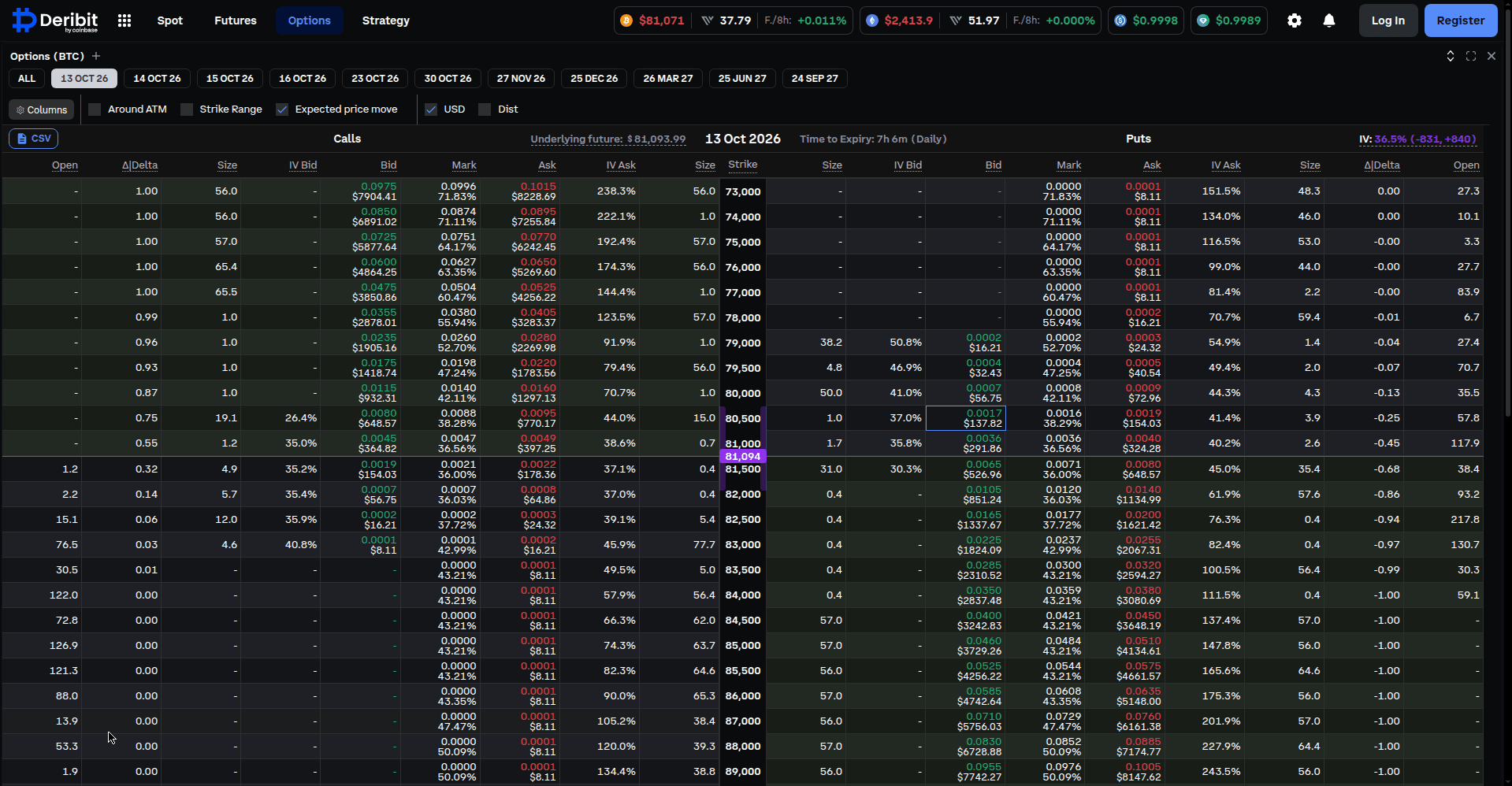
Deribit is where the crypto options market actually lives. While other exchanges bolt options onto a spot business, Deribit built its entire order book around them. It offers European-style options on BTC, ETH and SOL with weekly, monthly and quarterly expirations, alongside perpetual swaps, futures, volatility futures and block trading for large orders.
The fees are public and verifiable. At the standard tier, options cost 0.03% of the underlying value for both makers and takers, capped at 12.5% of the option's price. Expiry adds a 0.015% settlement fee on options, with daily options exempt. Volume-based VIP tiers reduce these rates further, and deposits are free in crypto with withdrawals costing only the network fee.
Two things stand out beyond the fee card. Deribit maintains a public insurance fund that absorbs liquidation shortfalls so losing positions are never socialized onto other traders, and it has a long record of covering liquidations without that happening. Since August 2025 the exchange is owned by Coinbase, which folded it into its global exchange business, and it holds a VARA licence in Dubai. It does not serve US retail directly. Full KYC is required for all accounts.
Bybit: options inside a full derivatives suite
Bybit packages options together with spot, perpetuals and copy trading in one beginner-friendly interface. Its options cover BTC, ETH and SOL, with a wide range of expiries and strike prices, deep order books and tight spreads that active traders appreciate.
On fees, Bybit's published entry-tier schedule shows 0.02% maker and 0.03% taker on options, with VIP tiers cutting rates based on 30-day volume or asset balance. Funding rates, spreads and withdrawal fees sit on top of that, so check the live fee schedule for your product and entity before trading. KYC is mandatory on Bybit, and US residents cannot use the platform.
OKX: options with practice tools for newcomers
OKX is a full-stack exchange offering options on BTC and ETH, alongside spot, margin, perpetual swaps with high leverage, copy trading and a built-in Web3 wallet. Its interface is cleaner than the professional-only venues, which makes it less intimidating for a first options trade.
OKX is also known for its practice features, including a demo mode that lets you test strategies without real money on the line. Confirm current availability of demo trading for options in your region, since product access varies by entity. Options fees change between tiers and promotions, so read the live fee schedule rather than relying on a remembered number.
Binance: the broadest option asset range
Binance, the world's largest exchange by volume, offers the widest options menu of the four: contracts on majors like BTC, ETH and SOL plus altcoins, with expiries from days out to months. Its high liquidity means tighter spreads on popular strikes.
Binance includes a simplified Easy Options mode that walks newcomers through contract selection, which lowers the interface barrier even though the product risk stays exactly the same. Options fees and structures are tiered, so check the live fee page for the current maker and taker rates. Full KYC is required, and Binance is not available to US retail traders or new UK sign-ups.
Options platforms compared
| Platform | Options fees (verified) | Contracts | Best for |
|---|---|---|---|
| Deribit | 0.03% maker/taker of underlying value, capped at 12.5% of option price; 0.015% settlement fee (daily options exempt) | European-style options on BTC, ETH, SOL; weekly, monthly, quarterly expiries | Experienced options traders who want the deepest books |
| Bybit | 0.02% maker / 0.03% taker at entry tier; VIP tiers reduce rates | Options on BTC, ETH, SOL with broad expiry and strike ranges | Active derivatives traders who also want spot and copy trading in one place |
| OKX | Check the live fee schedule; tiered rates that change over time | European-style options on BTC and ETH | Beginners who want a demo mode and a cleaner interface |
| Binance | Check the live fee schedule; tiered rates | Widest asset range: BTC, ETH, SOL and altcoins; short to long expiries | Traders who want deep liquidity across many altcoin options |
Fee schedules move with promotions and tier updates, so treat every number above as a starting point. The platform's own live fee page for your product and region is always the final word.
How a beginner should actually start
If options are on your mind, the honest path is slow. Learn how calls and puts behave before expiry, then practice on a demo account or with paper trades. When you move to real money, size positions so that a total loss is annoying but harmless. Buyers of options should know the premium is the maximum loss; sellers of options should know the loss can be far larger.
Pick a platform for boring reasons: the contracts you actually want, fees you have verified on the live schedule, an insurance fund and transparent reserves, and availability in your country. A flashy interface never compensates for a product you do not understand. Our individual reviews of Deribit, Bybit, OKX and Binance go deeper on each one before you commit funds.
Frequently asked questions
What are crypto options?+
Crypto options are contracts that give you the right, but not the obligation, to buy (a call) or sell (a put) a cryptocurrency at a set price before or at an expiry date. They are used for hedging, speculation and leveraged strategies. Most crypto options are European-style, meaning they can only be exercised at expiry, not at any time before.
Are crypto options risky for beginners?+
Very. Options combine leverage, time decay and volatility pricing, so a position can lose its full value even if the market eventually moves your way. Beginners should learn with free educational resources and demo or paper trading first, start with tiny amounts they can afford to lose completely, and never trade with borrowed money.
Which platform has the deepest crypto options market?+
Deribit. It is the specialist venue where the crypto options market actually lives, with the deepest BTC and ETH options books in the industry and more than $30 billion in BTC options open interest reported in our October 2026 review. It is built for experienced and institutional traders, not beginners.
What are Deribit's options fees?+
At the standard tier, options cost 0.03% of the underlying value for both makers and takers, capped at 12.5% of the option's price. Expiry adds a 0.015% settlement fee for options (daily options are exempt). Volume-based VIP tiers reduce these further. These are Deribit's published rates; always check the live fee schedule before trading.
What are Bybit's options fees?+
Bybit's published entry-tier schedule shows 0.02% maker and 0.03% taker on options, with VIP tiers that reduce rates based on 30-day volume or asset balance. Funding, spreads and withdrawal fees are separate cost layers. Confirm the schedule for your account and region before trading.
Do I need KYC to trade crypto options?+
Yes on every mainstream venue in this guide. Deribit, Bybit, OKX and Binance all require identity verification for options trading. None of these platforms are available to US retail traders directly, so US residents should use regulated domestic alternatives instead.
Should a beginner trade crypto options at all?+
Honestly, most beginners should not. Options are one of the most complex products in crypto, and complexity is usually where beginners pay tuition. If you are curious, study the basics, practice on a demo account, and only risk money you could lose in full without affecting your life. There is no shame in sticking to spot trading.