Warning: Coinflare has shut down.
As of 20 April 2026, Coinflare users can no longer submit withdrawals through the platform, as part of an orderly wind-down of operations. The site now exists only for manual withdrawal requests of remaining assets. Do not deposit funds to Coinflare. If you have assets there, read the claim section below.
Updated 26 September 2026 · Originally published 1 August 2024 · By Alex Rivera · Reviewed for CryptosBeginner
Coinflare Review 2026: Exchange Shut Down (Wind-Down Notice)
Coinflare, formerly BITFLEX, was a small Seychelles derivatives exchange that wound down in April 2026. This page keeps the record straight: what happened, how to claim any remaining funds, and what the exchange was before it closed.
Alex Rivera · Crypto researcher, CryptosBeginner
Every review is research-led: specs, fees, and availability are checked against official sources before publication and re-checked on every update. Affiliate links never influence verdicts. Last reviewed 26 September 2026.
The shutdown: what happened
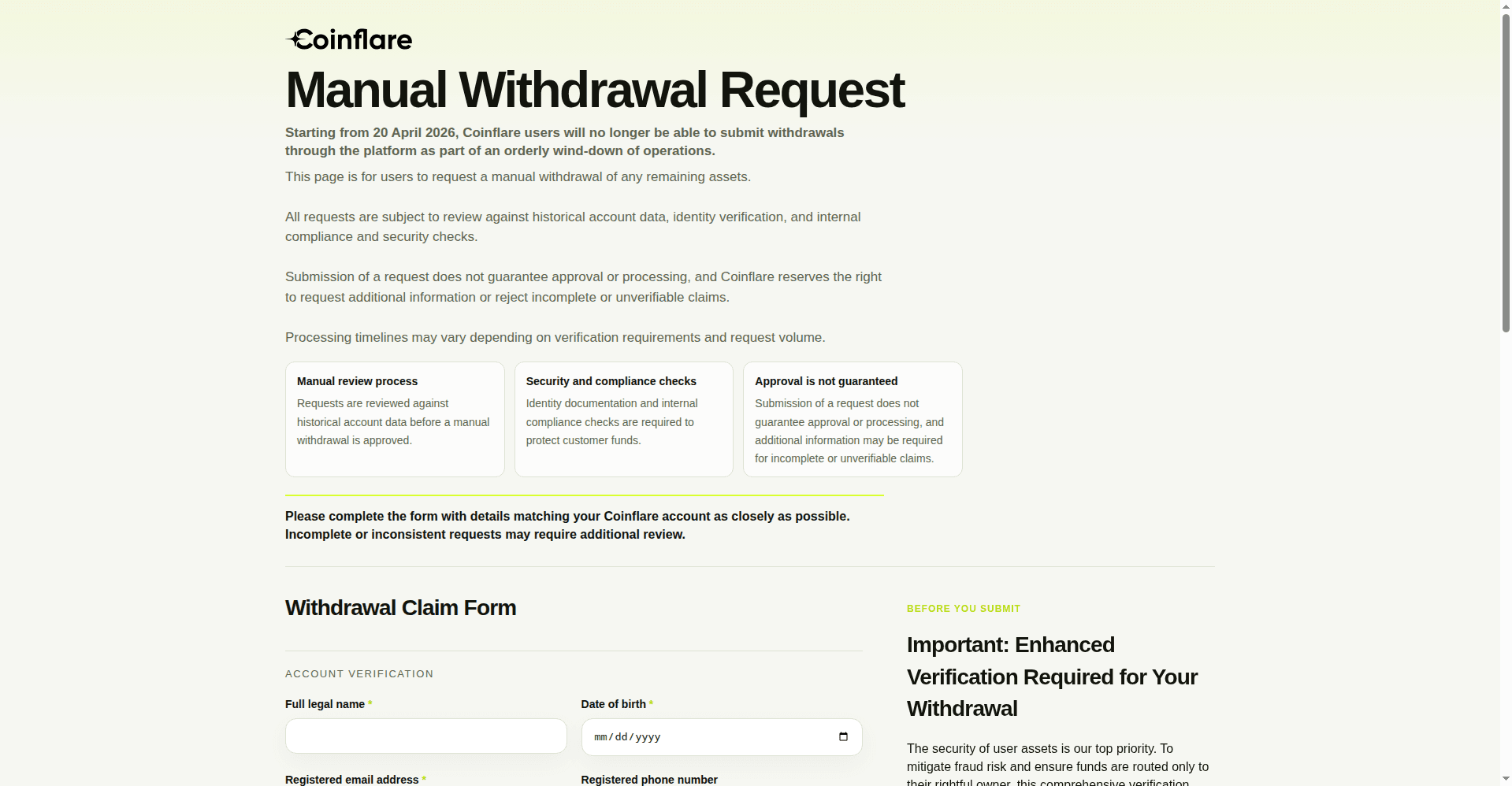
Coinflare's own site states it plainly: starting 20 April 2026, users could no longer submit withdrawals through the platform as part of an orderly wind-down of operations. The entire public site was replaced with a single manual withdrawal request page. No trading, no deposits, no fee schedule, no markets. Just the claim form.
We verified this directly from Coinflare's site code. There was no hack announcement and no regulator action we could confirm, just a quiet wind-down. That quietness is itself a data point: small offshore exchanges can simply stop, and when they do, users are left filing forms and hoping.
How to claim remaining funds
If you held assets on Coinflare, use the manual withdrawal request form on their site. Here is what the process involves, straight from their notice:
- Fill in the claim form with details matching your Coinflare account as closely as possible: full legal name, date of birth, registered email address, and registered phone number.
- Expect identity verification and compliance checks. Requests are reviewed against historical account data.
- Incomplete or inconsistent requests may need additional review, so get the details right the first time.
- Understand the limit: Coinflare says submission does not guarantee approval or processing, and unverifiable claims may be rejected.
Submit as soon as you can, keep copies of everything you send, and be wary of anyone contacting you claiming they can recover your funds for a fee. That is a classic post-shutdown scam.
What Coinflare was
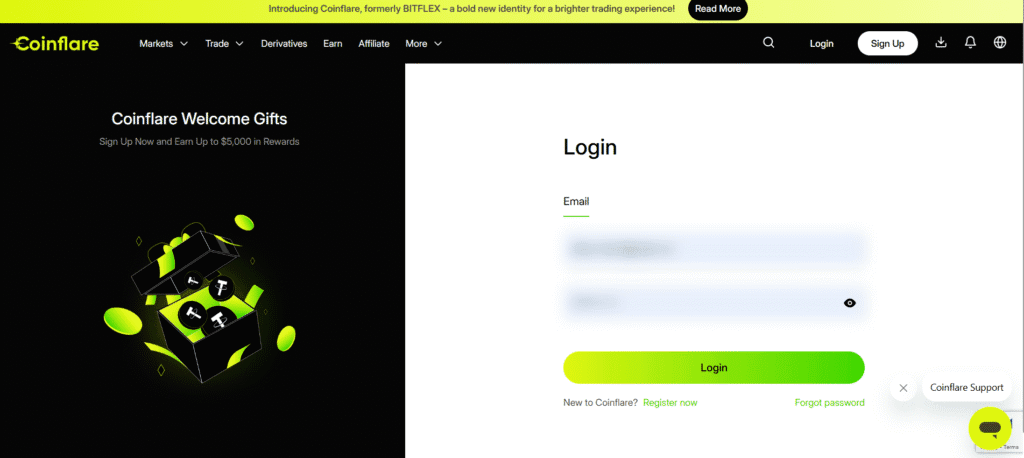
Coinflare launched in 2022 as BITFLEX and rebranded to Coinflare in 2024. Based in Seychelles and led by Ee Wui Yang, it was a small derivatives-focused exchange: a handful of spot coins, around 80 futures contracts, and up to 100x leverage. KYC was optional, with unverified accounts able to withdraw up to 5,000 USDT per day.
Its security story was a mixed bag that, in hindsight, reads like a warning. It partnered with Fireblocks, Jumio, and Coincover, which sounded reassuring. But it never published proof of reserves, held no meaningful licence, and operated with thin public transparency. The partnerships were real; the verifiable backing for customer funds was not.
Fees and features (historical)
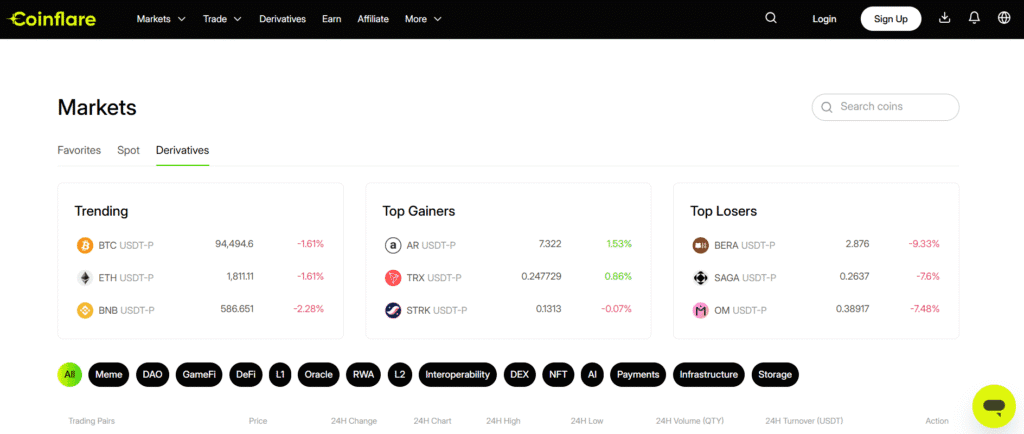
For the record, Coinflare's last published fees were 0.1% maker and taker on spot and 0.02% maker and 0.06% taker on futures, with volume tiers below that. It ran a RewardsHub with tasks and Flex Points, an earn program, and regular trading campaigns. All of this is now historical. Do not let old fee comparisons or bonus articles send you to a dead platform.
Lessons from the shutdown
Coinflare is the reason this site keeps saying the same thing on every review: trade on small offshore exchanges if you must, but never store funds there. No proof of reserves, no major licence, and a quiet wind-down with a form as your only recourse is exactly how this story goes. Prefer venues with published reserves and real regulators, keep balances minimal everywhere else, and withdraw to a wallet you control.
Alternatives
For no-KYC derivatives with a longer track record, BloFin or BYDFi. For low-fee futures with published proof of reserves, Bitunix. For regulated trading, Kraken or Deribit. Our best crypto exchanges guide compares the leading venues side by side.
Coinflare questions
Is Coinflare still operating?
No. As of 20 April 2026, Coinflare disabled withdrawals through its platform as part of an orderly wind-down of operations. The site now serves only a manual withdrawal request page for remaining assets. Do not deposit funds to Coinflare.
How do I withdraw my remaining funds from Coinflare?
Use the manual withdrawal request form on coinflare.com. You will need to provide your full legal name, date of birth, registered email address, and registered phone number, matching your Coinflare account as closely as possible. Requests are reviewed against historical account data and require identity verification. Approval is not guaranteed.
What was Coinflare?
Coinflare, formerly BITFLEX, was a Seychelles-based crypto exchange launched in 2022. It offered spot trading at 0.1% maker and taker and futures at 0.02% maker and 0.06% taker with up to 100x leverage, optional KYC, and security partnerships with Fireblocks, Jumio, and Coincover. It never published proof of reserves.
Will I definitely get my funds back from Coinflare?
There is no guarantee. Coinflare states that submission of a request does not guarantee approval or processing, and incomplete or unverifiable claims may be rejected. Submit your request with accurate, matching details as soon as possible.
What are good alternatives to Coinflare?
For no-KYC derivatives, consider BloFin or BYDFi. For low-fee futures with published reserves, Bitunix. For regulated trading, Kraken or Deribit. See our best crypto exchanges guide for the full comparison.