 Visa
Tria · Visa
Tria Card
Tria is a self-custodial crypto neobank with a Visa card: you hold the keys, not Tria, not a bank, and every transaction needs your Face ID. Three annual memberships set your cashback and perks. Lite costs 20 USD a year with a virtual card and 1.5% cashback on the first 1,000 USD of monthly spend. Pro costs 109 USD a year with a plastic card and 4.5% on the first 1,000 USD. Max costs 250 USD a year with a metal Visa Signature card and 6% on the first 2,000 USD. Card top-ups work from nine networks with gasless deposits on most chains. Our full review was tested on the live app with real fee tables captured in-app.
Published 25 August 2026 · facts checked 2026-11-24. Image: Official Tria product image, cached locally. Terms can change.
Affiliate disclosure: The highlighted check-card button may be a referral link. It does not change the editorial facts, guarantee approval, or make this a personal recommendation.
Product model
Debit · Self-custody
Availability
Tria advertises card spending in 150+ countries; confirm current country eligibility in the application flow.
Card formats
Virtual · Plastic · Metal Visa Signature
Verification
Provider onboarding and country eligibility apply; check the current application flow for the exact verification requirements.
Real usage · October 2026
$15.8M spent with this card
#9 of 28 tracked programs · 1.2% share of the month's total · -5.7% vs previous month · 11,580 paying users · $147 average payment
Tracked onchain by PaymentScan and republished by Castle Labs. Settled payments, not top-ups. Data updated 12 November 2026.
What it is
The product in plain English
A self-custodial Visa card with Lite, Pro, and Max memberships and up to 6% cashback.
Best fit, not a ranking: Self-custody believers who want a Visa card with tiered cashback and can spend enough to justify a membership.
Money movement
How the card is funded
Top up the card from nine networks: Bitcoin, Ethereum, Polygon, Base, Arbitrum, Optimism, BSC, Aptos, and Solana. Minimums are 50 USD for BTC and 10 USD for other tokens. Gasless deposits on most chains, except Solana which needs native SOL for gas. Direct SOL deposits are not supported; convert SOL first. Avalanche is not supported for card top-ups. Tria charges no top-up fee itself, but a provider fee applies to swaps and routing and varies with the network, liquidity, and route. TRON top-ups need native TRX for gas.
Rewards: Boosted cashback applies to the first slice of monthly spend, then drops: Lite 1.5% on first 1,000 USD/month then 0.5% unlimited; Pro 4.5% on first 1,000 USD/month then 1% unlimited; Max 6% on first 2,000 USD/month then 1% unlimited. The app showed a 10 USD joining bonus during our review, marked as time-limited. Game purchases are excluded from cashback under Tria's terms (via @xKseilas).
Cost reality
Read beyond the headline
Physical card and delivery are free on the Pro and Max tiers (via @0xVishnya, November 2026). Annual memberships: Lite 20 USD, Pro 109 USD, Max 250 USD. ATM withdrawals cost 1 USD plus 1% of the amount, with a 750 USD maximum per transaction and 3 withdrawals per 24 hours. A declined ATM transaction costs up to 2 USD (via @xKseilas). Card top-up minimums are 50 USD for Bitcoin and 10 USD for other supported tokens.
Caution: Self-custody does not eliminate wallet, smart-contract, conversion, tax, or card-issuer risk. Cashback caps mean headline rates apply only to the first 1,000 to 2,000 USD of monthly spend. Google Play rates the app 1.9 stars from about 3,895 reviews, with users citing support and transparency issues.
Cashback tiers
What each tier actually pays
| Tier | Rate | Spend band | Paid in |
|---|---|---|---|
| Lite | 1.5% | first $1,000/mo | USD |
| Lite | 0.5% | above $1,000/mo | USD |
| Pro | 4.5% | first $1,000/mo | USD |
| Pro | 1% | above $1,000/mo | USD |
| Max | 6% | first $2,000/mo | USD |
| Max | 1% | above $2,000/mo | USD |
Tier structures change; confirm current bands on the provider page before applying.
Worked examples
What the fees look like on a real transaction
Line-by-line walkthroughs built from each card's published fee schedule. ATM operator surcharges and exchange-rate spreads can add costs on top.
ATM withdrawal: $200
You withdraw $200 at an ATM. Tria charges $1.00 plus 1% of the amount per withdrawal.
- Withdrawal amount
- $200.00
- Flat ATM fee
- -$1.00
- 1% of $200
- -$2.00
You receive $200 in cash; the total cost to your balance is $203.00.
Based on Tria in-app fee display: $1.00 + 1% per ATM withdrawal, max $750 per transaction.
ATM withdrawal: $750 (max per transaction)
You take the maximum $750 in one transaction. The 1% scales with the amount.
- Withdrawal amount
- $750.00
- Flat ATM fee
- -$1.00
- 1% of $750
- -$7.50
You receive $750 in cash; the total cost to your balance is $758.50.
Based on Tria in-app fee display: $1.00 + 1% per ATM withdrawal, max $750 per transaction.
Getting started
How people apply
Open our link, download the Tria app for iPhone or Android, create your self-custodial account, pick a membership tier (Lite, Pro, or Max), complete verification, then fund your card from the Cards section.
What changed recently
Update trail
Currency Accounts launched on 18 November 2026 (Tria Help Center): eligible users get personal EUR account details in the app, and euros sent by SEPA or SWIFT are converted to USDC and delivered to the self-custodial Tria Wallet, usually within minutes by SEPA. The infrastructure is provided by Noah; Tria charges no fee until 31 December 2026, and the Noah partner fee is 1.00 EUR plus 0.25% per SEPA deposit. Incoming transfers only; there are no EUR withdrawals. The rollout is gradual, reaching eligible users over about four weeks. Buy/Sell is also live and rolling out gradually, covering crypto, tokenized stocks through xStocks and pre-IPO exposure through PreStocks tokens, which give price exposure only, with no shares, dividends or voting rights.
Last editorial check: 2026-11-24. CryptosBeginner does not automatically guarantee that provider pages remain unchanged after this date.
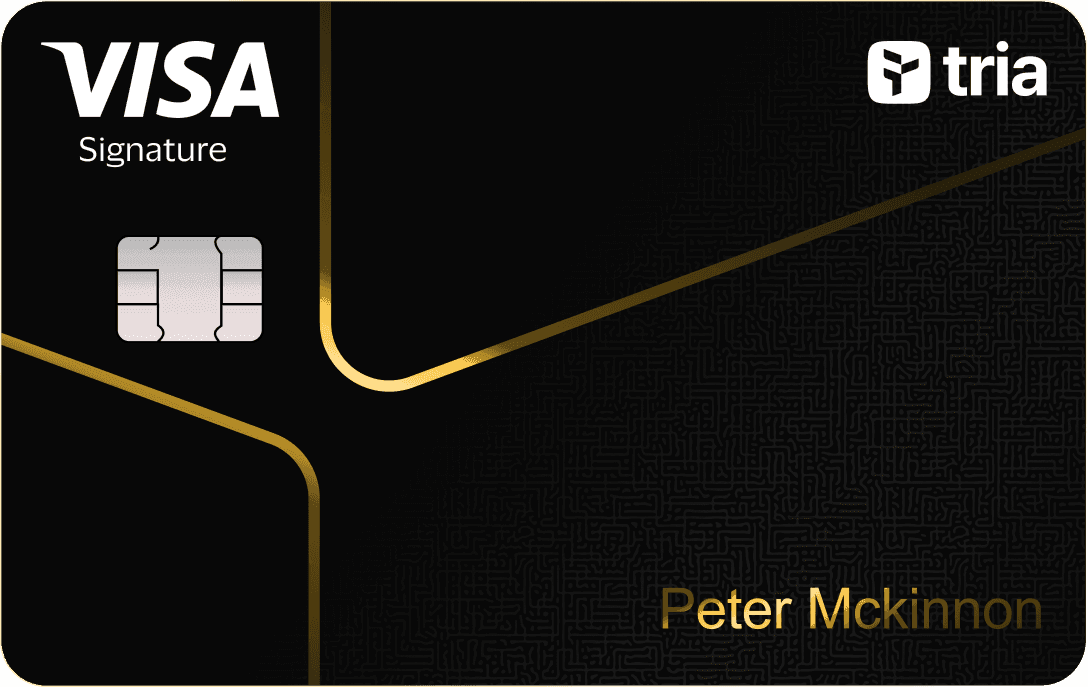
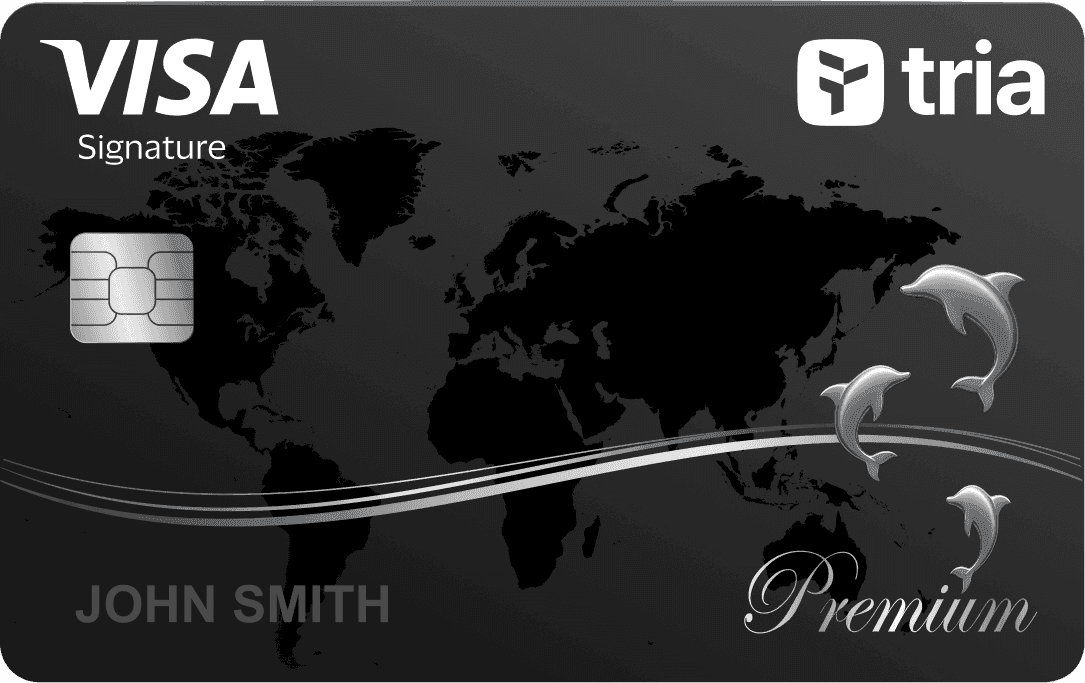
Official product visuals
More views from the provider
Potential upsides
What stands out
Genuinely self-custodial: you hold the keys, Face ID on every transaction
Up to 6% cashback on Max, 4.5% on Pro
Nine supported top-up networks with gasless deposits on most chains
Apple Pay and Google Pay on all tiers
Price protection up to 2,000 USD and purchase protection up to 10,000 USD
In-app futures trading via Hyperliquid and Decibel
Potential trade-offs
What to verify
Cashback caps: boosted rates only on first 1,000 to 2,000 USD of monthly spend
Google Play rating is 1.9 stars from about 3,895 reviews
Users cite poor support and transparency
Solana needs native SOL for gas; direct SOL deposits not supported
Avalanche not supported for card top-ups
ATM withdrawals cost 1 USD plus 1%, capped at 750 USD per transaction
Before you apply
Five checks that prevent bad comparisons
01
Country
Confirm the product is actually available at your address.
02
Funding
Know whether you spend cash, converted crypto, or borrowed value.
03
Fees
Look for spreads, FX, ATM, top-up, and subscription charges.
04
Issuer
The brand on the card may not be the legal issuer.
05
Tax
Spending crypto can create tax consequences in some jurisdictions.
FAQs
Questions readers ask before applying
What does Tria Card cost?+
Physical card and delivery are free on the Pro and Max tiers (via @0xVishnya, November 2026). Annual memberships: Lite 20 USD, Pro 109 USD, Max 250 USD. ATM withdrawals cost 1 USD plus 1% of the amount, with a 750 USD maximum per transaction and 3 withdrawals per 24 hours. A declined ATM transaction costs up to 2 USD (via @xKseilas). Card top-up minimums are 50 USD for Bitcoin and 10 USD for other supported tokens. Provider fees and regional terms can change, so use the linked fee details before applying.
How is Tria Card funded?+
Top up the card from nine networks: Bitcoin, Ethereum, Polygon, Base, Arbitrum, Optimism, BSC, Aptos, and Solana. Minimums are 50 USD for BTC and 10 USD for other tokens. Gasless deposits on most chains, except Solana which needs native SOL for gas. Direct SOL deposits are not supported; convert SOL first. Avalanche is not supported for card top-ups. Tria charges no top-up fee itself, but a provider fee applies to swaps and routing and varies with the network, liquidity, and route. TRON top-ups need native TRX for gas.
Where is Tria Card available?+
Tria advertises card spending in 150+ countries; confirm current country eligibility in the application flow.
Why is Tria Card featured in this directory?+
Tria Card is featured because its published product model and current provider information give readers a useful starting point for assessing its stated audience, fees, funding route, and eligibility. This page also includes a clearly disclosed referral link; using it is optional and does not guarantee approval, pricing, rewards, security, availability, or suitability.
Head to head