The short version
What happened
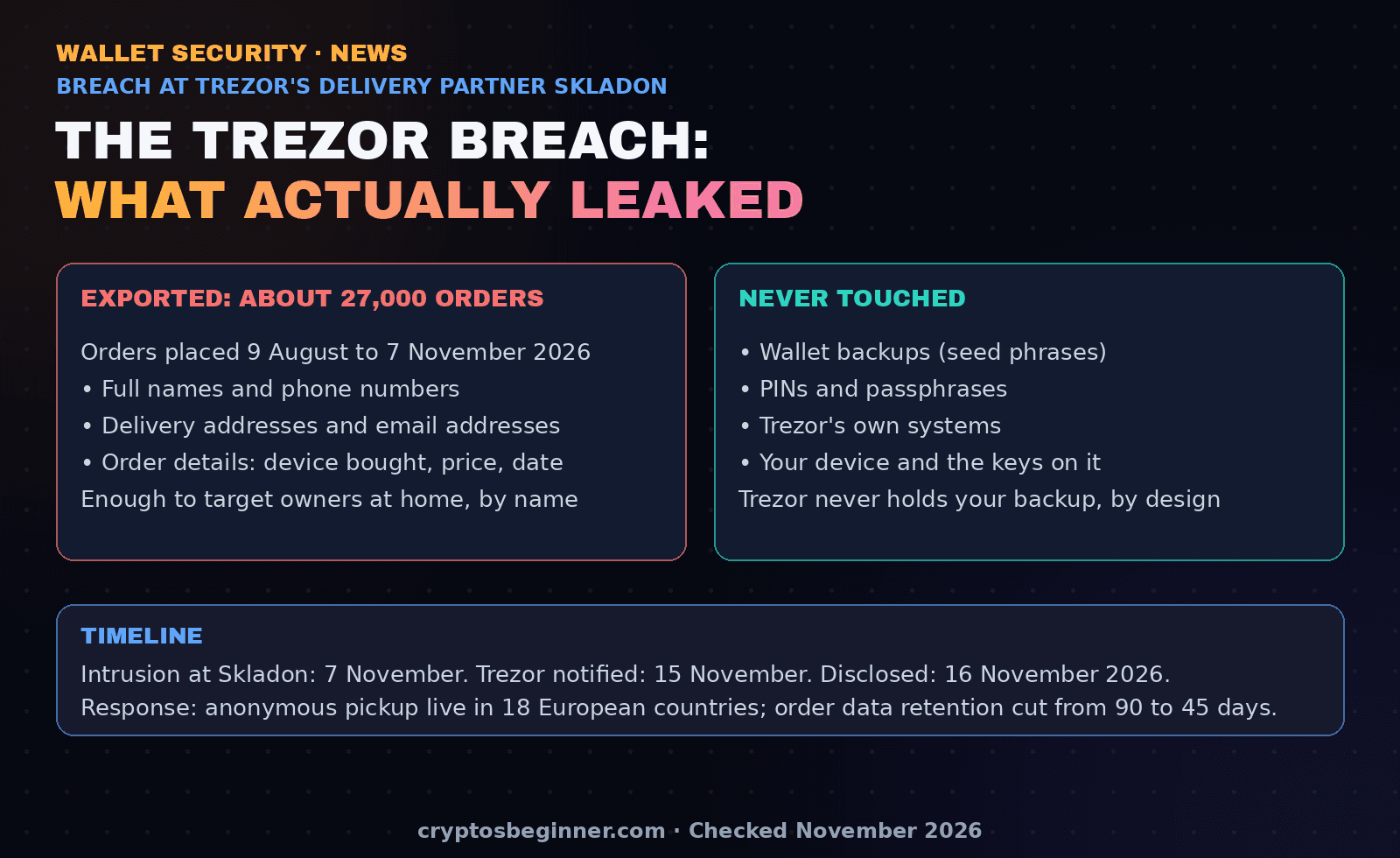
Skladon is a fulfilment and delivery partner: to ship a hardware wallet, it holds the order record, who bought it, where it is going, and how to reach them. Trezor says Skladon notified it on 15 November that an attacker had gained unauthorized access to that order data, with the intrusion itself dated to 7 November. Trezor believes the attacker exported the data for about 27,000 orders placed between 9 August and 7 November 2026, and says it is still investigating with Skladon. Trezor emailed the affected customers it can reach and, per reporting on the disclosure, notified the data protection authority.
One group cannot be reached at all: customers who ordered between 9 and 14 August and whose details Trezor had already anonymized in its own systems. There is a bleak irony in that. The anonymization worked exactly as intended, and it also means those buyers cannot be warned, even though the partner's copy of their data was exposed.
What leaked, and what did not
The exported records cover the order, not the wallet: full names, phone numbers, delivery addresses, email addresses, and order details such as the product bought and its price. Nothing in the dataset can move funds. Wallet backups, PINs and passphrases were not part of it, and Trezor's own systems and devices were not compromised. That is not luck; it is the hardware wallet model working as designed. Your backup is generated on the device in your hand, and no copy exists on a company server to steal.
What the data does enable is targeting. A name, a home address, a phone number and proof that the person at that address bought a hardware wallet is precisely the raw material for convincing phishing, for scam calls that open with accurate details, and in the worst case for physical extortion. Trezor's own disclosure tells customers to be alert to risks to their physical security, and that is the sentence to take seriously.
The real risk is contact, not coins
Trezor says some customers have already reported scam calls. Expect the standard script, upgraded with real data: a caller who knows your name, your address and the exact device you bought, claiming there is a problem with your order or a security issue with your wallet, and walking you toward revealing your backup or moving funds to a "safe" address. Every part of that call is the attack. The defenses are boring and complete:
- Trezor will never cold-call you. Any unsolicited call, text, email or letter about your order should be treated as suspicious by default, however accurate its details sound. Accuracy is what the breach provides.
- Your backup is yours alone. No company, support agent or "security team" will ever legitimately ask for your wallet backup, PIN or passphrase. Anyone who does is the thief.
- Go direct, never via the message. If something about your order genuinely needs attention, open Trezor's official site or app yourself rather than following a link or number you were sent.
- Think about the address on the order. If your home address is in this dataset, you cannot un-leak it. What you can do is raise the bar: be discreet about holding crypto, and consider a pickup point or work address for future orders.
The second shipping partner breach since August
This is not Trezor's first partner problem, and the pattern is the story. In August 2026, a breach at ShipMonk, another Trezor shipping partner, exposed personal information for about 13,700 customers across seven countries. Two different partners, the same dataset, the same lesson: the strongest part of the hardware wallet model is the device, and the weakest part is everything around it. The order database is, in effect, a registry of crypto owners with home addresses, maintained by logistics companies whose security standards the buyer never sees.
Trezor's response addresses that layer directly. Anonymous pickup is now live in 18 European countries, letting customers collect a device without giving a real name, home address or phone number, with a US rollout reported as planned. The company is also shortening how long it keeps order data, from 90 days to 45, and says it will require its shipping partners to follow the same retention policy. Shorter retention is the unglamorous fix that actually shrinks the next breach: data that no longer exists cannot be exported.
What this means when you buy a hardware wallet
Every hardware wallet purchase creates a record somewhere: with the maker, with a retailer, or with a delivery partner. This breach is a reminder that the record, not the device, is the attack surface. The habits that help are the same ones behind our guide to anonymizing Bitcoin: assume records persist, minimize the ones you create, and keep the records you do control in order, the same discipline Germany's new crypto seizure law rewards from the other direction. Order with a dedicated email, use pickup or an alternate delivery address where the option exists, and do not announce purchases publicly. None of that makes the next partner breach impossible. All of it makes you a smaller line in the spreadsheet when it happens.
Frequently asked questions
Was my seed phrase or wallet backup leaked in the Trezor breach?
No. The breach hit Skladon, a delivery partner, and the data it held was order data: names, phone numbers, delivery and email addresses, and order details. Trezor says no wallet backups, PINs or passphrases were involved, and that is consistent with how hardware wallets work: your backup is created on your device and Trezor never receives or stores it.
Am I affected by the Skladon breach?
You are in the affected set if you ordered a Trezor between 9 August and 7 November 2026 and Skladon handled the delivery. Trezor emailed the customers it can reach. Skladon does not ship to the United States, so US customers are not affected by this incident. A small number of customers who ordered between 9 and 14 August cannot be emailed because Trezor had already anonymized their details.
Is my Trezor device still safe to use?
Yes, on everything Trezor has disclosed. Trezor says its own systems were not compromised and the device is secure. The breach exposed who bought devices and where they live, not anything that can unlock a device. The risk to manage is contact and targeting, not the hardware.
What should I do if I get a call or message about my Trezor order?
Treat it as hostile. Trezor says it will never cold-call you or ask for your wallet backup, and it has warned that some customers have already reported scam calls. Do not share your backup, PIN or passphrase with anyone, do not follow links in unexpected messages about your order, and check anything important through Trezor's official site or app, typed in yourself.
Why did a delivery company have my name and address at all?
Because someone has to ship the box. Fulfilment partners hold the order data needed to deliver: who you are, where it goes, and what you bought. That data normally sits with the partner until it is deleted. Trezor says it is shortening how long order data is kept, from 90 days to 45, and requiring its shipping partners to follow the same policy.
Sources
This article is based on Trezor's own disclosure of 16 November 2026 and on reporting that works from it, including Decrypt, The Block and crypto.news. The support article linked from Trezor's post was returning a 404 when this article was published; if Trezor publishes more detail there, we will update this page. Nothing here is financial advice.