The short version
What happened on 12 November
The law's full title translates as the law for more fairness through strengthening the customs administration and combating financial crime; everyone calls it the Zollfinanzgerechtigkeitsgesetz, or Customs Financial Justice Act. The federal cabinet adopted the draft on 12 August 2026, the government submitted it to parliament on 30 September as Drucksache 21/8282, a 390 page bill, and the Finance Committee issued an amended version, Drucksache 21/9136, on 11 November. The Bundestag adopted that version the next day, with the CDU/CSU, SPD and AfD voting in favour, Die Linke against, and the Greens abstaining. The government presents the bill as part of its February 2026 action plan against organised crime and as implementing recommendations of the FATF and the Egmont Group, and it budgets roughly €308 million a year in expected revenue from 2028.
Crypto is not the bill's target so much as its most visible passenger. The reform covers customs administration broadly, and the asset procedure inside it applies to property generally: cash, cars, real estate, and crypto assets as defined in Article 3(1)(5) of the EU's Markets in Crypto-Assets Regulation, plus comparable digital representations of value. No coin, exchange or company is named.
How the procedure works
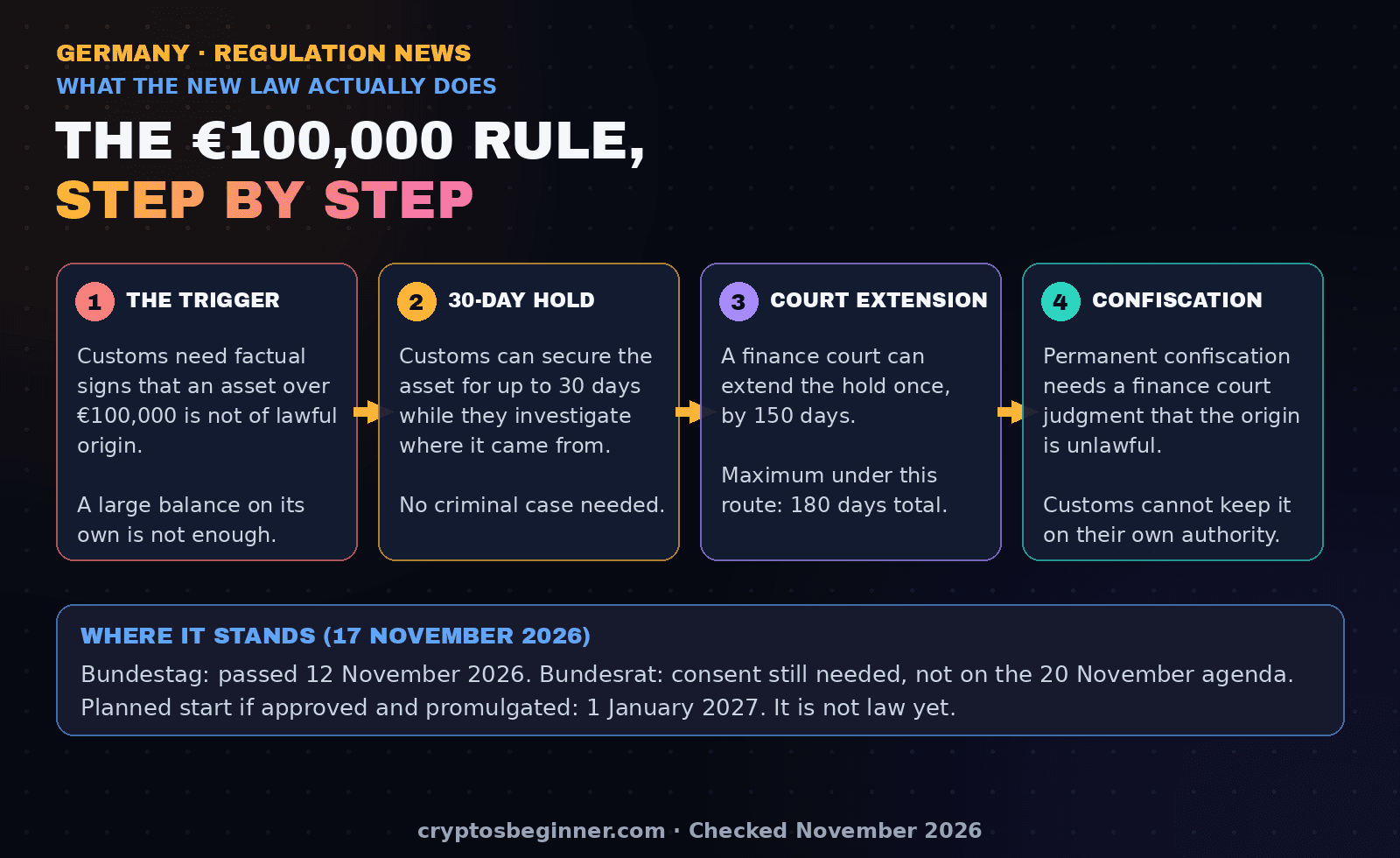
The mechanism is a new block of sections in the Finanzverwaltungsgesetz headed "administrative asset investigation and securing." Section 53 sets the trigger: customs may use the special measures when factual indications suggest that a significant asset is not of lawful origin, in the bill's phrasing, when a lawful acquisition does not appear plausible. Section 54 governs how the authorities assess whether reasonable doubts about the origin exist. An asset counts as significant above €100,000, or above €50,000 if it belongs in a public register, as land, vehicles, ships and aircraft do. Crypto sits in no such register, so €100,000 is the operative figure, about 1.7 BTC at mid-November 2026 prices.
Section 56 sets the clock. Customs may seize and take custody of a qualifying asset for up to 30 days to clarify its origin. A finance court can then extend the hold once, by up to 150 days, at customs' request, which makes 180 days the maximum under this route. Confiscation is a separate, higher step: it requires a finance court to be convinced the origin is unlawful. One detailed reading of the adopted text notes a two year window for the holder to demonstrate a lawful origin before confiscation and public auction follow. Throughout, the procedure is administrative. It runs alongside, not instead of, ordinary criminal asset recovery, which continues to exist under its own rules.
What the law does not do
- It does not ban or restrict holding crypto. Nothing in the act limits buying, selling or self-custody. It is an investigation and securing procedure for assets whose origin is in doubt.
- It does not trigger on size alone. The €100,000 threshold defines which assets are significant enough to examine. The examination itself requires factual indications of unlawful origin.
- It does not let customs confiscate on their own authority. Customs can hold for 30 days. Extensions and confiscation both run through a finance court.
- It is not in force. As of 17 November 2026 the Bundesrat has not consented and the law has not been promulgated, so none of these powers can be used yet.
- It does not change tax law. Germany's existing rules, including the one year holding period after which private crypto gains are tax free, are untouched. What changes is how much an undocumented holder may one day have to explain.
Where it stands: the Bundesrat step
The government drafted the act as a consent law, meaning the Bundesrat, the chamber representing Germany's 16 states, must approve it before it can be signed and published in the Bundesgesetzblatt. The Bundesrat already considered the government draft in a first review in September 2026, which is normal procedure, but its formal consent is still outstanding. Its next plenary session is on 20 November, and the agenda for that session, last updated on 13 November, does not list the customs law, though agendas can be supplemented. No date for the consent vote had been announced when this article was published. If consent and promulgation follow the government's timetable, Article 26 of the act sets entry into force for 1 January 2027, with several provisions staged to start later.
The bill also has organised opposition. The German Federal Bar Association (BRAK) has spoken against it, arguing that it hands customs too much discretion to question how assets were acquired, and that there is a real risk of missing or incomplete records being treated as evidence of illegal origin. That criticism goes to the design's pressure point: the procedure is built for assets whose paperwork does not speak for itself, and in crypto, old paperwork is exactly what many honest holders do not have.
What it means if you hold crypto in Germany
Nothing changes today, and nothing in the bill asks holders to do anything yet. But the direction is unmistakable, and it rewards one habit above all others: being able to show where your coins came from. The exposure is not really about the €100,000 figure. It is about the profile this procedure is designed for, large holdings whose origin cannot be documented. In Germany that profile includes plenty of ordinary people: early buyers whose exchange has since shut down, holders who bought over the counter or in person, people who received crypto as gifts or payment years ago, and long-term holders who, precisely because the one year rule made their gains tax free, never filed or kept anything.
The records that close that gap are mundane, and most of them still exist if you gather them now:
- Exchange records: account statements, trade history exports and deposit and withdrawal logs from every exchange you have used, including closed accounts where the data is still retrievable.
- Fiat trail: bank statements showing the transfers that funded purchases, which connect the crypto to taxed, lawful income.
- Tax filings: any returns or assessments that mention crypto, even where the one year rule meant no tax was due.
- Origin documents for non-exchange coins: gift or inheritance paperwork, invoices for work paid in crypto, mining records, and dated wallet transaction histories that match them.
- A simple timeline: one page, written by you, that says when you bought, where, and how you paid. In an origin assessment, a coherent story backed by documents is the whole game.
One connection worth making explicit: privacy tools and records pull in opposite directions, and this law is a reminder that both matter. Our guide to anonymizing Bitcoin makes the same point from the other side: breaking the public trail decides who can follow your money, but your own records are what you would actually produce if the state ever asks. Keep the second even when you use the first.
Frequently asked questions
Is Germany's crypto seizure law in force now?
No. The Bundestag passed the Customs Financial Justice Act on 12 November 2026, but the bill was drafted as a law requiring the consent of the Bundesrat, the chamber of Germany's 16 states. That consent had not been given as of 17 November 2026, and the law also needs formal promulgation before it can apply. The planned start date is 1 January 2027, with some provisions staged later.
Can customs take my crypto just because it is worth more than €100,000?
No. The €100,000 figure only defines a significant asset. Section 53 of the amended law requires factual indications that the asset is not of lawful origin, meaning a lawful acquisition does not appear plausible. A large balance on its own does not meet that test, and permanent confiscation requires a finance court to be convinced the origin is unlawful.
How long can customs hold an asset under this law?
Up to 30 days on customs' own authority, while they investigate the origin. A finance court can extend the hold once by up to 150 days, so the maximum under this administrative route is 180 days. Keeping the asset permanently is a separate step that requires a court judgment.
Does the law only apply to cryptocurrency?
No. It is a general unexplained wealth procedure covering cash, vehicles, real estate and other property. Crypto is included expressly through the EU's MiCA definition of a crypto asset, which is why the €100,000 threshold rather than the €50,000 threshold for registered assets like land and cars applies to it.
What records prove the origin of crypto holdings?
The law does not publish a checklist, and assessments are case by case, but the practical evidence is the paper trail of lawful acquisition: exchange account statements and trade history exports, bank statements showing the fiat used to buy, tax filings where they exist, and records of gifts, inheritance or mining income. The gap this law targets is holdings that are large and old enough that the owner never kept, or can no longer get, those records.
Sources
This article is based on the Bundestag's own documents, the government bill (Drucksache 21/8282) and the Finance Committee's amended version adopted on 12 November 2026 (Drucksache 21/9136), and on reporting that works from the same text, including Bitcoin Magazine, Coindaro's section-by-section explainer and BlockchainReporter. The Bundesrat consent was still outstanding when this article was published on 17 November 2026; we will update it when the vote is scheduled. Nothing here is legal or tax advice.