Learn · privacy
Can you anonymize Bitcoin? Four methods, honestly rated
Updated 16 November 2026 · Reviewed for CryptosBeginner
Alex Rivera · Crypto researcher, CryptosBeginner
Every review is research-led: specs, fees, and availability are checked against official sources before publication and re-checked on every update. Affiliate links never influence verdicts. Last reviewed 16 November 2026.
A short post by Bitcoin security educator Schnuartz listed four ways to anonymize Bitcoin: CoinJoin, swapping to Lightning and back, swapping to Monero and back, and swapping to Liquid and back. The list is real. What it leaves out is everything that decides whether the trick works: what each method actually hides, what it costs, and what the 2024 to 2026 crackdowns did to the tools. This guide fills that in, with the status of every method checked in November 2026.
The short version
- All four methods work, none makes you anonymous. Each one breaks the public trail between the Bitcoin you have and the Bitcoin you end up with. None of them erases the record of you buying it, which for most people is the link that matters.
- Strongest: the Monero round trip. Monero hides sender, receiver and amount by protocol, so the middle leg leaves nothing public to follow. The weak points are the two swaps at the edges.
- CoinJoin still works, but 2023 guides are dangerous. Samourai is gone and its founders are in prison, Wasabi's coordinator is shut, and the original JoinMarket code is archived with a do-not-use warning. The surviving tools are named below.
- Lightning is fast and cheap, but the swap service sees both sides, and its biggest service, Boltz, suspended swaps in August 2026.
- Liquid is the weakest of the four for this job. It hides amounts, not the transaction graph, and you wait about 17 hours to get in.
First, what you are hiding from
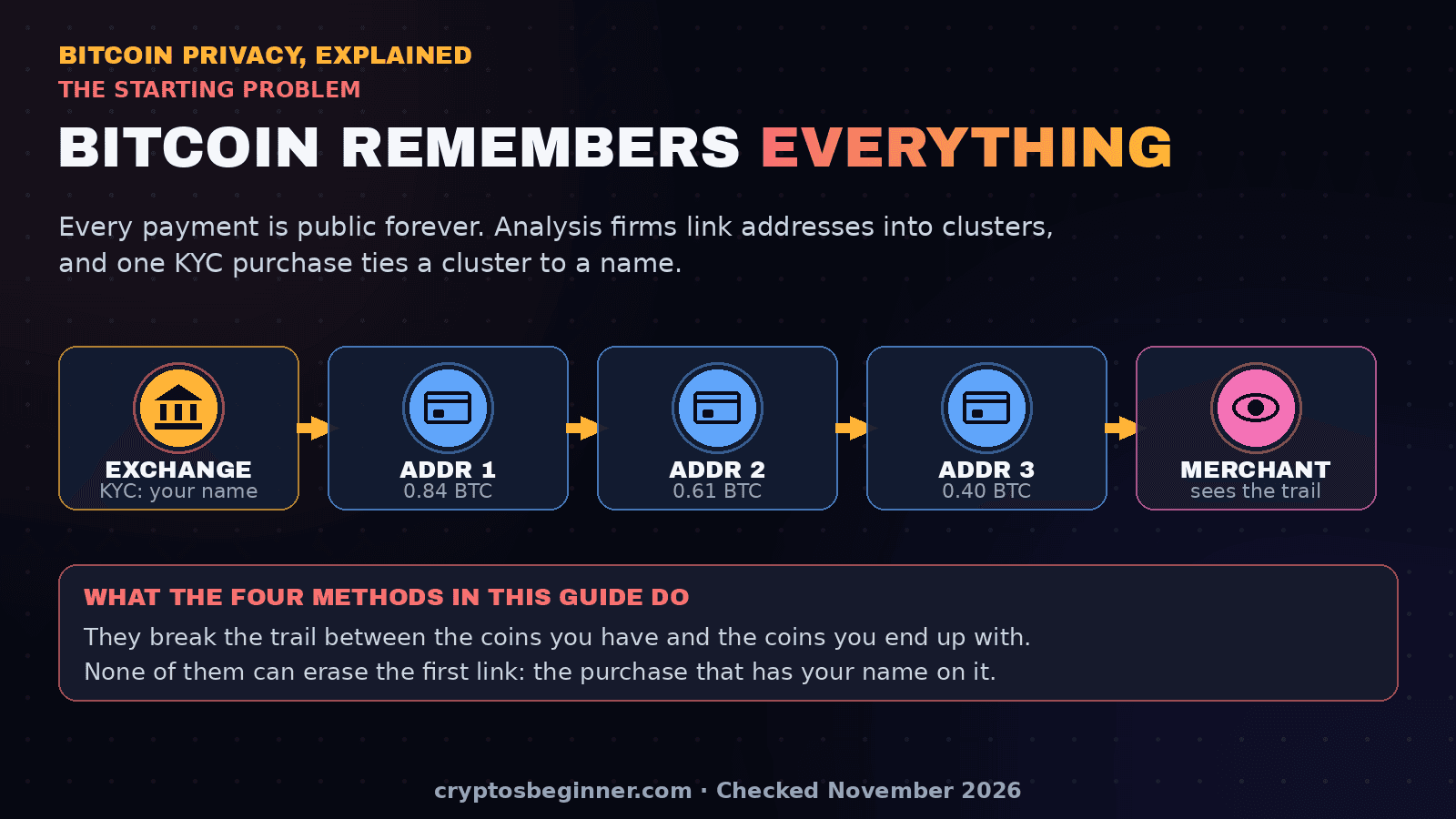
Bitcoin's ledger is public and permanent. Every transaction shows its inputs, its outputs and its amounts, forever, to anyone with a browser. Analysis firms turn that into identity with two heuristics and one database. The first heuristic is common-input ownership: if a transaction spends from five addresses at once, those five addresses almost certainly belong to one wallet, because spending them together required all five private keys. The second is change detection: pay 0.61 BTC for something that costs 0.4 and the leftover output that returns to a fresh address in the same transaction is probably yours too. Apply both across years of transactions and millions of addresses collapse into clusters, one per wallet or service.
The database is the exchanges. A cluster is just a shape until one address in it touches a regulated exchange, at which point the shape gets a name, an email and a passport scan. That is the on-ramp problem, and it is why the honest word for everything in this guide is trail-breaking, not anonymity. The four methods below attack the trail in the middle. The purchase record at the start is yours to live with, and no technique in this guide deletes it. Anyone who sells you a method that promises otherwise is selling you something.
Why bother at all, then? Because the trail is what strangers use. Once your name is attached to a cluster, anyone you pay can walk backwards through your balances and salary, and anyone who sees a large balance can find a target. Breaking the forward trail is a legitimate safety measure, the same reason you would not want your bank statements pinned to your front door. It is not a cloak for crime, and used that way it tends to fail anyway, because investigators start from the ends, not the middle.
Method 1: CoinJoin, share one big transaction
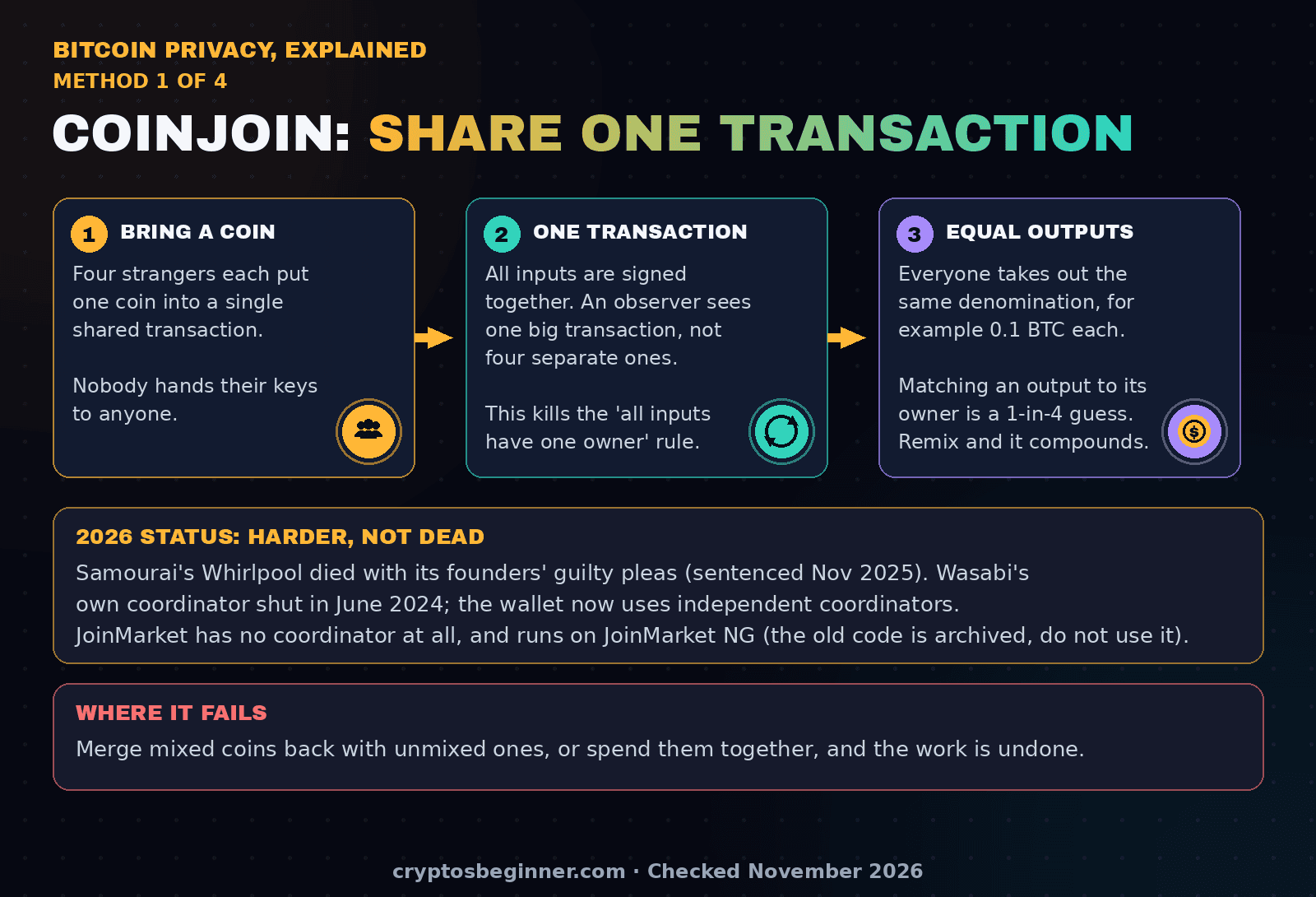
A CoinJoin is a transaction built by strangers together. Each participant contributes inputs, each participant receives outputs of identical size, and everyone signs only their own part, so no coordinator or fellow participant can steal anything. The trick is aimed straight at the first heuristic: a transaction with forty inputs no longer implies one owner, and forty identical 0.1 BTC outputs cannot be matched to their owners better than a one-in-forty guess. Run the outputs through a second and third round, a remix, and the guessing compounds. Whirlpool, the strictest design, used fixed pools of 0.001, 0.01, 0.05 and 0.5 BTC with five participants per round, so every output in a pool was perfectly interchangeable.
What CoinJoin does not hide is almost as important. Amounts that do not fit the denominations stay linkable: deposit 0.73 BTC into a 0.5 pool and the remainder needs handling that can point back at you. And the privacy is perishable. Merge a mixed coin with an unmixed one in a later payment, or spend two mixed outputs together in a way that recombines them, and an analyst can re-stitch what you paid to separate. CoinJoin is a discipline, not a button.
The tooling is where 2026 readers get hurt, because the famous names are gone or changed. Samourai Wallet's founders were arrested in April 2024, pleaded guilty in July 2025 to conspiring to operate an unlicensed money transmitting business, and were sentenced in November 2025 to five and four years, with a forfeiture order of about $237.8 million. Whirlpool died with the service, although a separate project, Ashigaru, revived the design in June 2025 behind its own coordinator. zkSNACKs shut down Wasabi's coordinator on 1 June 2024; the wallet lives on as a community project and you now supply an independent coordinator yourself, with rounds that charge no coordinator fee. Ginger Wallet, a Wasabi fork with its own coordinator, charges 0.3% on inputs above 0.03 BTC and excludes US users in its terms. JoinMarket, the design with no coordinator at all, survived untouched, but its original software was archived in April 2026 with an explicit warning that it has vulnerabilities that will not be fixed. The maintained implementation is JoinMarket NG, with the Jam web interface in beta. If a guide tells you to download the old JoinMarket or open Samourai, close the guide.
Verdict: a real break, scored 3 of 5. It keeps you in Bitcoin, costs little more than mining fees plus small coordinator or maker fees, and works today if you use the maintained tools. It asks the most of you afterwards: careless spending undoes it, and the CoinJoin pattern itself is visible on chain, which some exchanges treat as a reason to ask questions.
Method 2: the Lightning round trip
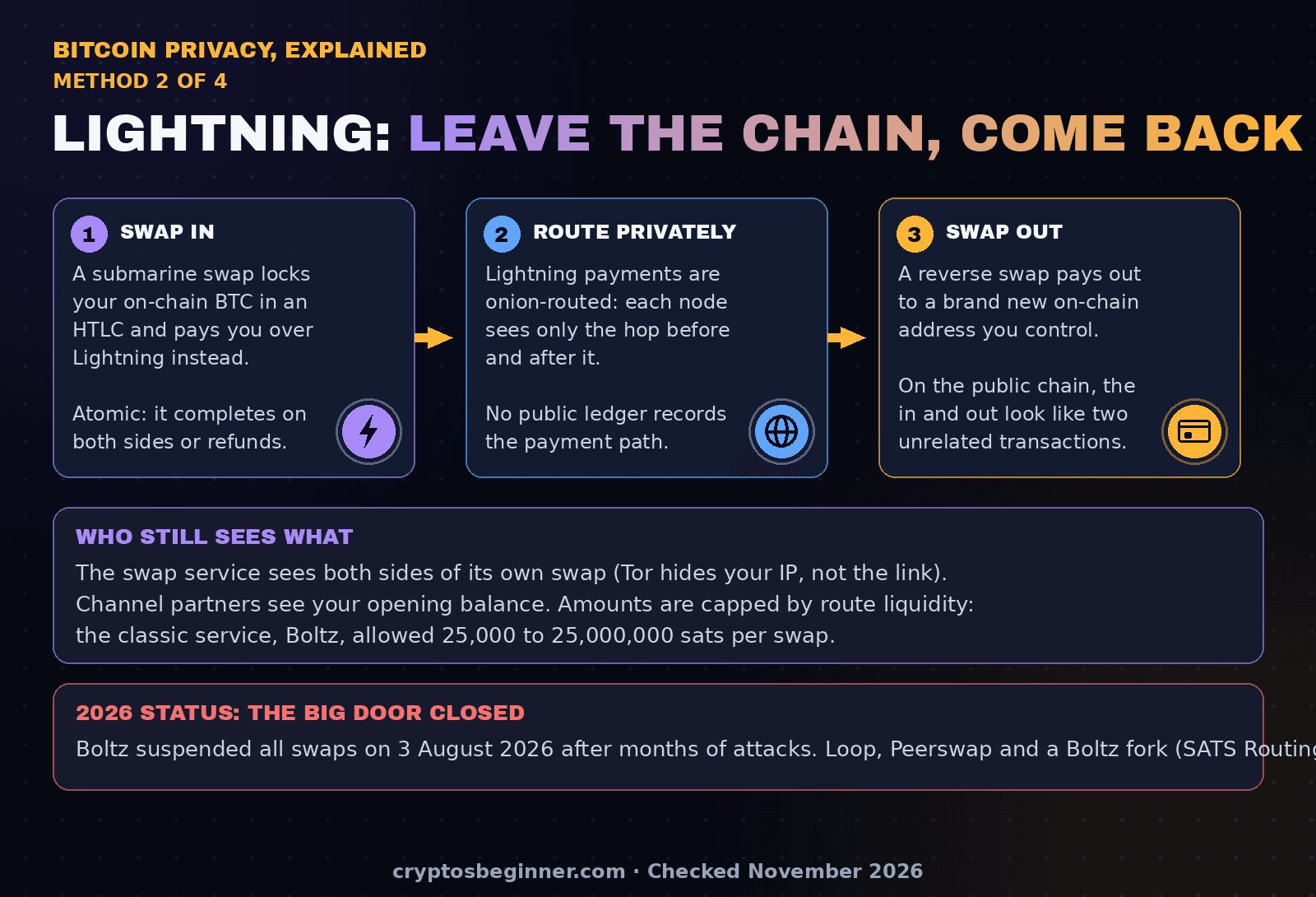
Lightning payments do not touch the blockchain at all while they move, and they are onion-routed: a payment is wrapped in layers so each node along the path can see only the node before it and the node after it, never the sender, the receiver and the amount in one place. To use that as a trail-breaker you need a way in and a way out, and that is the submarine swap. In a normal submarine swap you lock on-chain BTC into a hash time-locked contract and the service pays your Lightning invoice; the secret that settles the Lightning payment is the same secret that lets the service claim your locked coins, so the exchange is atomic: both legs complete, or both refund. A reverse submarine swap runs it backwards and pays out to any on-chain address you name. On the public ledger, the deposit and the payout are two ordinary, unrelated transactions.
The catch is the counterparty. The swap service necessarily sees both sides of its own swap: your locked coins in, your payout address out. Running the service over Tor hides your IP address; it does not hide the link the service itself processed. Your channel partners on Lightning likewise see your channel balances. Amounts are also capped by available liquidity: the category's standard service, Boltz, charged 0.1% and accepted swaps between 25,000 and 25,000,000 sats, and large payments still fail or split when routes cannot carry them.
Then 2026 happened to this method too. On 3 August 2026 Boltz suspended all of its swaps, on-chain, Lightning and Liquid, saying months of AI-assisted attacks had outpaced its small team's ability to patch. Boltz was plumbing, not just a website: wallets such as Aqua, Bull Bitcoin and Zeus routed ordinary users through it without naming it. What remains is Lightning Labs' Loop, built mainly for node operators, the peer-to-peer Peerswap, and SATS Routing, an unaffiliated fork of the Boltz model that launched after the shutdown with per-swap limits of 50,000 to 5,000,000 sats at launch. The technique is unchanged; the front doors are fewer and newer, which is itself a risk factor worth weighing.
Verdict: scored 3 of 5. The fastest and cheapest break on this list, minutes and about 0.1% plus network fees when services are running, and strong against anyone watching only the public chain. Weak against the one party who matters most in the design, the swap service, and currently short on established services.
Method 3: the Monero round trip
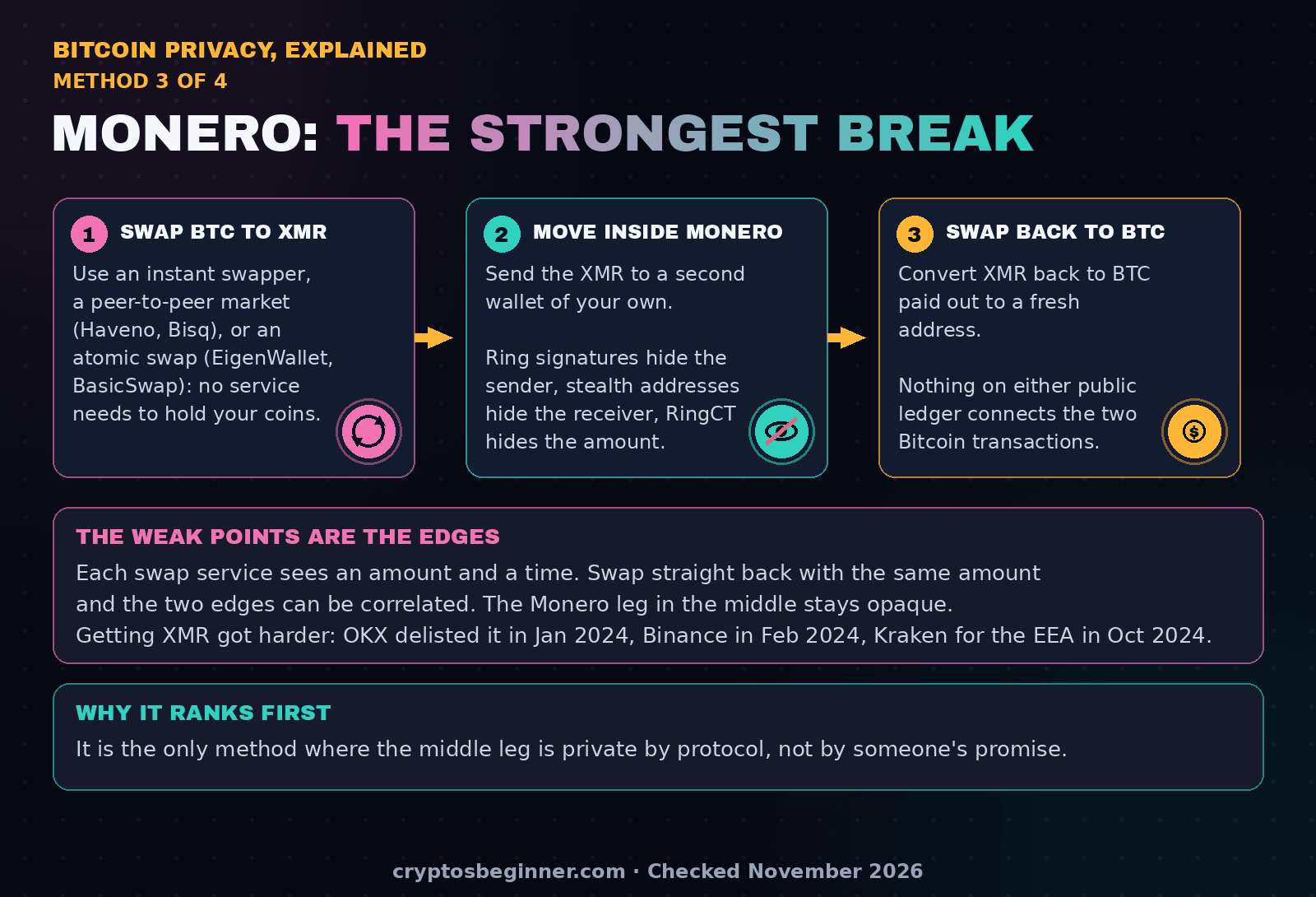
Monero is the only entry on the list where privacy is the protocol rather than a procedure. Every Monero transaction mixes the real input among decoys in a ring signature, pays a one-time stealth address that cannot be linked to the receiver's public address, and encrypts the amount with RingCT. There is no public trail inside Monero to follow, not a weakened one, none. So the round trip is simple in outline: swap BTC for XMR, send the XMR to a second wallet of your own, then swap back to BTC paid out to a fresh address. The two Bitcoin transactions share no address, no amount fingerprint on any public ledger, and no counterparty in common unless you reuse the same swap service twice.
The work has moved to the edges. Each swap sees one amount and one timestamp, and an amount that goes in and comes back out nearly unchanged, minutes apart, is a correlation an analyst can make from the services' records or from watching the services' wallets. The Monero leg in the middle stays opaque; the doors at either end are where this method leaks. Treat the edges with the same respect you would give the CoinJoin outputs: the middle is strong precisely so that sloppy edges stand out.
Getting XMR is the practical hurdle, because the big exchanges left. OKX delisted Monero on 5 January 2024, Binance followed on 20 February 2024, and Kraken withdrew it region by region: Ireland and Belgium in June 2024, the whole EEA on 31 October 2024, Canada in September 2025. Kraken still lists it in some regions, and the Monero project's own directory now points to accountless swap services (SimpleSwap, ChangeNOW, Godex and StealthEX among them), peer-to-peer markets such as Haveno's RetoSwap network and Bisq, and atomic swaps, where EigenWallet swaps BTC to XMR and BasicSwap works in both directions with no service holding funds at all. Atomic swaps and peer-to-peer markets remove the record-keeping middleman entirely, at the price of thinner liquidity and more technical setup. Expect the two swaps together to cost noticeably more than an ordinary exchange trade once spreads are counted, and expect the whole trip to take an hour or two with confirmations. In the EU the direction of travel is explicit: from 10 July 2027 the Anti-Money Laundering Regulation bars regulated platforms from keeping accounts that allow anonymization at all.
Verdict: scored 5 of 5, the strongest break available, because it is the only method whose middle leg is private by mathematics rather than by a coordinator's, federation's or service's behavior. Its costs are practical, not cryptographic: shrinking exchange access, swap spreads, and edges that punish hurry.
Method 4: the Liquid round trip
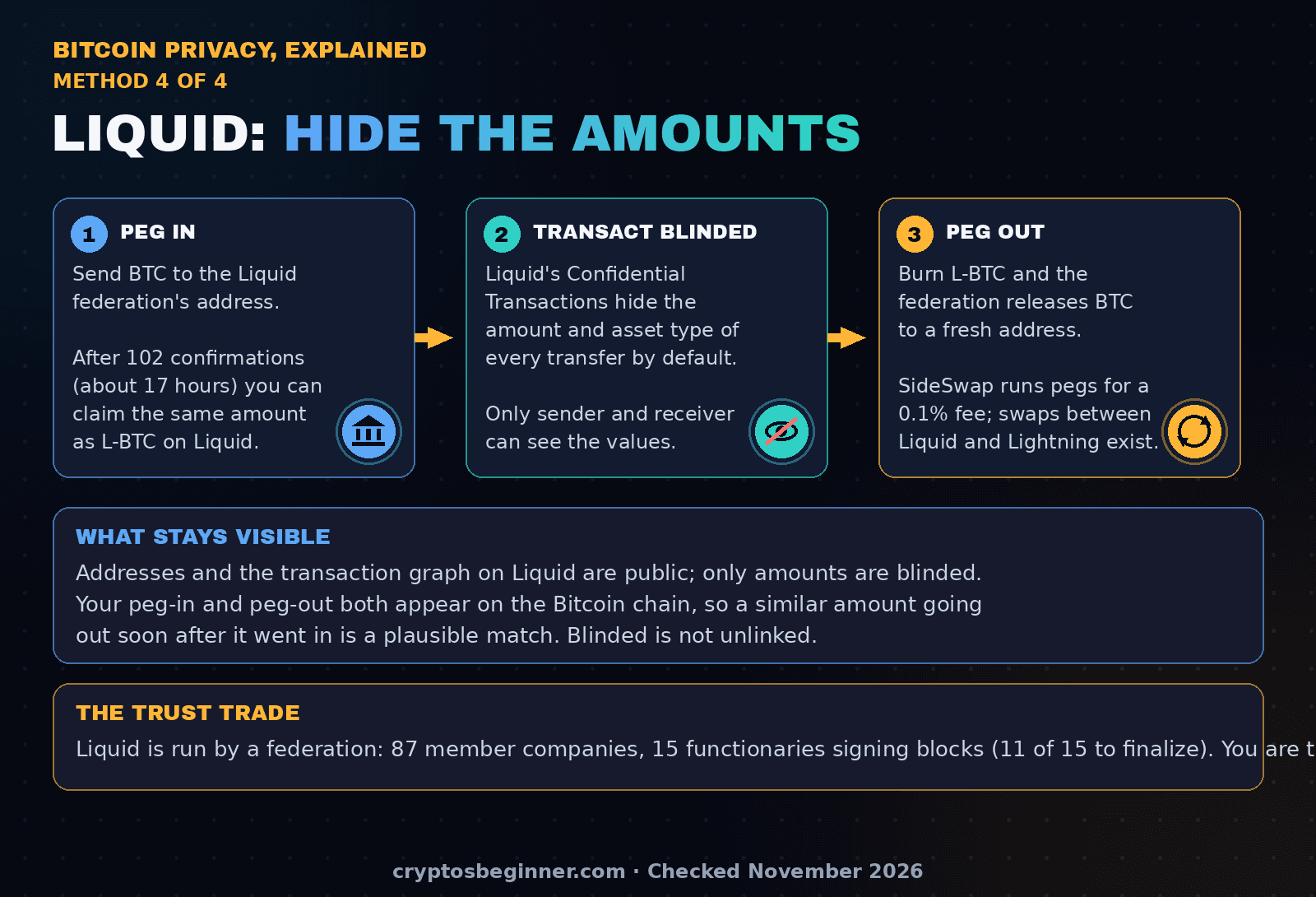
Liquid is a Bitcoin sidechain run by a federation of companies, 87 members as of early 2026, with 15 of them, the functionaries, signing blocks in an 11-of-15 arrangement and guarding the bitcoin that backs the sidechain one to one. You peg in by sending BTC to a federation address and, after 102 Bitcoin confirmations, roughly 17 hours, claim the same amount as L-BTC. You peg out by burning L-BTC and having a federation member release BTC on the main chain; services such as SideSwap run both directions for a 0.1% fee, and swaps between Liquid and Lightning exist for smaller, faster hops.
Inside Liquid, every transaction uses Confidential Transactions by default, which blind the amount and the asset type so that only sender and receiver can see them. That is a genuine improvement over Bitcoin's glass ledger, and for traders moving funds between exchanges it is the entire point. But read the fine print of the design: addresses and the transaction graph on Liquid are still public. An observer cannot see how much moved, yet can see which address paid which, and your peg-in and peg-out both happen on the Bitcoin chain in the clear. Peg 2 BTC in on Monday and peg about 2 BTC out on Tuesday, and the blinded middle has not stopped anyone from making the obvious guess. Liquid hides the numbers on the parcels; it does not hide that the parcels traveled, or between whom.
There is also a trust trade the other three methods mostly avoid. Your L-BTC is a claim on bitcoin held by the federation's multisig, and peg-outs are processed by federation members rather than by you unilaterally. The federation has operated since 2018 without a peg failure, and its members are named companies with reputations to lose, but the model is a committee, not a proof.
Verdict: scored 2 of 5 for trail-breaking. As a confidentiality tool for amounts it works exactly as advertised; as an anonymity method it is the weakest here, slow to enter, graph-visible throughout, and dependent on the federation honoring the peg.
All four, side by side
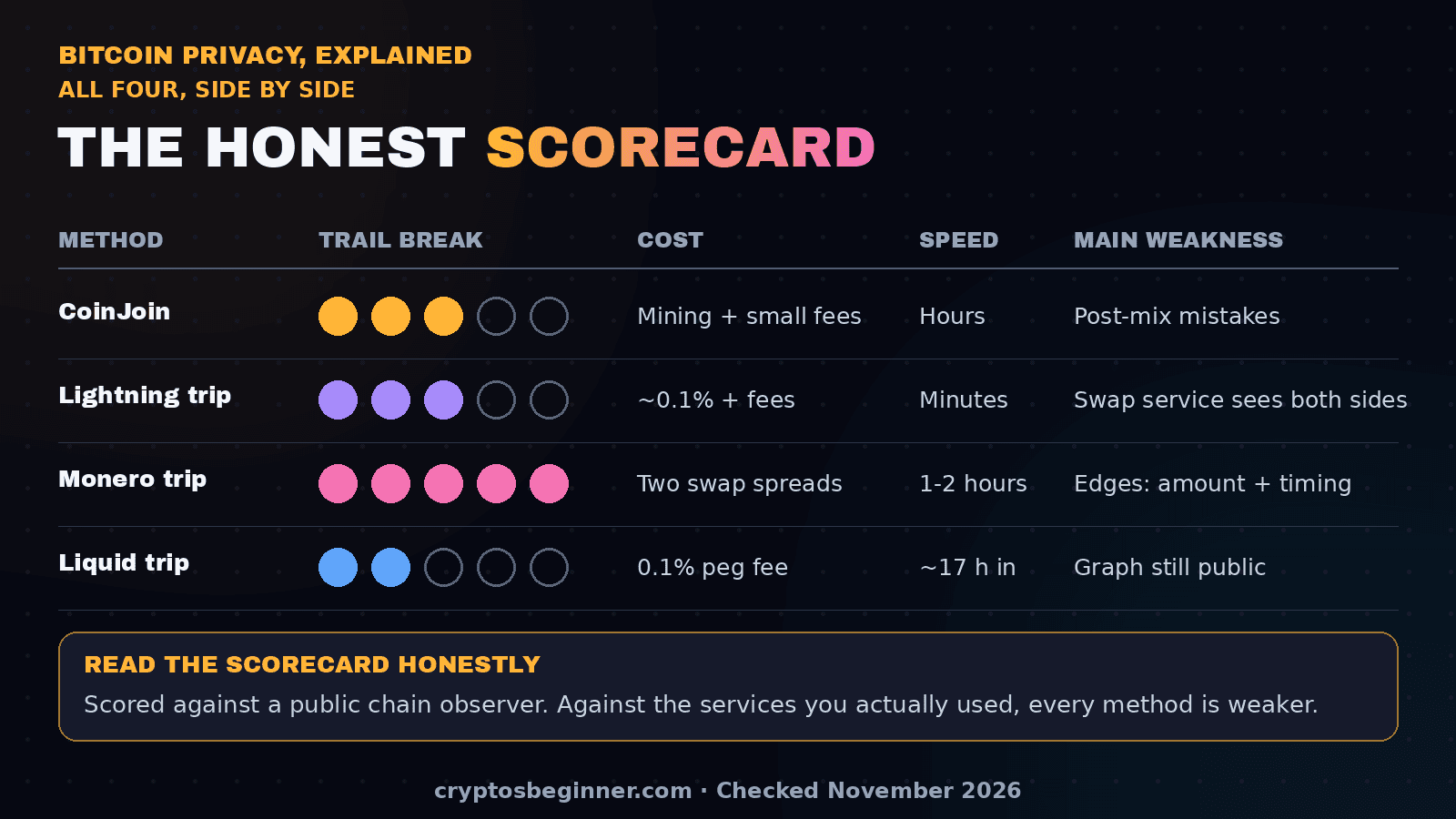
| Method | Trail break | Typical cost | Speed | Main weakness |
|---|---|---|---|---|
| CoinJoin | 3 of 5 | Mining fees, plus 0% to 0.3% coordinator or maker fees | Hours, longer with remixes | Post-mix mistakes undo it; the pattern is visible |
| Lightning round trip | 3 of 5 | About 0.1% plus network fees | Minutes | The swap service sees both sides; Boltz suspended since Aug 2026 |
| Monero round trip | 5 of 5 | Swap spreads on both legs | About 1 to 2 hours | The swap edges: amounts and timing; delistings shrink access |
| Liquid round trip | 2 of 5 | 0.1% peg fee via SideSwap | About 17 hours to peg in | Amounts hidden, graph public; federation trust |
One honest footnote to the whole table: the trail break column is scored against an observer working from public data, a chain analysis firm, a nosy counterparty, a data broker. Against the services you personally used, every score drops, because each service holds its own records. That asymmetry is the real lesson of the list this guide started from: these methods decide who can follow your money, they do not make following it impossible for everyone.
The risks the short posts skip
- Exchanges ask questions. A CoinJoin is visible as a pattern, and some exchanges restrict or interrogate deposits with recent mixing history. Coins returning from swaps can draw source-of-funds checks too. Policies differ per platform and change without notice, so never route money you urgently need through any of these methods.
- Tax records are still yours. In many countries each swap is a taxable disposal, including BTC to XMR and back. Privacy from the public is not privacy from your tax authority, and reconstructing records afterwards is far harder than keeping them as you go.
- The swap layer is scam country. Accountless swap sites are trivial to clone, and fake versions harvest deposits. Reach services through the Monero project's directory, the tool's own documentation or your wallet's built-in integration, never through a search ad, and test with a small amount first.
- Everything here is irreversible. A CoinJoin sent to a bad coordinator choice, a submarine swap abandoned mid-flight, a peg sent to a wrong address: none of it has a support desk. Small test amounts are not paranoia, they are the procedure.
- The law is moving. The Samourai sentences tell service operators exactly where US prosecutors stand, and the EU's 2027 rule tells platforms where Europe stands. Using privacy tools on your own coins and running them for others are very different legal positions, and this guide describes the first, as information only.
So, can you anonymize Bitcoin?
Not in the strong sense the word promises. You can, today, break the public trail between your named purchase and your later spending, and the four methods do it to measurably different degrees: Monero by protocol, CoinJoin by crowd, Lightning by leaving the ledger, Liquid by blinding the amounts. What survives every one of them is the ends: the exchange that sold you the coins knows, the services you swapped through know their half, and the person you finally pay sees a payment arrive. Used with that understanding, these are reasonable tools for keeping your finances off public display. Used with any other understanding, they are a way to pay fees for a false sense of security.
If you want the broader landscape, read privacy coins vs mixers for how Monero's built-in privacy compares with add-on mixers, what is Monero for the protocol itself, what are privacy swaps for the swap layer in depth, and Tornado Cash explained for the legal saga that reshaped this whole field.
Frequently asked questions
Is it illegal to anonymize your own Bitcoin?
Using privacy software on your own coins is not banned in most countries, and financial privacy itself is legal. Laundering money, evading sanctions and hiding criminal proceeds are illegal everywhere, and prosecutors have gone after the people running privacy services: Samourai Wallet's founders pleaded guilty in July 2025 to running an unlicensed money transmitting business and were sentenced that November. Rules also differ by country and are tightening in the EU, where from July 2027 regulated platforms are barred from offering accounts that anonymize transactions. This is general information, not legal advice.
Does CoinJoin still work in 2026?
Yes, but the tools changed. Samourai's Whirlpool is gone, Wasabi's original coordinator shut down in June 2024 and the wallet now uses independent coordinators you choose yourself, and the original JoinMarket software was archived in April 2026 with a warning not to use it. The maintained routes are JoinMarket NG (with the Jam interface), Wasabi with a third-party coordinator, Ginger Wallet, and the Ashigaru revival of Whirlpool. All are more technical than the 2023 versions.
Which method breaks the trail best?
The Monero round trip. It is the only method where the middle leg is private by protocol: sender, receiver and amount are all hidden on Monero's ledger, so there is nothing public to correlate. Its weak points are the two swaps at the edges, where a service sees an amount and a timestamp. CoinJoin ranks second if you remix and handle the outputs carefully. A Lightning round trip hides you from the public chain but not from the swap service. A Liquid round trip hides amounts only, and the transaction graph stays public.
Can an exchange tell that coins were CoinJoined?
Usually, yes. A CoinJoin is a recognizable pattern on the blockchain: many inputs, many equal outputs. Some exchanges ask about the source of funds or restrict accounts that deposit recently mixed coins, and policies vary and change. Coins that arrive from a Lightning or Monero swap look like an ordinary payment from whoever sent them, but the sending service may still have records, and an exchange can always ask questions later. Assume anything you do can be examined, and keep your own records.
Is using a fresh address for every payment enough?
It helps, and every good wallet does it by default, but it is hygiene, not anonymity. The moment two of your addresses appear as inputs in the same transaction, analysis software treats them as one wallet. Change addresses, round payment amounts and reused deposit addresses link the rest. Fresh addresses stop a casual looker; they do not break a funded trail, which is what the four methods in this guide are for.
Sources and further reading
Tool status, fees and dates in this guide were checked in November 2026 against the projects' own pages and reporting close to the events. The Samourai pleas and sentences are US Department of Justice announcements (July and November 2025). The CoinJoin tool status reflects the projects' own repositories and November 2026 status checks at Knowing Bitcoin and Coldcard's CoinJoin explainer. Liquid mechanics follow Blockstream's Liquid documentation and Atlas21's Liquid guide. Submarine swap mechanics follow Boltz's own lifecycle documentation, and the August 2026 suspension and the SATS Routing fork are covered at Massmux. Monero routes and delisting dates follow the Monero project's merchant directory and the exchanges' own delisting notices. Nothing here is legal, tax or financial advice.