Learn · privacy
Privacy coins vs mixers: what is the difference?
Updated 15 October 2026 · Reviewed for CryptosBeginner
Two different answers to the same question: how do you transact privately on a public ledger? One rebuilds the money. The other scrubs the trail.
Alex Rivera · Crypto researcher, CryptosBeginner
Every review is research-led: specs, fees, and availability are checked against official sources before publication and re-checked on every update. Affiliate links never influence verdicts. Last reviewed 15 October 2026.
The core difference in one paragraph
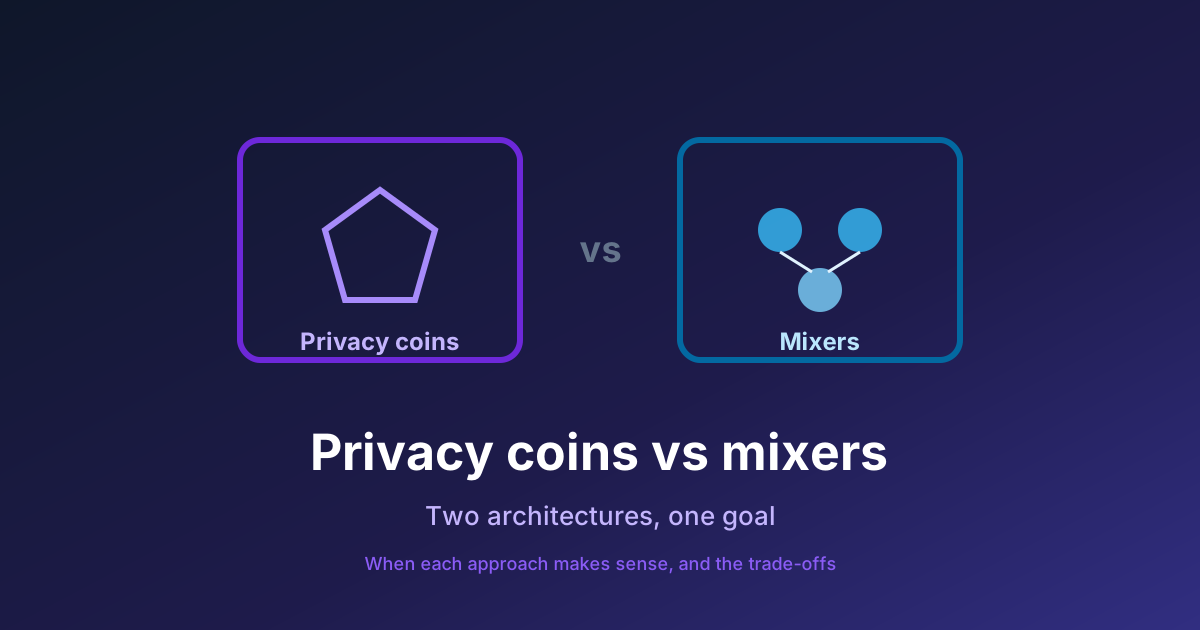
A privacy coin like Monero is a separate blockchain where privacy is built into every transaction by the protocol itself. A mixer like Tornado Cash is a smart contract running on a transparent blockchain (usually Ethereum) that you use for specific transfers you want to obscure. Privacy coins change the money. Mixers add a privacy step on top of existing money.
Left: a privacy coin hides everything by default. Right: a mixer is an optional privacy step on an otherwise transparent chain.
Head-to-head comparison
| Privacy coins | Mixers | |
|---|---|---|
| Examples | Monero, Zcash (shielded) | Tornado Cash, Railgun, Privacy Pools |
| Privacy scope | Entire network, all transactions | Only funds routed through the mixer |
| Default or opt-in | Monero: default. Zcash: opt-in. | Always opt-in per transfer |
| Ecosystem | Standalone chain; limited DeFi and apps | Lives on Ethereum; full DeFi access before/after mixing |
| Exchange access | Heavily delisted (Monero); patchy (Zcash) | You mix coins you already hold; no special listing needed |
| Legal risk profile | Holding is legal most places; exchange access shrinking | Tool itself contested; developers prosecuted; usage scrutinized |
| Anonymity set | Every transaction on the network (Monero) | Only the mixer's pool; small pools mean weak privacy |
When each approach makes sense
- Choose a privacy coin when you want ongoing private money: receiving payments, holding savings, or spending without building a visible financial history. It is simpler (no extra steps) and the anonymity set is the whole network.
- Choose a mixer when your wealth already lives on Ethereum and you want to obscure specific transfers without leaving the ecosystem. It is a tactical tool, not a lifestyle.
- Consider compliance-oriented tools like Railgun or Privacy Pools if you want privacy but also want to be able to prove your funds are clean. This middle path is where the industry is heading.
Dive deeper: our privacy coins hub, the Monero guide, the Zcash guide, and the Tornado Cash story.
Frequently asked questions
Which is more private: Monero or Tornado Cash?+
They protect different things. Monero hides every transaction on its network by default, so the entire blockchain is opaque. Tornado Cash only protects the specific funds you route through it, but it can break links on Ethereum where Monero cannot go. For holding and spending private money, Monero is simpler and more comprehensive. For obscuring the trail of ETH you already own, a mixer is the tool that exists.
Can I use a mixer legally?+
Privacy software itself is not banned in most countries, but using it to launder money, evade sanctions, or commit crimes is illegal everywhere, and prosecutors have pursued mixer developers and operators aggressively. The legal landscape is unsettled and varies by jurisdiction. This is general information, not legal advice.
Why not just use a privacy coin for everything?+
Practical reasons: privacy coins have been delisted from most major exchanges, so converting in and out is harder and more expensive. Liquidity is thinner, fewer merchants accept them, and some wallets and services do not support them. Mixers let you keep using the Ethereum ecosystem while adding privacy to specific transfers.
What are the new compliance-friendly privacy tools?+
Projects like Railgun and Privacy Pools try to split the difference: your transactions stay private, but the protocol screens out sanctioned funds or lets you prove your funds are clean. The idea is to give regulators less reason to attack the tool while preserving privacy for legitimate users. It is too early to say whether regulators will accept the compromise.