Exchanges · comparisons
Kraken vs Coinbase 2026: fees, features, and which exchange suits you
Updated 15 October 2026 · Originally published April 2025 · Reviewed for CryptosBeginner
Kraken and Coinbase are the two most trusted names in crypto exchanges, and they appeal to different people. This head-to-head compares them on fees, security, coins, and ease of use, so you can pick the one that fits how you actually plan to trade.
Alex Rivera · Crypto researcher, CryptosBeginner
Every review is research-led: specs, fees, and availability are checked against official sources before publication and re-checked on every update. Affiliate links never influence verdicts. Last reviewed 15 October 2026.
Kraken vs Coinbase at a glance
| Category | Kraken | Coinbase |
|---|---|---|
| Simple-app buy fee | About 1% plus spread | Spread plus fee (check live schedule) |
| Advanced spot fees (entry) | Kraken Pro: 0.40% maker / 0.80% taker | Advanced: 0.40% / 0.60% (2025 figure, verify live) |
| Futures fees (entry) | 0.02% maker / 0.05% taker | Available on Advanced; check live schedule |
| Supported cryptos | 400+ assets | 250+ assets |
| Security record | Never hacked since 2011; proof of reserves | Cold storage plus crime insurance; USD FDIC-insured |
| Ease of use | Simple app is easy; Pro has a learning curve | The easiest major exchange app to learn |
| Global reach | 190+ countries; MiCA license reported via Ireland | 100+ countries; MiCA license reported via Luxembourg |
| EUR deposits | SEPA, SWIFT, cards | SEPA, cards, PayPal, Apple Pay |
| Staking | Yes, availability varies by region | Yes, availability varies by region |
Kraken fee figures are verified from our Kraken review. We do not yet publish a Coinbase review, so Coinbase figures come from our 2025 coverage of its public schedule: confirm them on coinbase.com before you trade.
Fees: where the real difference lives
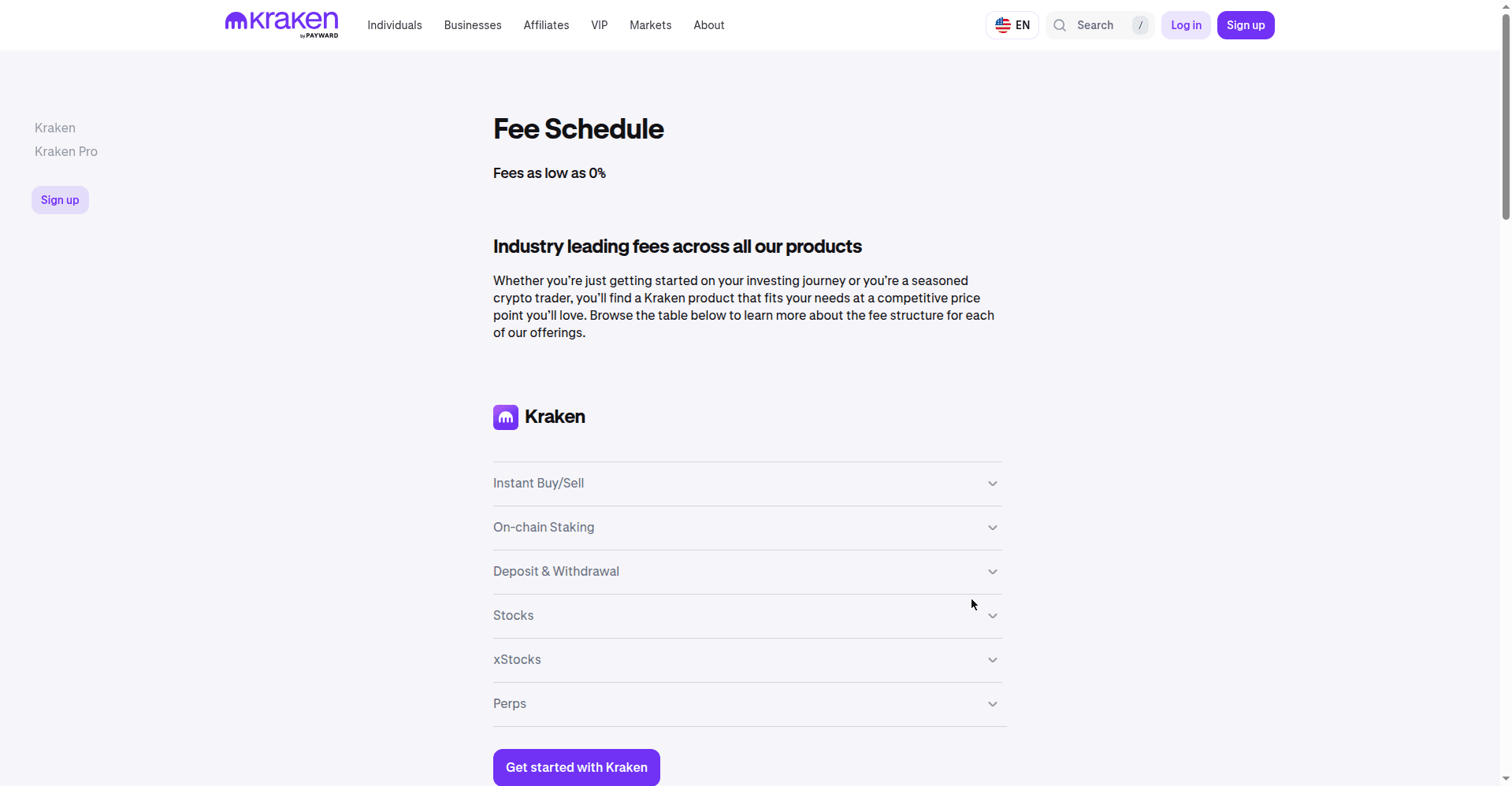
Both exchanges run a two-tier system, and the tier you use matters more than the brand. On Kraken, the simple app charges about 1% per buy, sell, or convert plus a spread. Switch to Kraken Pro, free on the same account, and the entry tier is 0.40% maker and 0.80% taker after the 9 July 2026 schedule change, dropping as your 30-day volume grows.
Coinbase works the same way: the simple buy flow bakes a spread plus a fee into the price, while Coinbase Advanced gives you the real order book at much lower rates. Our 2025 coverage put Advanced at 0.40% maker and 0.60% taker for entry-tier users, but Coinbase adjusts its schedule, so treat that as a starting point and check the live page.
The lesson for both: if you buy more than once in a while, learn the advanced interface. Ten minutes of learning saves a meaningful percentage on every trade for the rest of your crypto life.
Security and trust
This is the closest-fought category. Kraken's headline is its unblemished record: operating since 2011 without a hack, the vast majority of customer funds in geographically distributed cold storage, and proof of reserves you can independently verify. Few exchanges in history can say the same.
Coinbase counters with institutional-grade custody, the bulk of customer crypto in cold storage, commercial crime insurance, and FDIC insurance on US dollar balances held in custody. As a US-listed public company, it also publishes audited financials, which is a transparency level private exchanges cannot match.
Honestly, both clear the bar for a major exchange. The more important security decision is yours: enable two-factor authentication, use a unique password and a passkey where offered, and move anything you plan to hold long-term into a wallet you control.
Features and who each suits
Choose Kraken if you want lower ongoing trading costs, the strongest security track record in the industry, deep euro liquidity with SEPA funding, and a pro terminal with margin and futures. It suits regular traders, Europeans funding in euros, and anyone who values a battle-tested platform over a pretty app.
Choose Coinbase if you are buying your first crypto and want the gentlest possible on-ramp, you value the transparency of a publicly listed company, or you want PayPal and Apple Pay funding options alongside SEPA. It suits occasional buyers and beginners who will trade rarely enough that the higher simple fees barely register.
Both offer staking, mobile apps, and solid customer support with 24/7 chat. Neither offers copy trading. Kraken lists materially more assets, while Coinbase is more selective, which can actually be a plus if you prefer a curated menu over a long tail of small caps.
Pros and cons
Kraken strengths
- Never hacked since 2011, proof of reserves
- Cheaper Pro fees once you learn limit orders
- Deep EUR liquidity, SEPA and SWIFT funding
- 400+ assets, margin and futures on Pro
Kraken watch-outs
- Simple app costs about 1% plus spread
- Pro interface intimidates first-timers
- Verification can be slow at peak times
- Pro entry fees rose in July 2026
Coinbase strengths
- Easiest major exchange app to learn
- Publicly listed, audited financials
- PayPal, Apple Pay, and SEPA funding
- Strong educational content for beginners
Coinbase watch-outs
- Simple buy fees are high
- Fewer listed assets than Kraken
- Support can be slow unless you pay for priority
- Staking restricted in several US states
Verdict
Coinbase is the better first exchange: nothing teaches crypto buying faster than its app. Kraken is the better second exchange: once you are comfortable, Kraken Pro's lower fees, deeper euro liquidity, and unmatched security record make it the smarter long-term home. If you only want one account and you plan to trade with any regularity, pick Kraken and spend an afternoon learning Pro. If you will buy occasionally and value simplicity above all, Coinbase will serve you well.
For the full deep dive on our pick, read the Kraken review. Europeans comparing more options should see our best exchanges in Europe guide.
Frequently asked questions
Which is cheaper, Kraken or Coinbase?+
Kraken is cheaper for anyone who uses Kraken Pro with limit orders: the entry tier is 0.40% maker and 0.80% taker after the July 2026 schedule change, falling with volume. Coinbase Advanced lists 0.40% maker and 0.60% taker per our 2025 coverage, so check the live schedule. On both platforms, the simple one-tap buy costs far more than the advanced interface, around 1% plus spread on Kraken and a spread plus fee on Coinbase.
Is Kraken better for beginners than Coinbase?+
No. Coinbase wins on pure beginner-friendliness: the app is simpler, the onboarding is smoother, and the educational content is excellent. Kraken's simple app is fine, but its real value unlocks in Kraken Pro, which has a learning curve. Beginners who plan to trade more than occasionally should still consider learning Kraken Pro, because the fee savings add up fast.
Which is safer, Kraken or Coinbase?+
Both are among the most secure exchanges operating today. Kraken has never been hacked since its 2011 founding and keeps the vast majority of funds in cold storage, with proof of reserves you can verify. Coinbase also keeps most customer crypto in cold storage and carries crime insurance, plus FDIC insurance on US dollar balances. Neither record suggests you should worry, but neither replaces moving long-term holdings to your own wallet.
Do Kraken and Coinbase both offer staking?+
Yes, both offer staking, but availability depends heavily on where you live. US state-level restrictions have limited staking on both platforms at various points, and the eligible coins differ. Check the staking page for your country before counting on rewards, and remember that staking locks your assets for a period.
Can I use Kraken and Coinbase in Europe?+
Yes. Kraken has a long European track record with SEPA euro deposits and a MiCA license reported through Ireland. Coinbase holds a MiCA license reported through Luxembourg and supports SEPA plus cards across much of Europe. Our Europe guide covers the MiCA licensing picture in more detail.
Should I just use both?+
Many people do. A common setup is Coinbase for the first purchase and its simple app, Kraken Pro for ongoing trading at lower fees, and a personal wallet for long-term storage. There is no rule against holding accounts on both, and comparing their prices on a big trade can save real money.