Tools · trading bots
OdinBot Review 2026: Solana copy trading, tested and assessed
Updated 9 October 2026 · Originally published April 2025 · Reviewed for CryptosBeginner
OdinBot is a web-based Solana bot built around mirror trading: pick wallets, set your size, and it copies their buys and sells automatically, with take-profit and stop-loss rules to handle exits. This review covers the features, the 1% fee, the speed tiers, the custodial wallet reality, and who copy trading actually suits.
Affiliate disclosure: Some links on this page are affiliate links. CryptosBeginner may earn a commission if you register through one. This does not change our assessment criteria or conclusions. This page is educational content, not financial advice.
TL;DR: our take
- Best for: experienced Solana traders who understand copy trading risk and want automated mirroring with rule-based exits.
- Not ideal for: beginners, anyone who cannot afford to lose the deposit, and anyone uncomfortable with custodial web wallets.
- Fee reality: flat 1% per transaction plus speed-tier costs (Standard ~0.002 SOL, Turbo ~0.006 SOL, Godly ~0.06 SOL). Speed costs stack on every trade.
- Custody: you deposit SOL into OdinBot's web wallet. That is custodial risk, whatever the marketing says. Keep trading balances small and withdraw the rest.
- Main caveat: mirroring copies entries and exits, not judgment. A wallet's past run guarantees nothing about its next month.
Video review
Watch: OdinBot review
Our video review walks through the OdinBot app: the dashboard, mirror setup, and how the bot behaves on live Solana markets.
On this page
What is OdinBot?
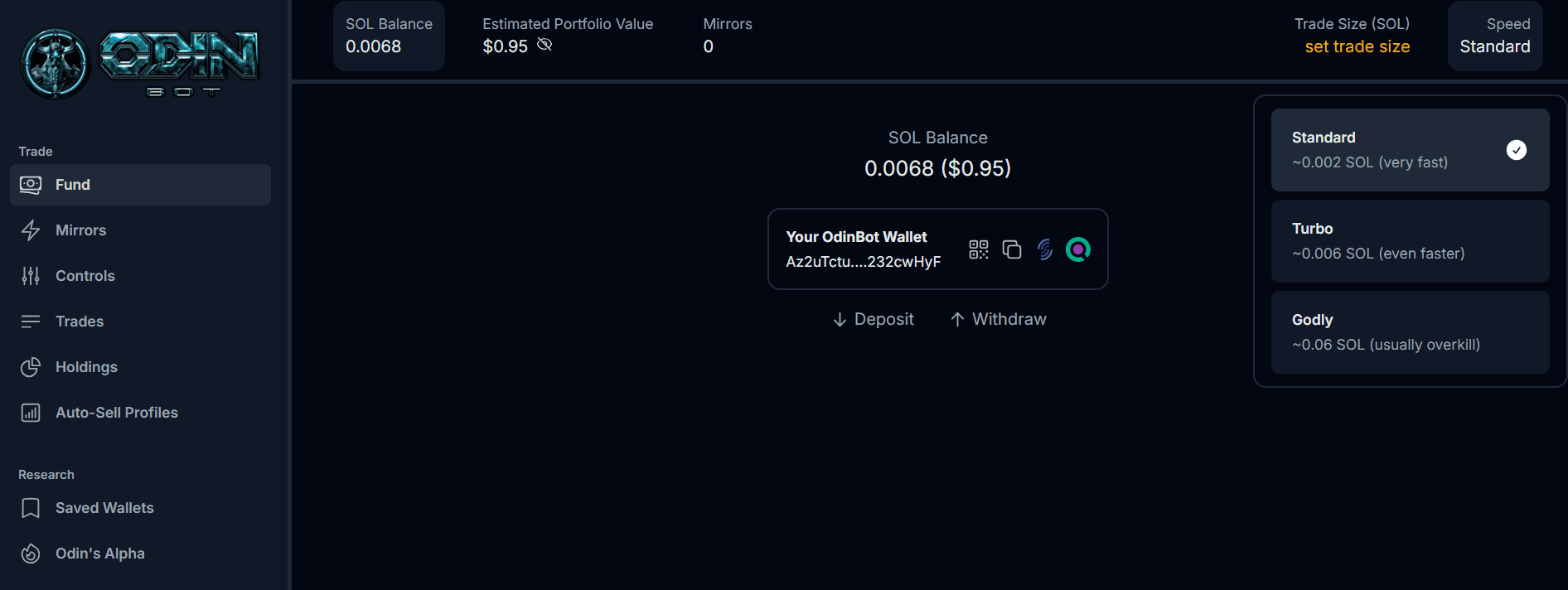
OdinBot is a web-based Solana trading bot with one specialty: copy trading, which it calls mirror trading. Instead of typing commands into Telegram like the classic Solana sniper bots, you use a full web dashboard: fund a built-in wallet, add wallets to mirror, set trade sizes and speed, and define auto-sell rules. The bot then copies the buys and sells of your chosen wallets automatically.
The pitch is speed. OdinBot markets itself as the fastest Solana copy trade bot, claiming trade times as low as one second and up to 30% of trades landing in the same block. Treat those as provider claims rather than verified benchmarks: execution speed on Solana depends on network congestion, priority fees, and the venue, and no dashboard number captures your fills perfectly.
It covers the venues Solana memecoin traders actually use: Pump.fun, Moonshot, Boop.fun, Raydium, Orca, and Meteora, with perpetuals routed through Jupiter's perp protocol. The dashboard also includes manual trade controls, holdings views, saved wallets for research, and an "Odin's Alpha" research section.
Features that matter
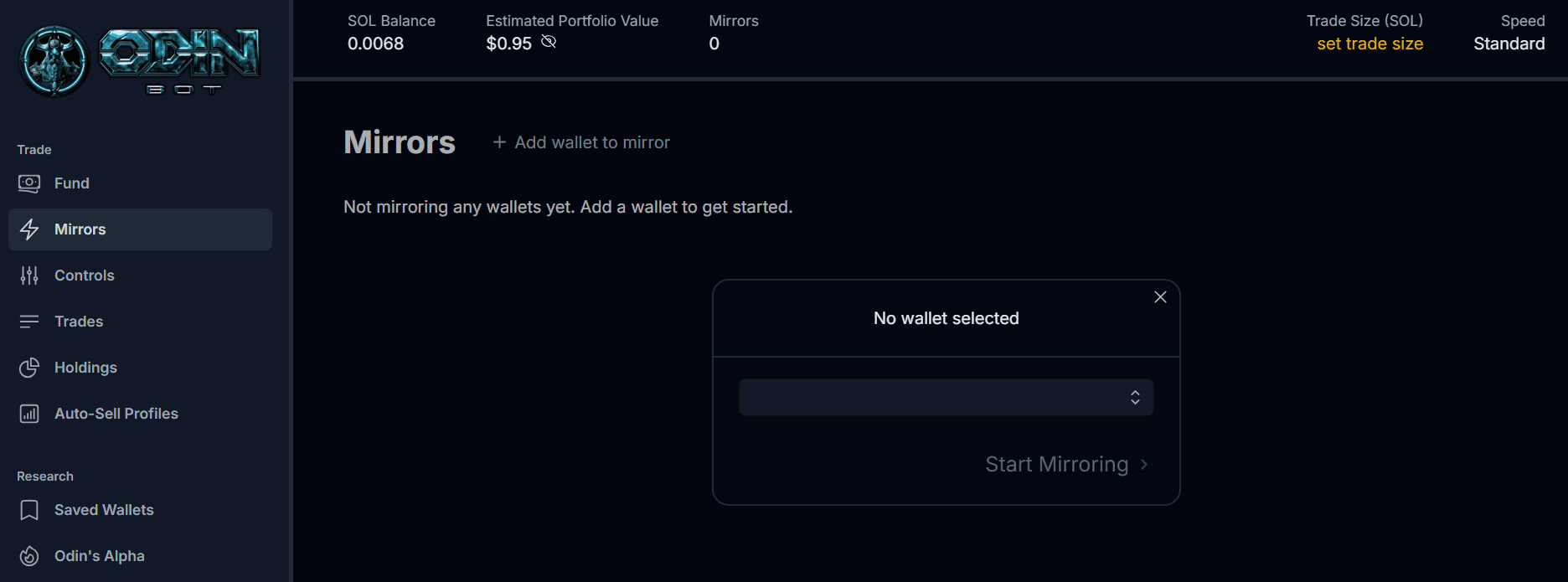
Mirror wallets. The core feature. Add any Solana wallet address and OdinBot copies its trades into your account at your chosen trade size. This is genuinely useful for tracking a thesis, and genuinely dangerous as a strategy: you inherit the wallet's entries without its reasoning, position sizing context, or off-chain hedges.
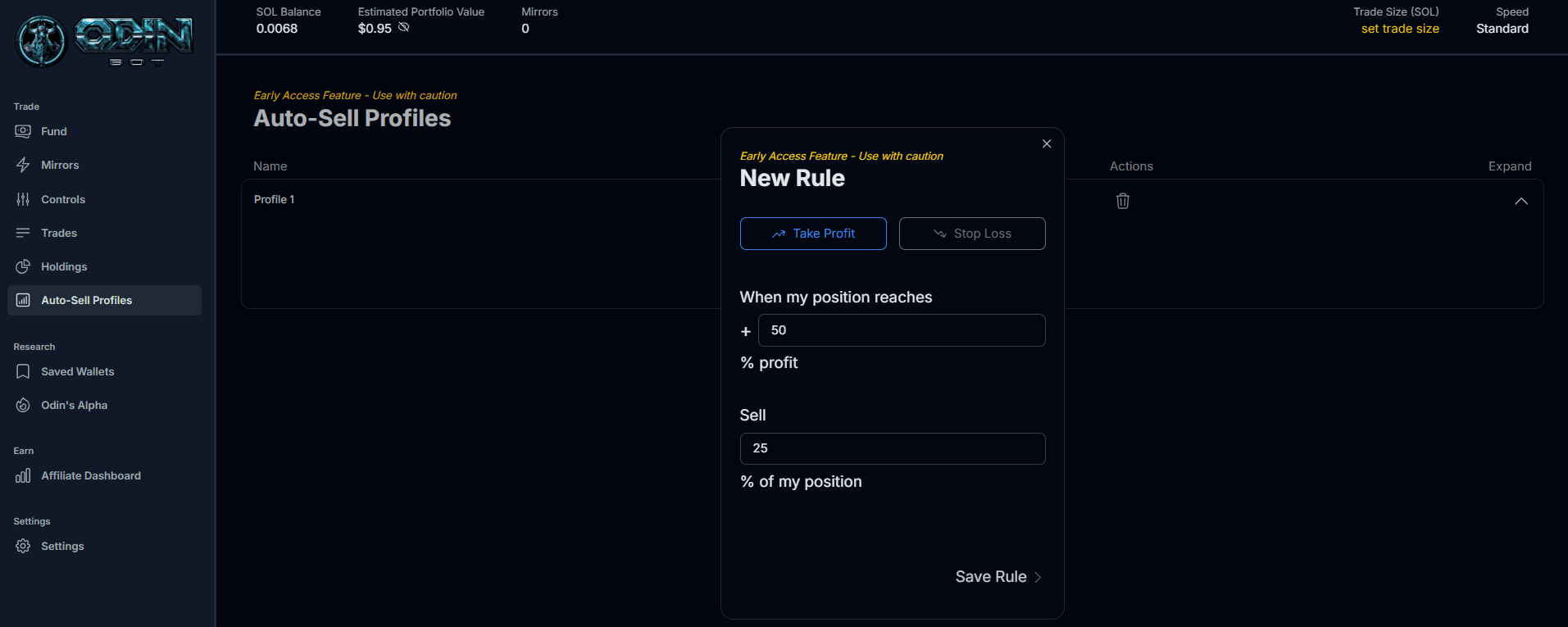
Auto-sell profiles. Rule-based exits with take profit and stop loss levels, for example selling 25% of a position when it reaches 50% profit. This is the most defensible part of the product: it automates the exit discipline that manual traders routinely fail at. It cannot save a bad entry or a token that rugs instantly.
Speed tiers. Standard, Turbo, and Godly tiers pay increasing SOL per transaction for faster block inclusion. During calm markets Standard is fine; during a hot mint, traders pay up. The honest way to think about it: speed is a per-trade tax you choose to pay, and it compounds across mirrored trades.
Controls, trades, and holdings. The dashboard separates live controls from history cleanly: open positions and holdings in one view, full trade history in another. Saved wallets and the Alpha section support the research workflow around mirroring, which matters because wallet selection is the entire game.
Fees and speed tiers
OdinBot charges a flat 1% per transaction, with a 0.001 SOL minimum according to its published terms. That is the base cost before speed. The tiers, as shown in the app: Standard around 0.002 SOL per transaction, Turbo around 0.006 SOL, Godly around 0.06 SOL.
Do the compounding math before mirroring an active wallet. A wallet that trades ten times a day on Turbo pays the 1% plus 0.06 SOL daily in speed costs alone, win or lose. Copy trading looks cheap per trade and expensive per month, which is exactly why the fee section deserves more attention than the feature list.
Pros and cons
Strengths
- Full web dashboard instead of Telegram command soup
- Auto-sell profiles automate exit discipline
- Speed tiers with transparent per-trade SOL costs
- Wide venue coverage: Pump.fun, Raydium, Orca, Meteora
- Saved wallets and research tooling around mirroring
- Simple flat 1% fee, no subscription tiers to decode
Weaknesses
- Custodial web wallet: deposits sit in their infrastructure
- Copy trading inherits entries without the reasoning
- Speed costs compound fast on active mirrored wallets
- Speed claims are provider marketing, not verified benchmarks
- No paper mode: every lesson costs real SOL
- Feature depth means a real learning curve for beginners
The custodial reality
This deserves its own section because it is the most misunderstood part of trading bots. OdinBot is not a read-only tracker. You deposit SOL into a web wallet the platform controls, with deposit and withdraw buttons in the app. Your trading capital lives in their infrastructure between the moment you deposit and the moment you withdraw.
That is custodial risk, plain and simple, and it sits on top of ordinary trading risk. The sensible posture: fund only what you are actively mirroring with, withdraw profits and idle balances regularly, and never treat the bot wallet as storage. If the idea of a third party holding your SOL makes you uneasy, that unease is correct information.
Who it suits, and who should skip it
OdinBot suits experienced Solana traders who already trade manually, understand that mirrored wallets are experiments, and want automation plus rule-based exits for strategies they have validated themselves. If you have a small set of wallets whose behavior you have studied for months, mirroring with tight auto-sell rules is a coherent use case.
Skip it if you are new to Solana trading, if you cannot afford to lose the entire deposit, if custodial wallets bother you, or if you are shopping for a bot that "makes money." Nobody sells a money printer for a 1% fee. Learn manual spot trading first, practice on our paper trading simulator, and only then decide whether automation adds anything to a process that already works.
Alternatives
Axiom, GMGN, and Padre are the web terminals most Solana memecoin traders live in. They are manual trading environments with charts, wallet tracking, and fast execution, without the mirror-trading automation. Our reviews: Axiom, GMGN, Padre.
Telegram sniper bots like BonkBot or Photon offer faster onboarding through chat commands and smaller feature sets. They suit traders who want speed without a dashboard learning curve, at the cost of OdinBot's auto-sell depth and research tooling.
Manual trading plus alerts remains the honest baseline. A terminal, price alerts, and your own rules cost nothing in bot fees and teach the judgment that no mirror can copy.
Verdict
OdinBot is a capable, well-built automation layer for a specific job: mirroring wallets you have already researched, with exits handled by rules instead of emotions. The web dashboard beats Telegram bots for control, the auto-sell profiles are genuinely useful, and the fee structure is at least transparent.
The verdict hinges on the two risks no feature fixes: custodial deposits and the illusion that copying equals understanding. Fund small, withdraw often, mirror only wallets you could defend in writing, and let the auto-sell rules do the hard part. If any of that sounds like too much machinery, you do not need a copy trading bot yet.
FAQ
OdinBot questions
What is OdinBot?
OdinBot is a web-based Solana trading bot focused on copy trading, which it calls mirror wallets. You deposit SOL into its web wallet, choose wallets to mirror, set trade sizes and auto-sell rules, and the bot copies their buys and sells automatically. It also supports manual trading on Solana memecoins across venues like Pump.fun, Raydium, and Orca.
How much does OdinBot cost?
OdinBot charges a flat 1% fee per transaction, with a minimum of 0.001 SOL according to its published terms. On top of that, speed tiers cost extra SOL per transaction: Standard around 0.002 SOL, Turbo around 0.006 SOL, and Godly around 0.06 SOL. Faster tiers aim for quicker block inclusion during congested markets.
Is OdinBot custodial?
Yes, in practice. You deposit SOL into an OdinBot web wallet that the platform controls, as shown by the deposit and withdraw functions in the app. That is custodial risk: your funds sit in their infrastructure until you withdraw. Only keep what you are actively trading with, and withdraw the rest.
Does copy trading actually work?
Copy trading copies entries and exits, not judgment. A mirrored wallet can be lucky for a stretch, trade sizes you cannot see off-chain, hedge elsewhere, or simply stop performing. Past results of any wallet guarantee nothing. If you use mirror trading, risk small amounts, use auto-sell rules, and treat every mirrored wallet as an experiment, not income.
What are OdinBot's auto-sell profiles?
Rule-based exits: you define take-profit and stop-loss levels, such as selling 25% of a position when it reaches 50% profit. They run automatically once set, which removes the hesitation that ruins many manual exits. They cannot fix a bad entry or a token that goes to zero instantly.
Who should skip OdinBot?
Skip it if you are a beginner who has not traded spot manually yet, if you cannot afford to lose the deposit, if you are uncomfortable with custodial web wallets, or if you expect mirrored wallets to print money. Learn manual trading first, ideally with paper trading, before automating anything.
Disclaimer: Educational content only. This page is not financial, investment, legal, or tax advice. Copy trading involves real risk of loss, and past wallet performance predicts nothing. Features, fees, and availability change; verify the live provider terms before depositing funds. Availability of linked third-party sites depends on their own terms.