Polymarket: how it works, fees, and resolution
A crypto-collateralized prediction market where users trade outcome shares on future events.
Affiliate disclosure: CryptosBeginner may earn a commission from this partner link. It does not affect ranking, editorial inclusion, fees, availability, or safety.
Polymarket Perps link is a separate leveraged product and is not the same as prediction-market outcome shares.
Market model
CLOB
Collateral
USDC and related settlement assets described by the selected market or product.
Access
Wallet and platform access vary by product and jurisdiction
Topics
Crypto, Politics
The beginner version
What does a prediction-market position mean?
A market asks a defined question about a future event. A binary market may offer YES and NO shares; a multi-outcome market can offer several mutually exclusive answers. Traders buy and sell these shares before the market closes. A price such as $0.63 can be read as an approximate 63% market-implied probability, but it is not a promise that the event will happen.
When the event is ready for determination, the provider follows the market’s published source and rules. If one outcome wins, its share may redeem for the stated payout—often $1—while losing shares may become worthless. The exact rules, source, close time, exceptions, fees, and dispute process matter more than a short title.
Read the lifecycle
1. Define
Question, outcomes, close time, source, and edge cases are published.
2. Trade
Orders meet on a book or through a market-making pool; price moves as information and demand change.
3. Resolve
The provider or its oracle follows the stated rules and determines the result.
4. Redeem
Winning outcome shares receive the documented payout; losing shares do not.
Source-backed profile
Fees, settlement, and access
Fees: The official documentation states that makers are not charged and that taker fees apply only to certain markets. The fee formula and rates vary by category; geopolitical and world-events markets are listed as fee-free in the reviewed documentation. Source ↗
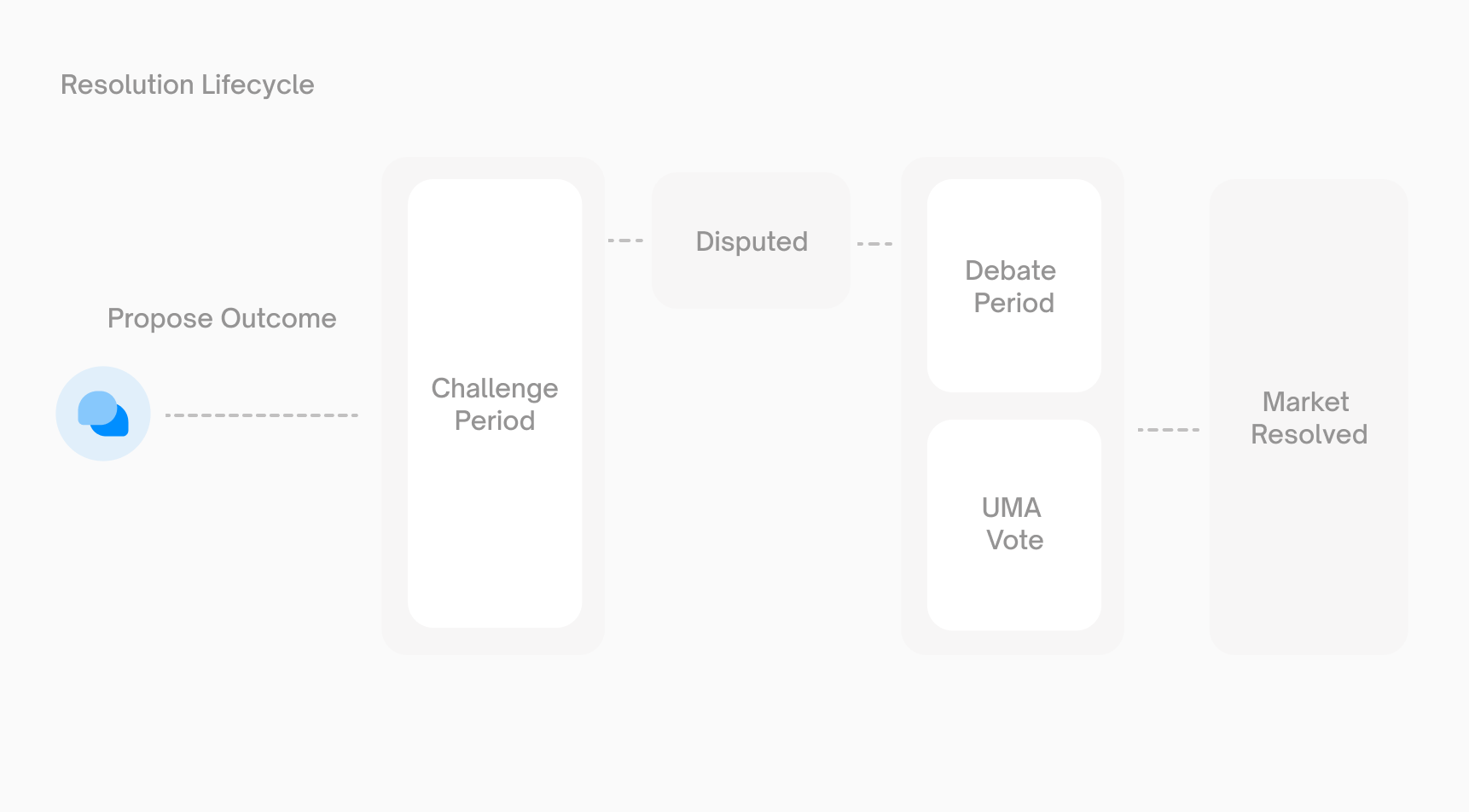
Resolution: Markets use pre-defined rules and a UMA Optimistic Oracle process. Anyone may propose an outcome and anyone may dispute it; winning tokens can redeem for $1 after resolution while losing tokens become worthless. Rules source ↗
Availability: Market and jurisdiction dependent; availability can differ between Polymarket Predictions and Polymarket Perps.
Verification and eligibility: Read the market’s resolution source, end date, edge cases, and platform availability notice before taking a position.
Risks to understand
Outcome shares are not guaranteed investments or ordinary token balances. A position can lose its purchase price, liquidity can be limited, and the market rules—not the headline question alone—control resolution. Check country eligibility, collateral, order price, spread, and the exact resolution source.
Official product visuals
How the interface and rules are presented
Potential strengths
- Broad event-market coverage
- Published documentation for orders, fees, and resolution
- Order-book pricing makes the bid/ask visible
Trade-offs
- Rules and availability vary by market and jurisdiction
- Taker fees can vary by category
- Resolution and liquidity risks remain even when an event seems obvious
FAQ
Questions beginners ask
How do Polymarket markets work?+
Polymarket presents a question about a future event and lets users trade one or more possible outcomes. The displayed price can be read as a market-implied probability, not a guaranteed forecast; the market rules define the final result.
How are Polymarket outcomes decided?+
Markets use pre-defined rules and a UMA Optimistic Oracle process. Anyone may propose an outcome and anyone may dispute it; winning tokens can redeem for $1 after resolution while losing tokens become worthless.
What fees does Polymarket charge?+
The official documentation states that makers are not charged and that taker fees apply only to certain markets. The fee formula and rates vary by category; geopolitical and world-events markets are listed as fee-free in the reviewed documentation.
What should beginners check before using Polymarket?+
Outcome shares are not guaranteed investments or ordinary token balances. A position can lose its purchase price, liquidity can be limited, and the market rules—not the headline question alone—control resolution. Check country eligibility, collateral, order price, spread, and the exact resolution source. This directory is educational comparison content, not a personal recommendation or betting advice.