The short version
Announcement one: Zelle brings its stablecoin to Solana
Zelle has spent 2026 building an international business on top of a network that historically only moved money inside the United States; it moved more than $1.2 trillion between American accounts in 2025. In June 2026 it named India as its first remittance corridor, with US to India transfers planned before the end of 2026, and unveiled ZelleUSD as the asset intended to underpin international payments in more markets over time. Breakpoint added the missing piece: the chain. Alexandra Lang, Zelle's vice president of digital asset partnerships and strategy, presented Solana as a deliberate choice for payments at scale, and the Solana Foundation used the same stage to announce the network's move out of beta, with finality improving to about 150 milliseconds.
For the bank consortium behind Zelle, this is the first time its cross-border plans have been tied publicly to a specific public blockchain. That is a different category of decision from a crypto company launching a token: the owners include the banks that run much of the US payments system, and their network reaches more than 2,400 banks and credit unions.
How the Zelle demo worked
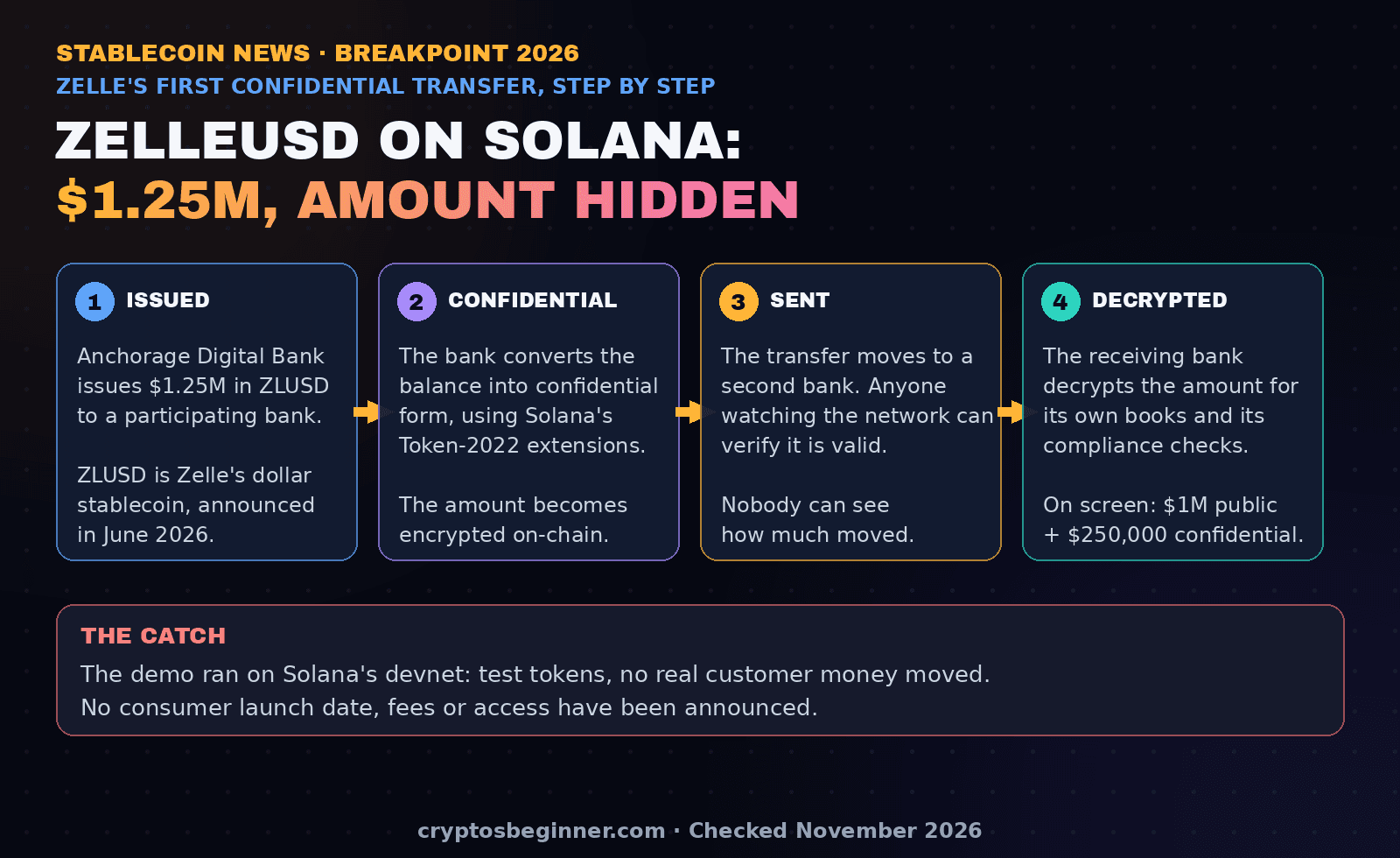
The live demonstration walked through one complete confidential payment. Anchorage Digital Bank, the issuer, issued $1.25 million in ZLUSD to a participating bank. That bank converted the balance into confidential form and sent it to a second bank. The receiving institution decrypted the amount before the funds returned to Anchorage. At no stage could an outside observer see how much had moved, even though the network verified the transfer was valid. The demo interface split the total on screen into a $1,000,000 public balance and a $250,000 confidential balance, which is a neat picture of the model: the token behaves like an ordinary stablecoin until the holder switches a balance into its encrypted form.
The technology is Solana's Token-2022 standard and its confidential transfer extension. Amounts are encrypted, and zero-knowledge proofs let the network confirm that a statement about the transfer is true, that the sender had the balance and that nothing was created from nothing, without revealing the number behind it. The banks on either end hold the keys to decrypt what they need, which is what makes the design sellable to compliance departments: privacy from the public, visibility for the institutions with legal obligations. It sits in the same family as the privacy tools in our guide to privacy swaps, aimed at institutions instead of individuals.
Watch the demonstration as Solana posted it from the Breakpoint stage:
The catch on Zelle: devnet is not a launch
Almost everything exciting about the demo comes with the same footnote. It ran on devnet, Solana's development network, where tokens are created freely and carry no real value, so the $1.25 million figure describes the size of the test, not money at risk. ZLUSD itself exists on the main network only in pre-launch form: on-chain trackers showed roughly 138,000 tokens at the start of November, and no public reserve attestation had been released at that point. Neither presenter gave a date for a production launch, and the announcement included no consumer access, no fee schedule and no list of supported markets beyond the India corridor Zelle had already named. Whether ZLUSD settles that corridor from its first day is also unconfirmed.
None of that makes the announcement hollow. Banks do not demo on a competitor's stage by accident, and the mechanics shown are the hard part of confidential institutional payments. It does mean the honest headline is "Zelle has chosen its chain and shown its privacy model working in test conditions," not "Zelle now moves money on Solana." The gap between those two sentences is where most crypto news coverage quietly lives, and it is worth refusing to skip.
Announcement two: MoneyGram turns Solana wallets into cash
The second announcement needs no test network disclaimer, because it is already switched on. Solflare, one of the largest Solana wallets, has integrated MoneyGram Ramps, the service that connects crypto balances to MoneyGram's physical agent network. Solflare users can now convert USDC into local currency and collect it as cash at participating MoneyGram locations in more than 170 countries and territories. Solflare reports more than 4 million active users holding over $15 billion in self-custodied assets; MoneyGram operates more than 480,000 agent locations worldwide and reports that Ramps volume grew 113% year over year. MoneyGram describes the service as available now to eligible users in supported markets, not as a rollout to come.
The cash-out flow, as described by MoneyGram and Solflare:
- Start in the wallet: open Withdraw in Solflare, choose MoneyGram, and enter the amount of USDC to redeem. Your funds stay in your own wallet until you send them.
- Verify and get a reference: MoneyGram checks your identity, quotes the transaction and issues a reference number for the pickup.
- Send the USDC: the stablecoins move from your wallet to settle the cash-out.
- Collect local currency: take the reference number to a participating MoneyGram agent and walk out with cash.
The fine print on the cash-out
Three qualifications keep this honest. First, the price: eligible users pay zero cash-out fees until 31 December 2026, which is a launch promotion, and after it ends, standard fees and exchange spreads apply. A zero fee is not the same as a free conversion, because the announcement publishes no representative exchange rate, and the spread on cash conversions is usually where the real cost sits. Second, the access: this is a regulated money service, so collection requires identity verification, it works only at participating locations, availability varies by market, and MoneyGram's crypto services are unavailable in Alaska, Hawaii and Louisiana. Third, the direction: cash-in through Ramps covers only about 25 countries, against 170 plus for cash-out, so this is mainly an off-ramp for people receiving and spending digital dollars, not a way to fund a wallet with banknotes.
Solflare is also not MoneyGram's first crypto integration, which is precisely why it matters. Ramps began in 2022 with the Stellar Development Foundation and Circle, arrived on Solana in August 2026 with the Rift wallet as its first integration, and Kraken agreed a similar crypto to cash arrangement in May 2026 covering more than 100 countries. MoneyGram is building Ramps as an embedded service that wallets plug into; adding a wallet with millions of self-custody users is the distribution play working as intended.
Why the two announcements belong together
Read side by side, the two announcements are the same thesis from opposite ends. Zelle's problem is institutional: banks will not move serious money on a ledger where every competitor can read the amounts, so the amounts have to become confidential while staying verifiable. MoneyGram's problem is human: a digital dollar is only useful in much of the world if it can become banknotes at a counter, quickly and without a bank account. Privacy for the institutions, physical access for the people, and a public blockchain underneath both. That is the architecture described in our guide to how stablecoin card programs work, running at national payments scale: an issuer mints, networks settle, and the customer sees an ordinary payment. One half of it is still a test network demo. The other half you can use today.
Frequently asked questions
Can I send money with ZelleUSD now?
No. ZelleUSD is in pre-launch status. Zelle has announced the token, its issuer and its first planned corridor, but there is no consumer access, no fee schedule and no launch date for the Solana based service. The Breakpoint demonstration was between banks, on a test network.
Did Zelle really move $1.25 million on Solana?
It demonstrated a transfer representing $1.25 million, live on stage at Breakpoint on 16 November 2026. The important qualifier is that the demo ran on Solana's devnet, the development network where tokens carry no real value. It proves the mechanics work end to end. It does not show a live service moving customer money.
What is a confidential transfer?
A transfer where the amount is encrypted on-chain. The network can still verify, using zero-knowledge proofs, that the transfer is valid and that no money was created or lost, without anyone watching being able to see how much moved. The sender and receiver can decrypt the amount; on Solana this is an optional feature of the Token-2022 standard, switched on by the issuer.
Who issues ZelleUSD and where will it be used first?
Anchorage Digital Bank issues ZLUSD. Zelle unveiled the token in June 2026 alongside its international plans, naming India as the first remittance corridor, with US to India transfers planned by the end of 2026. Whether ZLUSD settles that corridor from day one has not been confirmed, and no production timeline was given at Breakpoint.
Is the MoneyGram cash-out in Solflare live now?
Yes, according to MoneyGram: the integration is available now to eligible users in supported markets, not a future rollout. It covers participating MoneyGram locations in more than 170 countries and territories. Availability varies by market, and MoneyGram's crypto services are unavailable in Alaska, Hawaii and Louisiana.
What does the MoneyGram cash-out cost, and do I need ID?
Eligible users pay zero cash-out fees until 31 December 2026; after that, standard fees and exchange spreads apply, and the zero fee promotion says nothing about the exchange rate you receive, which is where much of the real cost of cash conversion usually sits. Cash collection is not anonymous: MoneyGram verifies your identity and issues a reference number for pickup once you send the USDC.
Why would banks want payment amounts hidden on a public blockchain?
Because public ledgers are public. A bank moving money for customers cannot broadcast amounts to competitors and observers, and regulators still need visibility. Confidential transfers split the difference: amounts are hidden from the public, the network verifies validity, and the participating institutions can decrypt what they need for compliance checks such as anti-money laundering controls.
Sources
The Zelle sections are based on Zelle's Breakpoint announcement of 16 November 2026 as reported by Cointelegraph, CryptoBriefing and Crypto News Flash, including their reporting that the demonstration ran on Solana's devnet. The MoneyGram sections are based on the Solflare integration announced the same day, as reported by The Block, CryptoBriefing and CryptoNews. We will update this page when Zelle announces consumer access or a production date, and when MoneyGram publishes post-promotion fees. Nothing here is financial advice.