Learn · trading guides
What is crypto arbitrage? Types, real examples, and risks
Updated 19 October 2026 · Reviewed for CryptosBeginner
Buy where it is cheap, sell where it is priced higher, keep the difference. Simple idea, brutal execution. Here is how it really works, with the numbers most guides leave out.
Alex Rivera · Crypto researcher, CryptosBeginner
Every review is research-led: specs, fees, and availability are checked against official sources before publication and re-checked on every update. Affiliate links never influence verdicts. Last reviewed 19 October 2026.
The short version
- Arbitrage exploits price differences for the same coin across exchanges, regions, or trading pairs.
- Typical gaps for major coins are fractions of a percent, and they close in seconds as bots pounce.
- The net spread after fees is the only number that matters. A 1% headline gap is often a loss after costs.
- Guaranteed-profit arbitrage bots are scams. Real automation never needs your withdrawal permissions.
The idea in one paragraph
Crypto has no central price feed. Hundreds of independent exchanges each set prices from their own order books, their own liquidity, and their own regional demand. So the same asset routinely trades at slightly different prices in different places at the same moment. Arbitrage is the act of buying where it is cheaper and selling where it is priced higher, pocketing the difference. It is the same concept as in traditional markets, applied to an environment with hundreds of venues trading around the clock.
Here is the catch most introductions skip: the price you see is not the price you get. The real price is the effective price, after trading fees, withdrawal fees, network fees, slippage, and the time it takes to move coins between venues. A scanner that only shows headline gaps will mislead you. Every example in this guide does the full math.
The 7 types of crypto arbitrage
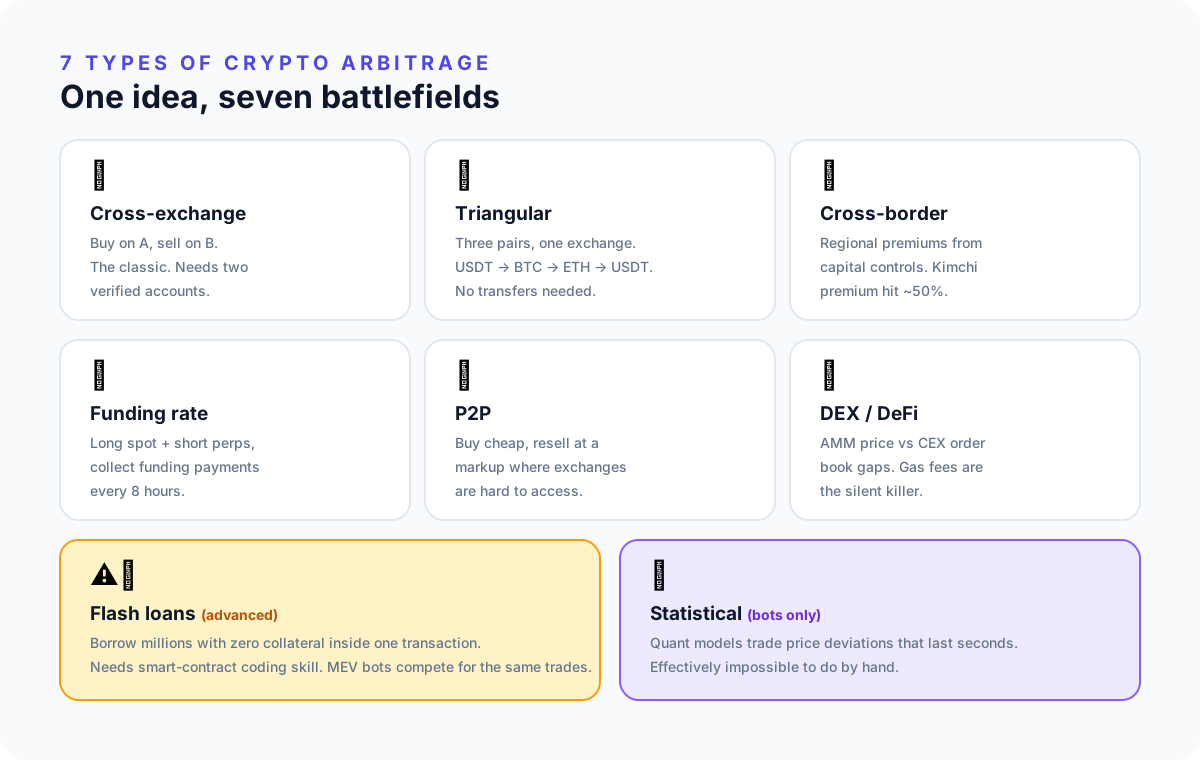
Arbitrage is one idea with several battlefields. Beginners should understand the first three; the rest are here so you recognize what people are talking about.
1. Cross-exchange (spatial) arbitrage
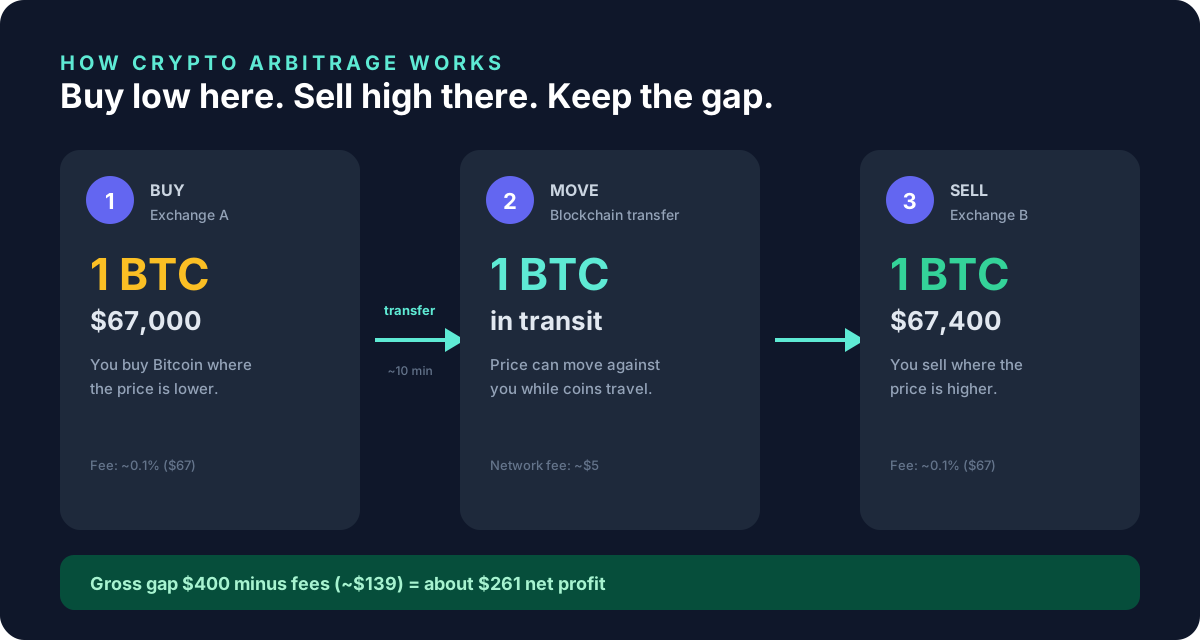
Buy on Exchange A, sell on Exchange B. Example: 1 BTC costs $50,000 on one exchange and $50,200 on another. Buy low, sell high: $200 gross profit before fees. This is the trade most people picture, and the one most exposed to transfer-time risk, because the coins must physically move between venues while the price can shift.
2. Triangular arbitrage
Cycle through three trading pairs on the same exchange to exploit misaligned implied rates. Example: start with 10,000 USDT, buy BTC, trade BTC for ETH, trade ETH back to USDT. If the three legs do not line up, you might end with 10,050 USDT. No cross-exchange transfer is needed, but you pay trading fees three times, which usually eats the edge.
3. Cross-border (geographic) arbitrage
Exploit persistent regional premiums caused by capital controls or local demand. The famous case is the Kimchi premium: Bitcoin has repeatedly traded at large premiums on Korean exchanges versus global prices, at times around 50%, with Japan seeing 10 to 15%. The premium persists precisely because moving large amounts of local currency out is hard, which is also why most outsiders cannot capture it.
4. Funding-rate arbitrage
On perpetual futures, a funding rate keeps futures prices near spot. When the rate is strongly positive, traders go long on spot and short on perps, collecting funding payments roughly every 8 hours. It looks market-neutral, but funding rates and margin requirements can change mid-trade, and leverage amplifies any mistake.
5. P2P arbitrage
Buy crypto cheaply and resell at a markup to buyers who cannot easily reach exchanges, often through P2P platforms. Stablecoins are the usual vehicle. During bull runs, premiums of 10 to 30% over spot are not uncommon in markets with restricted exchange access. The risks are counterparty trust and, for in-person deals, personal safety.
6. DEX / DeFi arbitrage
Exploit gaps between decentralized exchanges (which price via automated market makers) and centralized exchanges (which use order books), or between DEX pools themselves. Example: ETH at $2,000 on a BNB Chain pool versus $2,100 on a centralized exchange. Gas fees are the silent killer here: on-chain legs get expensive exactly when opportunities are richest.
7. Flash loans and statistical arbitrage (advanced)
Flash loans let programmers borrow large sums with zero collateral inside a single blockchain transaction, route through profitable swaps, and repay everything in the same transaction. Statistical arbitrage uses quant models to trade deviations lasting seconds. Both are institutional or developer territory, and MEV searchers compete for the same crumbs. Included here for completeness, not as a suggestion.
A worked example with real numbers
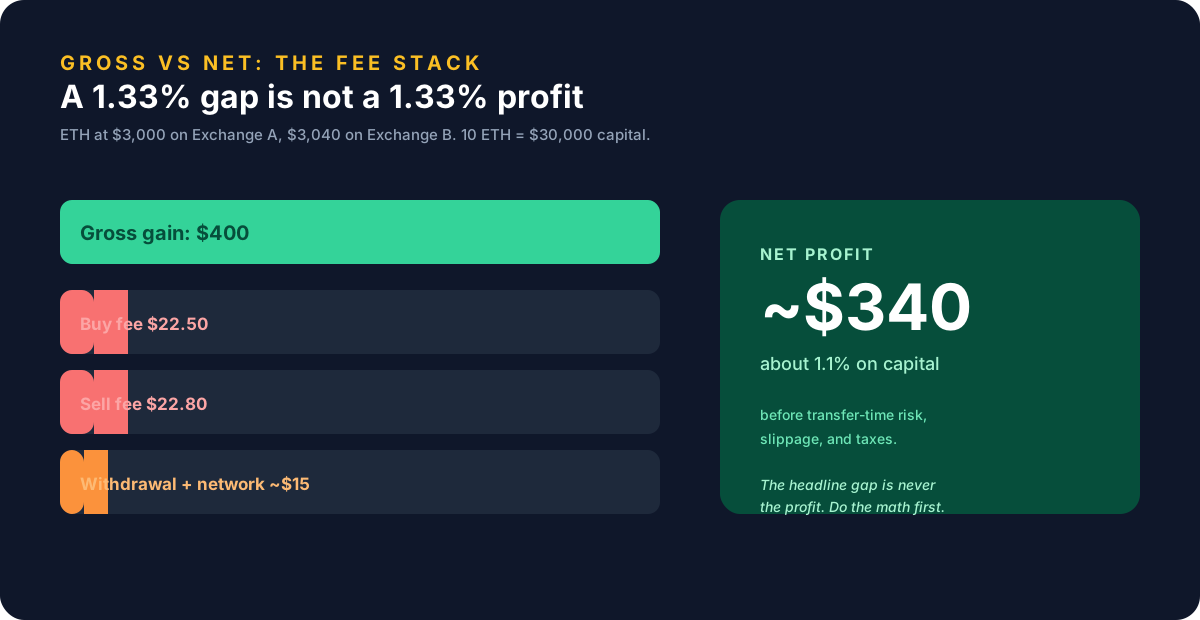
Let us run a cross-exchange trade the way a careful trader would, costs first. ETH is $3,000 on Exchange A and $3,040 on Exchange B: a 1.33% gross spread. You commit 10 ETH, which is $30,000 of capital.
| Line item | Amount |
|---|---|
| Buy 10 ETH on Exchange A | $30,000.00 |
| Sell 10 ETH on Exchange B | $30,400.00 |
| Gross gain | +$400.00 |
| Buy-side taker fee (0.075%) | −$22.50 |
| Sell-side taker fee (0.075%) | −$22.80 |
| ETH withdrawal + network fee | −$10.00 |
| Net profit (before slippage and tax) | ≈ $344.70 |
That is about 1.15% on $30,000 of capital, and it assumes the price did not move during the transfer, your orders filled at the quoted prices, and nothing else went wrong. Shrink the spread to 0.8% and keep the same costs, and the trade flips to a loss. This is the single most important lesson in arbitrage: the headline gap is never the profit.
The full cost and risk stack
Professionals evaluate every trade against this list. If you cannot answer each line, you are gambling, not arbitraging.
Trading fees, twice
Maker/taker fees run about 0.02 to 0.1% per side on most exchanges, and you pay on both legs. Triangular arbitrage pays three times.
Withdrawal and network fees
Moving coins off an exchange costs a withdrawal fee plus the blockchain network fee. Some venues waive one or the other, most do not.
Transfer-time risk
The signature risk of arbitrage. Bitcoin averages about 10 minutes per confirmation, and cross-exchange transfers can take anywhere from seconds to days. The price can move against you while your coins are in transit.
Slippage
Your own order moves the price on thin order books. The quoted price is not the filled price, especially at size.
KYC and verification delays
Serious size needs verified accounts on every venue you touch. Verification takes days, and some regions are blocked entirely.
Capital fragmentation
Spreads are thin, so meaningful profit needs meaningful size, and that capital sits split across venues instead of working in one place.
Exchange risk
Funds parked on multiple venues are exposed to hacks, insolvency, withdrawal freezes, and delistings. A few exchanges even forbid arbitrage in their terms.
Withdrawal limits
Daily and weekly caps slow how fast you can redeploy capital after a trade.
Tax and regulation
Arbitrage is legal in most places, but profits are usually taxable as capital gains, and some countries ban or restrict crypto outright. Rules shift; check yours.
The pro workaround: pre-positioned capital
Experienced arbitrageurs keep fiat and crypto already sitting on both exchanges. When a gap appears, they buy on A and sell on B near-simultaneously, with no blockchain transfer in the critical path. This removes transfer-time risk and withdrawal fees from the trade itself. It requires more capital and more exchange risk, which is why arbitrage is a capital game, not a cleverness game.
Why beginners usually lose
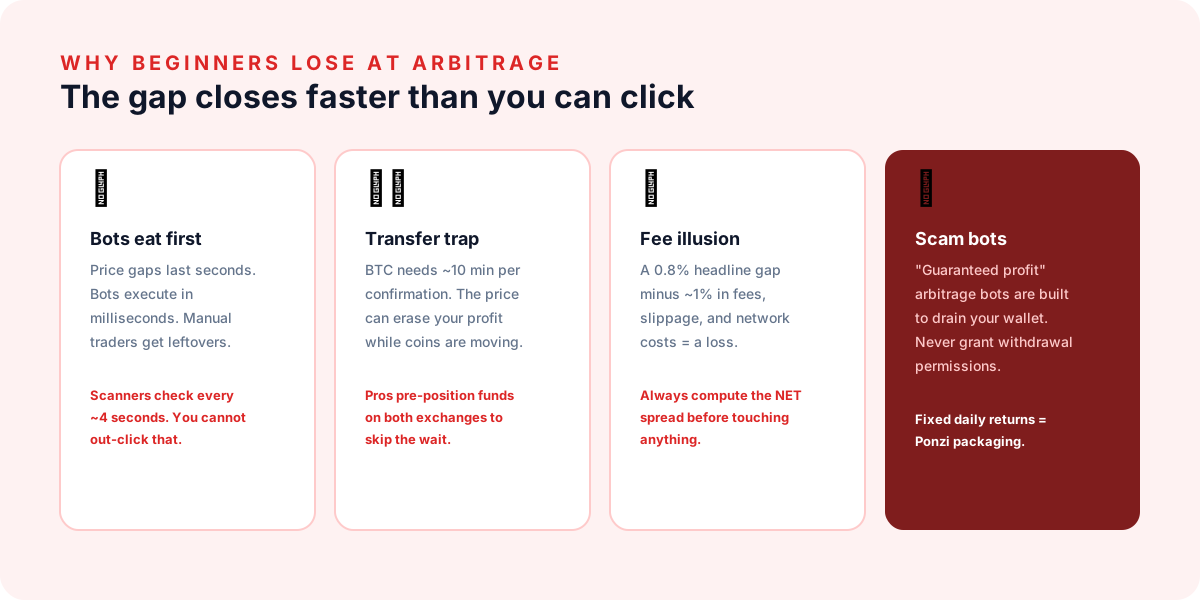
Put bluntly: you are racing bots that execute in milliseconds for gaps that last seconds, while paying retail fees on both legs. As more arbitrageurs enter, spreads compress and opportunities shrink. The beginners who survive treat arbitrage as a math exercise first: spreadsheet the net spread, assume slippage, and walk away from anything marginal.
Scam red flags
Arbitrage hype attracts scammers because the pitch sounds like free money. Memorize these:
- 🚨
Guaranteed-profit bots
No legitimate strategy guarantees profit. Bots sold with profit promises are frequently built to drain connected wallets or API keys. Real automation never needs withdrawal permissions.
- 🚨
Fixed daily returns
Promises like 5% daily from an arbitrage bot are Ponzi packaging. Real arbitrage yields are thin, variable, and never guaranteed.
- 🚨
Upfront activation fees
Paying to unlock a bot or mentorship is the classic advance-fee pattern.
- 🚨
Telegram and Discord schemes
Anonymous groups pooling funds for arbitrage plays have no accountability and a long history of disappearing.
- 🚨
Paper-profit scanners
A scanner showing profits you cannot execute is marketing, not a track record. Treat every scanner result as an estimate, never a promise.
Frequently asked questions
What is crypto arbitrage in simple terms?
Crypto arbitrage is buying a cryptocurrency where it costs less and selling it where it is priced higher, keeping the difference. Because hundreds of independent exchanges each set prices from their own order books, the same coin routinely trades at slightly different prices in different places at the same time.
Is crypto arbitrage profitable for beginners?
Rarely. Typical price gaps for major coins are fractions of a percent, while the all-in cost of trading fees, withdrawal fees, network fees, and slippage is often around 1% or more. Automated bots also close gaps in seconds. Most beginners lose money because they trade the headline gap instead of the net profit after every cost.
What are the main types of crypto arbitrage?
The main types are cross-exchange arbitrage (buy on one exchange, sell on another), triangular arbitrage (three trades on one exchange), cross-border arbitrage (regional price premiums), funding-rate arbitrage (long spot plus short perpetuals), P2P arbitrage (reselling where exchanges are hard to access), DEX arbitrage (price gaps between decentralized and centralized exchanges), and flash-loan arbitrage (advanced, single-transaction borrowing).
Is crypto arbitrage legal?
Arbitrage itself is legal in most countries; it is ordinary trading. But some jurisdictions ban or restrict crypto entirely, profits are taxable in most places (usually as capital gains), and a few exchanges forbid arbitrage strategies in their terms. This is general information, not legal or tax advice.
Are crypto arbitrage bots legitimate?
Real arbitrage automation exists, but it is built by professionals and never needs your withdrawal permissions. Bots marketed with guaranteed profits, fixed daily returns, or upfront activation fees are scams designed to drain wallets or run Ponzi schemes. Treat any guaranteed-profit claim as a red flag.
How much money do you need to start crypto arbitrage?
Because spreads are thin, meaningful profit requires meaningful capital, and that capital gets split across multiple exchanges. There is no fixed minimum, but with a few hundred dollars the fees alone usually erase the gap. Paper-trade the math first: if the net spread after all fees is not clearly positive, the trade is not worth taking.
Keep learning
Educational content only, not financial advice. Examples use illustrative prices and fees; actual numbers vary by venue and time. Research sources include Coinbase Learn, Bybit Learn, Crypto.com, MEXC, the Bitcoin Foundation, Chiliz, OneKey, and Arkm Research.