Updated 15 October 2026 · By Alex Rivera · Reviewed for CryptosBeginner
Solid Card Review 2026: Fees, Cashback Tiers & Is It Worth It?
Solid pairs a self-custodial money app with a Visa Platinum card: up to 5% cashback in USDC, up to 6% APY on your dollars, zero card fees, and you hold the keys the whole time. I went through Solid's official support docs line by line so you get the real fee tables, the real tier requirements, and the real catches. Here is the full picture.
Alex Rivera · Crypto researcher, CryptosBeginner
Every review is research-led: specs, fees, and availability are checked against official sources before publication and re-checked on every update. Affiliate links never influence verdicts. Last reviewed 15 October 2026.

The short version
- A self-custodial Visa card. You hold the keys via passkeys. Solid cannot move your funds.
- Real cashback. 3% to 5% in USDC depending on tier, with monthly caps of $50 to $200. It beats the card's own FX fees at every tier.
- The card is free. No issuance, monthly, annual, or top-up fees at any tier.
- Yield on idle money. Up to 6% APY on dollars, 15% on FUSE, 3% on ETH, with a 10% performance fee on yield.
- Two ways to spend. Savings Mode spends your balance; Borrow Mode borrows against it so your money keeps earning.
- Tiers cost money or lockup. Prime is $199/year or 50,000 FUSE locked 12 months; Ultra needs 400,000 FUSE locked 12 months.
What the Solid Card is
Solid is a stablecoin money app with a Visa Platinum card attached. At its core is SoUSD, a yield-bearing stablecoin: you deposit USDC, it mints SoUSD representing shares in a vault of audited DeFi strategies, and the token grows in value as the vault earns. No staking, no lockups, yield compounds on its own.
The card itself is issued by Rain or Wirex depending on your country, assigned automatically when you order. It spends your card balance wherever Visa is accepted. The headline pitch is the combination: self-custody (passkeys, audited infrastructure, Check Point audit), cashback on spending, and yield on the money sitting in the app. Everything below comes from Solid's official support docs, verified in October 2026.
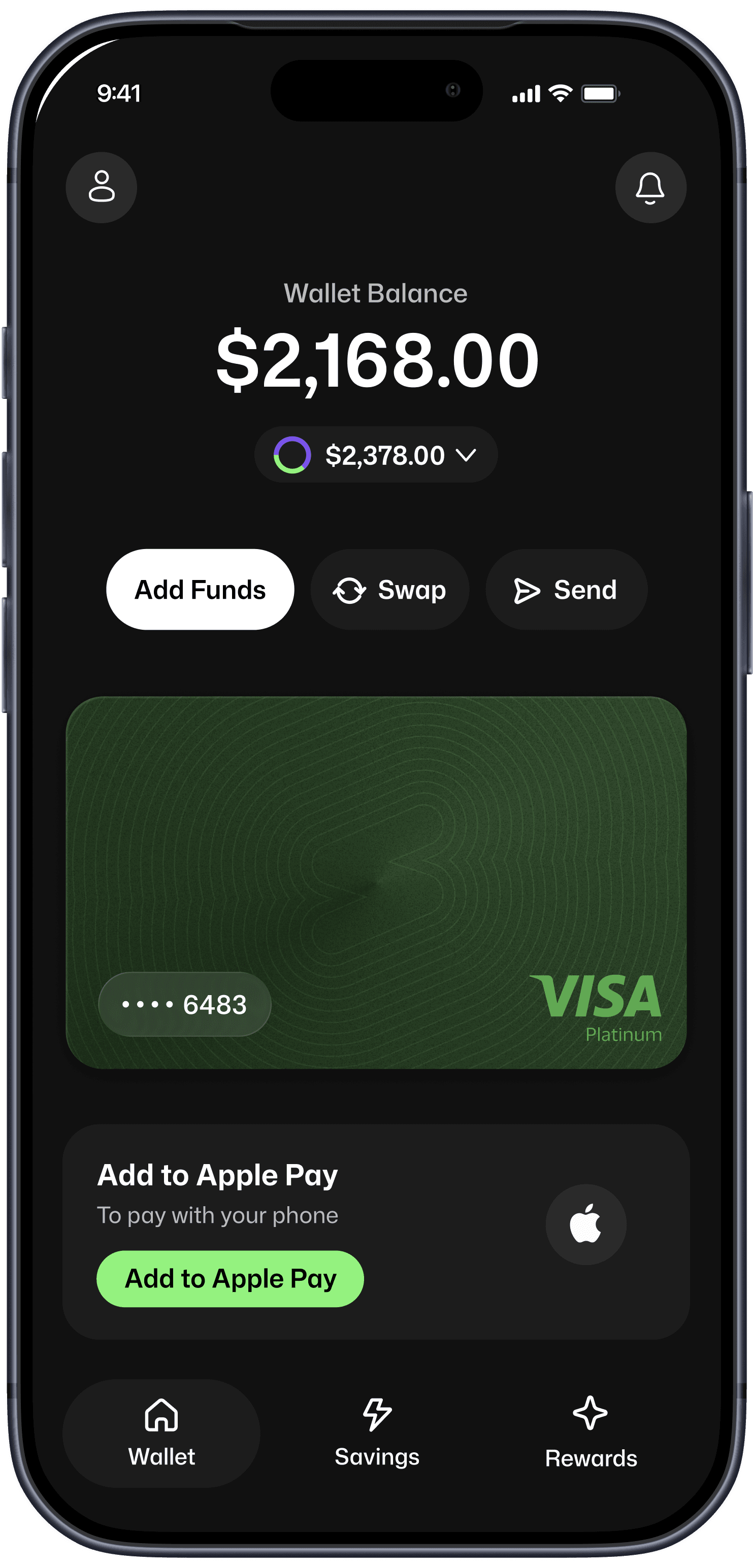
Savings Mode vs Borrow Mode
This is the feature that sets Solid apart from plain debit cards, so it is worth understanding before anything else.
Savings Mode is the simple one: the card spends directly from your balance. Money in, money out. What you do not spend keeps earning yield in Savings.
Borrow Mode is the clever one: you borrow USDC against your savings to spend, so your deposited funds stay put and keep earning yield while you spend the borrowed amount. It is the spend-without-selling idea, built into the card rather than bolted on. Like any borrowing, understand the terms before you lean on it.
How to sign up
Signup happens in the Solid app. The card is ordered from inside the app after your account is set up.
- Click the Solid link on this page to open the official site, then get the app.
- Create your Solid account and set up passkey authentication. This is your self-custody key, so follow the backup steps carefully.
- Order your Solid card from the card section of the app. The issuer (Rain or Wirex) is assigned based on your country.
- Complete identity verification to activate the card (next section).
How to complete verification
Identity verification is required for card issuance; there is no anonymous route. One wrinkle to know: local currency deposits through TransFi need a separate one-time verification with TransFi itself, even if your card is already active. Have a government-issued ID ready for both.
- In the app, start the card verification flow when ordering.
- Provide your ID and complete the liveness check as prompted.
- Wait for approval, then your card is activated.
- If you plan to deposit local currency, complete the separate TransFi verification on first use.
How to fund your card
You have three main routes to get money onto the card, and the fees differ by route and tier.
Crypto deposits. Send USDC or USDT from an external wallet. Free on the Fuse network, 0.1% on Ethereum, 0.03% on other networks (BNB Chain, Polygon, Base, Arbitrum). Minimum deposit $10, no maximum.
Local currency deposits. Pay from your local bank account or mobile money wallet in 16 currencies across Latin America, Africa, Asia, the Gulf, and the euro area, powered by TransFi. No crypto knowledge needed: you pay in your currency and USDC lands on your card balance. Solid's fee is 0.5%, shown inside the TransFi quote before you confirm. Thailand currently supports cash-out only.
Bank deposits and Virtual Account. Open a Virtual Account for a one-time $10 fee to get US bank account details in your name for ACH and wire transfers. Bank deposit fees are 0.5% at Core, 0.25% at Prime, and free at Ultra. Bank withdrawals currently carry no Solid fee at any tier.
- In the app, tap Add Funds and pick your route: crypto, cash deposit (local currency), or bank.
- For crypto, choose the network carefully. Fuse is free; Ethereum costs 0.1%.
- For local currency, pick your currency and payment method, complete TransFi verification once, and confirm the quoted rate.
- Move money from Wallet to your card's spendable balance. The card only spends what is on the card.
Rewards tiers: Core, Prime, Ultra
Everyone starts at Core. The tiers change your cashback rate and cap, and cut fees on bank deposits and swaps. Here is the honest breakdown.
| Benefit | Core | Prime | Ultra |
|---|---|---|---|
| Cashback (USDC) | 3% | 4% | 5% |
| Monthly cashback cap | $50 | $100 | $200 |
| Bank deposit fee | 0.5% | 0.25% | Free |
| Swap fee | 0.5% | 0.25% | Free |
| Solid FX fee (non-USD) | 0.5% | 0.5% | 0.5% |
| How to unlock | Everyone | $199/year or lock 50,000 FUSE 12 mo | Lock 400,000 FUSE 12 mo |
The math that matters: at Core you need to spend about $167 a month to hit the $50 cap at 3%. At Ultra you need $4,000 a month to hit the $200 cap at 5%. Be honest about your spending before paying for Prime or locking FUSE for Ultra. Locked FUSE cannot be withdrawn before the unlock date, and your tier ends when the lock ends unless you lock again.
How to spend and earn cashback
Spend anywhere Visa is accepted, in person or online. USD purchases are free. On non-USD purchases you pay 1% provider FX plus 0.5% Solid FX, 1.5% total at every tier. Wirex-issued cardholders pay zero FX on euro purchases made from a EUR balance or from soUSD with Credit mode on.
Cashback lands as USDC 14 days after the transaction settles, straight into your Savings where it starts earning yield immediately. Here is why the fee math works in your favor: even at Core, 3% cashback beats the 1.5% total FX cost. On a $100 equivalent euro purchase, you pay about $1.50 in FX and earn $3 back. On USD purchases there are no FX fees at all, so the full cashback is yours. That is the core of Solid's pitch, and the numbers check out.
The card works with Apple Pay and Google Pay at no extra cost. Cross-border and international transaction fees are covered by Solid, so FX and cross-border never stack on the same purchase.
Savings yield explained
Money you are not spending can sit in Savings and earn: up to 6% APY on dollars, up to 15% on FUSE, and 3% on ETH, per the official page. The yield comes from curated DeFi strategies, and Solid takes a 10% performance fee from the yield generated, never from your principal. If your Savings earn $100, Solid keeps $10 and you keep $90.
Moving money into Savings is free with no lockup or minimum. Withdrawing from Savings carries a 0.01% solver fee to cover onchain execution costs. These are variable DeFi yields, not bank interest: rates move with strategy performance, and the usual DeFi risks apply.
Full fee table (verified October 2026)
Every figure below comes from Solid's official support docs (the complete fees overview, updated 12 October 2026, and the card fees page, updated 9 October 2026). Fees can change; the app always shows the exact fee before you confirm.
| Item | Fee |
|---|---|
| Card issuance | Free, all tiers |
| Monthly or annual card fee | None |
| Top-up fee | 0% |
| USD card spending | Free |
| Non-USD card spending (total FX) | 1.5% (1% provider + 0.5% Solid), all tiers |
| EUR spending from EUR balance (Wirex cards) | Free |
| Apple Pay / Google Pay | Free |
| Cross-border fees | Covered by Solid |
| Cashback | 3% / 4% / 5% USDC (caps $50 / $100 / $200 per month) |
| Bank deposit | 0.5% Core, 0.25% Prime, free Ultra |
| Virtual Account opening | $10 one-time |
| Crypto deposit | Free on Fuse, 0.1% Ethereum, 0.03% other networks |
| Local currency deposit (TransFi) | 0.5% Solid fee inside the quote |
| Swaps | 0.5% Core, 0.25% Prime, free Ultra |
| Bank withdrawal | Currently free (tiered fee planned) |
| Savings performance fee | 10% of yield earned |
Visa Platinum perks
The Solid Card is issued on the Visa Platinum tier, which adds a set of Visa benefits at no extra cost on top of Solid's own cashback: purchase protection, price protection, extended warranty, and global auto rental insurance, managed through the Visa Benefits Portal. These are provided and administered by Visa, not Solid, and coverage can vary by region. Nice to have, not a reason to choose the card on its own.
Pros and cons
Pros
- Self-custodial: you hold the keys, Solid cannot move funds
- Card is completely free: no issuance, monthly, or top-up fees
- 3% to 5% USDC cashback beats the 1.5% FX cost at every tier
- Up to 6% APY on dollars, 15% on FUSE
- Borrow Mode lets you spend while savings keep earning
- Visa Platinum perks included
- 16 local currencies for deposits via TransFi
Cons
- Prime costs $199/year or a 50,000 FUSE 12-month lock; Ultra needs 400,000 FUSE locked
- Monthly cashback caps ($50/$100/$200) limit heavy spenders
- Cashback paid 14 days after settlement, not instantly
- No published global country list; EU payments still launching
- DeFi yield is variable and carries smart contract risk
- 10% performance fee on yield
Risks you should know
DeFi yield risk. The 6% APY is not bank interest. It comes from DeFi strategies that can underperform, and smart contracts can have bugs. Solid is audited, but audits are not guarantees. Only keep money in Savings that you can afford to have exposed to DeFi.
FUSE lockup risk. Prime and Ultra require locking FUSE for 12 months, during which you cannot withdraw it no matter what the token price does. 400,000 FUSE for Ultra is a serious commitment. Do the math on the token's volatility before you lock.
Issuer and region risk. Your card is issued by Rain or Wirex, and terms follow their program. Availability is not global and the EU rollout is still in progress. Confirm your country is supported before you get attached to the numbers.
Tax. In many countries, spending crypto and earning DeFi yield are taxable events. Cashback in USDC may also be taxable income where you live. Keep records and talk to a tax professional.
Verdict
Solid is the rare crypto card where the math genuinely works: a free card, cashback that exceeds its own FX fees at every tier, yield on idle money, and self-custody throughout. Core tier alone, with 3% cashback and no fees to get started, is a strong deal for everyday spending. Borrow Mode is a genuinely clever answer to spend-without-selling.
The honest caveats: the paid tiers demand real money or a big FUSE lockup, cashback caps limit heavy spenders, DeFi yield is not guaranteed, and availability is still rolling out in some regions. If you spend a few hundred dollars a month and want custody plus yield, start at Core and see how it fits. Only pay for Prime or lock FUSE if your spending actually clears the caps.
Solid Card questions
Is the Solid Card legit and safe?
Solid is a real operating company with a published fee schedule, a Visa Platinum card program issued through Rain or Wirex, and audits by Check Point. The self-custodial design means you hold the keys via passkeys and Solid cannot move your funds. That said, the yield comes from DeFi strategies, which carry smart contract and market risk. Only keep money in Solid that you can afford to have exposed to DeFi.
What does the Solid Card cost?
The card itself is free at every tier: no issuance fee, no monthly or annual fee, no top-up fee. Spending in USD is free. On non-USD purchases you pay 1% card provider FX plus 0.5% Solid FX, for 1.5% total at every tier. Wirex cardholders pay no FX on euro purchases from a EUR balance. Figures verified October 2026 from Solid's official support docs.
How does Solid cashback work?
Cashback is paid in USDC on eligible purchases: 3% at Core (cap $50/month), 4% at Prime (cap $100/month), 5% at Ultra (cap $200/month). It is credited 14 days after the transaction settles, lands in your Savings, and starts earning yield immediately. Because cashback exceeds the 1.5% total FX cost at every tier, even non-USD purchases leave you ahead.
What are the Solid Rewards tiers and how do I unlock them?
Everyone starts at Core. Prime unlocks with a $199 per year subscription or by locking 50,000 FUSE for 12 months. Ultra requires locking 400,000 FUSE for 12 months. Higher tiers raise your cashback rate and cap, and cut or remove fees on bank deposits and swaps. Locked FUSE cannot be withdrawn before the unlock date.
What is the difference between Savings Mode and Borrow Mode?
Savings Mode spends directly from your card balance. Borrow Mode lets you borrow USDC against your savings to spend, so your deposited funds stay put and keep earning yield while you spend the borrowed amount. It is the spend-without-selling pitch, built into the card.
Where is the Solid Card available?
The card is issued by Rain or Wirex depending on your country of residence, assigned automatically when you order. Solid does not publish one global country list. EU payments are still launching at the time of writing. Local currency deposits are live in 16 currencies across Latin America, Africa, Asia, the Gulf, and the euro area via TransFi; Thailand supports cash-out only for now. Check eligibility in the app before applying.
Does the Solid Card require KYC?
Yes. Identity verification is required for card issuance. Local currency deposits through TransFi need a separate one-time verification with TransFi, even if your card is already active.